 THE GAME ARCHIVE
18 Wheels of Steel: American Long Haul joins two kinds of work: hauling cargo yourself and organizing a trucking business. The manual describes deliveries between 44 cities alongside buying trucks and trailers, hiring or dismissing drivers, and choosing contracts. That combination gives a simple delivery a wider purpose. Positioning a trailer carefully protects its payment, while expanding the fleet introduces decisions about cargo compatibility and resource assignments rather than merely adding more vehicles to a collection.
Getting Oriented in the Cab
The manual’s introductory route begins in Campaign mode with Dallas selected as the company headquarters and starting city. Its first driving lesson stays in the parking lot: use the mouse to look around, E to start the engine, the up and down arrows to accelerate and brake, and the left and right arrows to steer. This is useful preparation for a game whose early work includes close positioning, not just following a road toward a distant destination.
Several views support that positioning work. The documented controls include cabin view on 1, external view on 2 and overhead view on 4; N opens the notebook, while M toggles the mini-map. The map’s white arrow indicates both position and facing direction. These tools answer different questions: the map helps establish where the truck is going, while changing the camera helps judge its relationship to the trailer during a maneuver.
Choosing Cargo and Coupling the Trailer
Job browsing begins over a rotating marker shaped like a downward arrow inside a circle. Park correctly and a popup asks you to press Enter to view offers. Browsing the cargo list reveals destination information: the receiving company, city and payment for a successful delivery. Longer journeys and more precious goods pay more. Compare the destination with the reward rather than treating the largest figure as an isolated benefit: the offer also commits you to a journey that must be planned and driven.
Collecting the trailer is a separate physical task. Reverse until the rear of the truck sits beneath it, align the vehicle and stop moving. A message then tells you to press T to attach. If that message does not appear, the manual identifies two possible causes: incorrect positioning or continued movement. Overhead view can help resolve the first. Avoid using collisions to judge alignment, because each impact with the trailer damages both it and the truck, and trailer damage reduces your payment.
Delivery Is a Parking Task, Not Just an Arrival
At the destination company’s yard, a glowing red box marks the trailer’s required position. The entire trailer must fit inside it; reaching the yard with the cab does not satisfy that placement requirement. The manual says reversing is usually necessary and recommends combining camera viewpoints to check the maneuver. Its completion instructions specify pressing Enter to unload and receive payment. The delivery loop therefore ends with another precision exercise, after which you can seek another job.
Fuel, Legal Status and Vehicle Condition
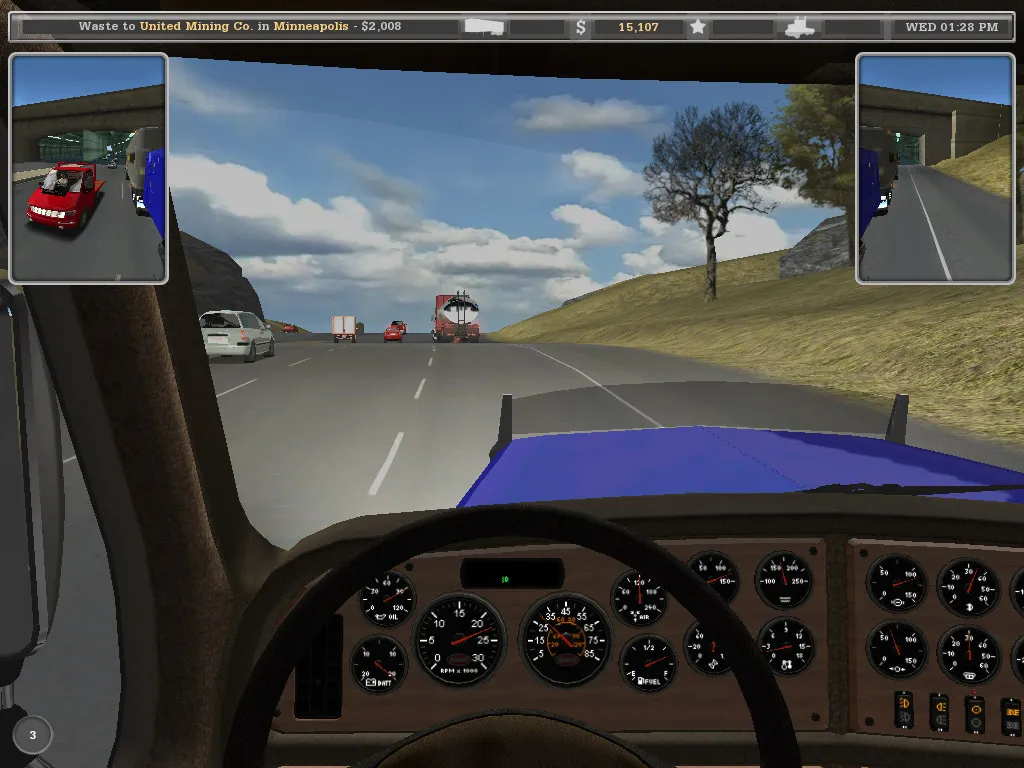
Between yards, monitor fuel consumption and plan with gas stations in mind. Road conduct has a separate indicator: a red legal-status bar beside the HUD’s star icon. Running a red light or crashing into another vehicle increases that bar, and encountering police with a red status may result in a fine. A collision can therefore have consequences beyond an awkward interruption to the journey. Fuel planning and attention to traffic rules belong alongside destination finding as practical parts of completing a haul.
Truck damage has its own red bar beside the truck icon. Damage affects performance, so the manual advises servicing a damaged vehicle. Service stations also offer upgrades with distinct purposes. ABS prevents wheel lockup during hard braking and reduces the chance of skidding; BBW improves braking response. AVI changes weigh-station procedure rather than braking: it permits passage without stopping, but you must still drive through the station. That distinction matters when deciding what an upgrade actually allows you to do.
Expanding With Suitable Equipment
Each truck has its own selection of purchasable parts, including engines and transmissions, so inspect that vehicle’s options rather than assuming a universal parts list. New trucks take at least one day to arrive, with Advance Time available to jump to the delivery date. Borrowing offers another business decision: the normal loan amount is $10,000, adjustable before selecting Take Loan. Repayments occur automatically each month over twelve months, while Repay allows the entire loan to be settled early.
Trailer buying demands a cargo check. Order Trailer presents a list of available trailers, and selecting one reveals its suitable cargo types. Those types limit the contract work it can perform: the Open Top trailer, for example, carries beet, potatoes and pumpkins. Match the intended work to that list before purchasing. New trailers also have a delivery time of at least one day, and Advance Time can move to their arrival date. Expansion thus involves suitability as well as acquisition.
Putting Drivers and Vehicles to Work
Recruit drivers at hotels and motels located through the notebook’s View Map button. The driver management screen then tracks their activities and allows dismissal. For contract work, look in the Company List for a dollar symbol, select that company and click Create Contract. Three assignment buttons allocate a driver, truck and trailer. Hiring someone is therefore only one part of the process: contract setup brings the employee and the required equipment together, with trailer cargo restrictions still relevant to the work it can perform.
Relocating parked equipment uses a different procedure. In Transport Vehicles, select the vehicle, choose its destination and click Move To. This supports transfers between headquarters, garages and parking lots. Keep relocation distinct from contract assignment: one changes where a parked fleet vehicle is located, while the other assigns a driver, truck and trailer to work. Together, these systems extend the game beyond the cab without replacing the specific handling and delivery rules that govern your own hauls.
Sources & further reading.
- 18 Wheels of Steel: American Long Haul — official game profileRetrieved Nov 23, 2026
- 18 Wheels of Steel: American Long Haul — official game profile — publisher-supplied gameplay manualRetrieved Nov 23, 2026
First published .