 THE GAME ARCHIVE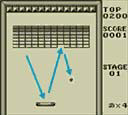
Paddle, Ball, and the Core Breakout Loop
A game of Alleyway begins with the ball resting on the paddle at the bottom of the screen. The player maneuvers the paddle left and right to intercept the descending ball and bounce it upward into the field of blocks. When the ball strikes a block, that block is destroyed. The ball caroms off the paddle, walls, and remaining blocks, and after hitting a surface it reflects at the same angle at which it arrived, so its path can be predicted as it travels around the playfield. Clearing every destructible block completes the stage.
The blocks themselves carry differing values and effects. A white block scores one point when broken, a gray block scores two, and a black block scores three. Beyond scoring, the gray and black blocks alter the ball's behavior: each time the ball makes contact with one of these tougher blocks, its speed increases, making subsequent returns faster. Certain other blocks cannot be broken at all, and those indestructible obstacles have no bearing on the condition required to clear the stage, so the player must work around them while eliminating every breakable block.
White, Gray, Black Blocks and Indestructible Obstacles
On page 14, the manual divides blocks into two groups: blocks that crumble and blocks that do not. White blocks award 1 point when destroyed, gray blocks award 2 points, and black blocks award 3 points. The same page adds that when the ball strikes a gray or black block, the ball's speed increases. The point value and the speed change are tied to the same contact, so hitting a gray or black block both raises the score and quickens the ball.
The second category is the indestructible block. The manual states these blocks do not crumble even when the ball hits them, and that they are unrelated to the stage-clear condition. Because they cannot be broken and do not count toward clearing a stage, they remain as permanent obstacles on the screen. This interacts with the crumble blocks: the player must clear the destructible white, gray, and black blocks while routing the ball around any indestructible blocks placed in the stage.
Stage Types and the 32-Stage Progression
The stage progression alternates through four distinct types, repeating in the fixed order 1, 2, 3, 4 before cycling back. Across the full run there are 32 stages in total: stages 1 through 3 account for 24 stages, while stage 4, the bonus stage, accounts for the remaining 8. The documented variations differ in how blocks behave. The first type is the basic stage, where the blocks do not move at all, giving a static field to clear. The second type has blocks that travel left and right at a constant speed.
Play follows a simple clear condition. Use the paddle to deflect incoming balls; hitting blocks breaks them. When every block is gone, the stage is cleared and the next stage begins. Starting a stage, or restarting after a miss, the round begins by launching the ball. Clearing all stages triggers a fanfare and the ending screen is displayed. The four-type cycle and the 32-stage count therefore form the full sequence a player works through from the first static field to the final bonus room and the ending that follows.
Bonus Rounds, Timed Rooms, and Special Bonuses
The fourth stage type described on manual page 18 is the bonus stage, a time-limited room where you try to break as many blocks as possible before the remaining time runs out. Breaking blocks raises your score, and clearing every block within the time limit earns a special bonus. Two rules set this room apart from normal play. First, if you fail to catch the ball with the paddle, it is not counted as a miss, but the bonus stage ends immediately. Second, the ball is not bounced back when it hits a block, so it passes through rather than rebounding off the wall of blocks.
Pausing works differently depending on the stage. On page 14, pressing the PAUSE button produces a sound effect and pauses the game; pressing it again resumes play from that point. The same page notes that you cannot pause during a bonus stage. The manual also ties block values to scoring: white blocks add one point when broken, gray blocks add two, and black blocks add three. Gray and black blocks additionally speed up the ball on contact, which changes how the ball behaves before it either clears the room or the timer expires.
Paddle Lives, Misses, and the Shrinking Paddle
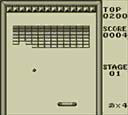
Missing the ball with the paddle counts as a miss, and each miss reduces the paddle's remaining count by one. When the paddle's remaining count reaches zero and a miss occurs, the game is over and the title screen returns. The manual also states that the remaining paddle count increases by one for every 1000 points added to the score. This increase does not occur when the paddle's remaining count is 9, nor when the score is 10000 points or higher, so those two conditions cap the life-gain rule even as scoring continues.
Starting from stage 4, a ball hitting the ceiling makes the paddle smaller. Through stage 3, indestructible blocks sit at the ceiling, so the ball does not hit the ceiling during those stages. The shrinking paddle rule therefore only becomes reachable once stage 4 begins and the ceiling above the ball is exposed rather than covered by those blocks. In that later setting, a ceiling contact directly changes the paddle size instead of acting as an ordinary wall bounce.
Controls, Techniques, and Launching the Ball
Within a stage, the A button launches the ball, putting it into play against the wall of blocks. Directional inputs move the paddle, and holding a directional input together with another button changes the paddle's speed: while holding the high-speed button the paddle moves at high speed, and while holding the low-speed button it moves at low speed. This adjusts how the paddle tracks the ball, and holding the speed button together with a left or right direction changes the paddle speed while moving, letting you reposition the paddle at a different rate without releasing movement.
The manual's technique section describes three interactions. First, changing the paddle's speed adjusts movement, achieved by pressing a direction together with the speed button. Second, a ball bounced off a block or wall rebounds at the same angle it struck, so you predict that path and move the paddle accordingly. Third, when the ball is bounced back, moving the paddle in certain ways changes the ball's direction and angle. Separately, pressing Start and Select together resets the game and returns to the title screen; sleep mode is outside original gameplay.
Sources & further reading.
- アレイウェイ — official game manual Retrieved Oct 15, 2026
First published .