 THE GAME ARCHIVE
Flight Controls: Tapping A, Holding B, and Steering Left or Right
In Balloon Fight, horizontal movement is handled by pressing left or right on the controller. That is the full instruction the manual gives for lateral steering: move left and right. Vertical control is separate and split between two buttons. Tapping A produces a rise, and the manual notes that repeated tapping is required for the action to take effect. So climbing is not a single press but a rhythm of taps on A, which the player must keep up to gain height. The manual lists these commands together under Basic Controls on page 2, alongside START for confirming a selection or pausing and SELECT for menu navigation.
Holding B gives the second upward option: rapid rise. Where tapping A raises the character, holding B is documented as the faster ascent. These are distinct inputs, not variations of one command, and both appear in the same Basic Controls list: Tap A under Rise with the word repeatedly, and Hold B beside Rapid rise. Left and right still govern horizontal position independently of whichever ascent method is used. START remains assigned to confirming a selection and pausing the game, while SELECT handles menu navigation, so the flight buttons stay separate from menu and pause duties.
Pre-Flight Checklist: Choosing Modes with SELECT and START
Before any flight begins, mode selection happens on the title screen. The manual lists SELECT under Basic Controls for menu navigation and START for confirming a selection or pausing the game, so SELECT cycles through the available game modes and START locks in the current one. The same page 3 instruction spells out the sequence for this screen: press SELECT on the title screen to select your game mode, and confirm with START. The three selectable entries are labeled A 1-PLAYER GAME, B 2-PLAYER GAME, and C BALLOON TRIP, each carrying its own objective.
The mode chosen determines what the player must do once flying. A 1-PLAYER GAME is described as a single player mode where you must work to defeat all on-screen enemies, while B 2-PLAYER GAME is a two player mode asking players to work together to defeat all the on-screen enemies while also competing against each other for the highest score. C BALLOON TRIP instead tasks a single player with guiding the character right or left, bursting as many balloons as possible along the way, so SELECT and START set up three distinct rulesets.
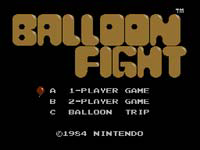
Three Ways to Fly: 1-Player, 2-Player, and Balloon Trip
Mode selection happens on the title screen: press SELECT to cycle through the three options, then confirm with START. Option A, the 1-PLAYER GAME, is a single-player mode where you must work to defeat all on-screen enemies. Option B, the 2-PLAYER GAME, is a two-player mode in which you work together to defeat all the on-screen enemies while also competing against each other for the highest score. Option C, BALLOON TRIP, is a separate single-player mode with its own rule: guide your character right or left, bursting as many balloons as possible along the way.
The first two modes share one clearing condition: defeat all on-screen enemies to clear the stage, as the manual states on page 4. Balloon Trip dispenses with that condition and instead asks you to burst as many balloons as possible while moving right or left. The two-player game keeps the same enemy-clearing goal as the one-player game but layers a scoring contest on top of it, so both players fight the same enemies while chasing the higher score.
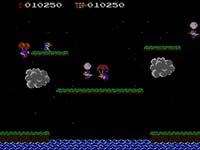
Two-Player Tension: Flying Together, Scoring Against Each Other
In the 2-PLAYER GAME, SELECT on the title screen lets you choose the mode and START confirms it. The manual states that in this two-player mode you must work together to defeat all the on-screen enemies while also competing against each other for the highest score. That dual requirement means both players share the same enemy-clearing objective, yet each keeps a separate score total. The mode is one of three listed alongside the single-player 1-PLAYER GAME and BALLOON TRIP, so the cooperation-and-competition rule described on page 3 is specific to the two-player selection.
The manual also documents a consequence for the timed bonus stage, which appears after completing three stages in a row of either 1-Player Game or 2-Player Game. In 2-Player Game bonus stages, you will not lose a life, even if both of your balloons are burst. That removes the usual result of having both balloons popped during the two-player bonus round, while the goal of bursting as many balloons as possible within the time limit remains. With two players sharing the enemy-clearing objective elsewhere, this bonus-stage rule keeps both competitors active while each pursues the highest score.
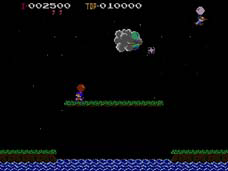
Every Four Stages: The Timed Balloon-Popping Bonus Round
Complete three stages in a row in either the 1-Player Game or 2-Player Game, and the game moves you to the bonus stage. There, the objective is to burst as many balloons as possible within the time limit. This timed interlude is the documented reward for that three-stage streak, not an optional mode selected from the title screen. The same page states that in 2-Player Game bonus stages, you will not lose a life, even if both of your balloons are burst, so the usual penalty for losing both balloons does not apply during that bonus stage.
The bonus stage appears after completing three stages in a row of either 1-Player Game or 2-Player Game. Once there, you must burst as many balloons as possible within the time limit. In 2-Player Game bonus stages, you will not lose a life, even if both of your balloons are burst. That contrasts with normal 1-Player Game and 2-Player Game stages, where losing both balloons is the usual life-losing event. Because the 2-Player Game normally also has you competing for the highest score, the bonus stage is a timed balloon-popping round without that life loss.
Points, Ranks, and Danger: How Scoring and Hazards Work
Points in Balloon Fight come from three sources: bursting enemy balloons, defeating enemies, and popping giant bubbles. After you burst an enemy's balloon, the enemy parachutes down; hit them again before they can blow up a new balloon to defeat them. Clear all on-screen enemies to finish a stage. Your rank out of 50 is shown in the top right corner of the screen, and in Balloon Trip mode, bursting 20 balloons in a row without missing grants extra bonus points.
You lose a life under four conditions: both of your balloons are burst, you are hit by lightning, you fall in the water, or you are eaten by a fish. Lose all your lives and it's game over. In Balloon Trip mode, touching lightning results in an immediate game over. To avoid these fates, steer clear of lightning, water, and fish while maneuvering through stages and the scrolling Balloon Trip course.
Sources & further reading.
- Balloon Fight — official game manual Retrieved Oct 15, 2026
First published .