 THE GAME ARCHIVE
Bejeweled 3 is a puzzle game developed by PopCap Games, Inc. and published by both PopCap Games, Inc. and Electronic Arts. The official store profile lists it for Windows and macOS and gives a release year of 2010 — a date that should be read as belonging to this Steam entry rather than as a complete release history for the title. Where it sits among earlier or later editions is not established by the available material.
The pitch is breadth. PopCap advertises eight game modes, framing the game as a set of moods rather than a single challenge: relaxed matching in one corner, a timed scramble in another, a structured puzzle campaign in a third, and four additional modes that only appear once the player has earned them. That structure — one familiar matching loop, re-tuned eight ways — is the most useful thing to understand before playing, and it is where the documented evidence is thickest.
The core loop: match, cascade, repeat
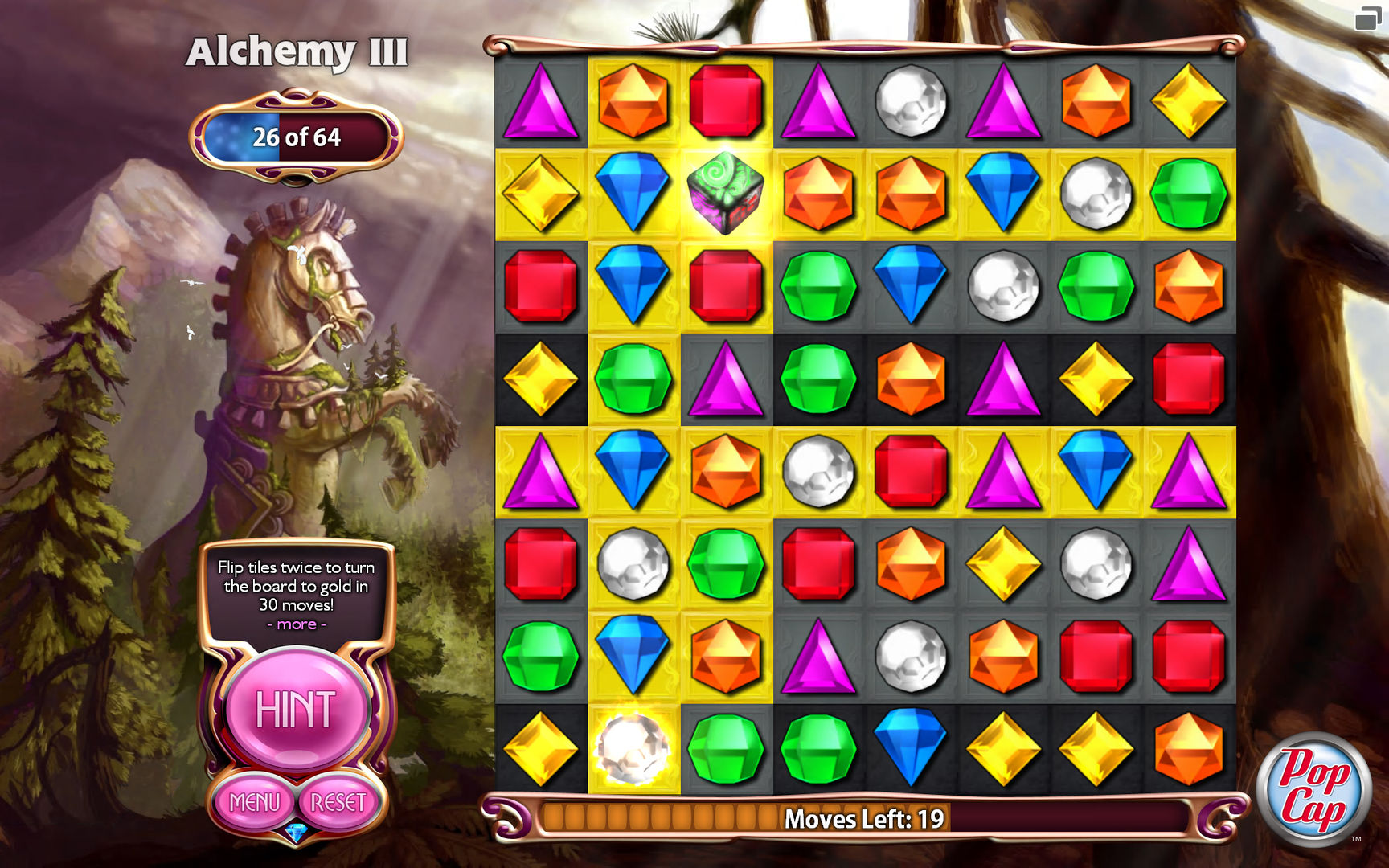
The store material does not spell out the basic exchange rule, and it is worth being honest about that: no supplied excerpt states in so many words that the player matches gems in lines of three or more. What the description does commit to is the rhythm that follows a match. Matches produce cascades, and the game is built around keeping those cascades moving. In Classic mode the player gets what PopCap calls cascades of fun, while a separate feature line promises ultra-smooth action — the ability to make multiple matches while new gems are still falling into place.
That second point is the one most worth dwelling on for a player coming back to the game now. If you can queue a match while the board is still settling, the game stops being a purely turn-based clearing exercise and becomes a question of tempo — you are reading the new board before it has finished arriving. The description also points to powerful new gems in Classic mode, implying that not every tile behaves like a plain one, though what those gems do is not documented here.
Four named modes, four hidden ones
PopCap splits the eight modes into four that are described openly and four that must be unlocked. The open set covers deliberately different tempos.
- Classic mode — described as the most popular puzzle game of the century rebuilt with powerful new gems and ultra-smooth gameplay, aimed at cascading matches.
- Quest mode — a journey through 40 puzzles, pitched as a multi-faceted challenge rather than an endless board.
- Zen mode — a relaxation space where sights, sounds and binaural beats can be tailored to the player's taste.
- Lightning mode — a timed, heart-pounding variant described as gem-blasting fun with a clock running against the player.
The four remaining modes sit behind progression: the description says four all-new games unlock as you play. Nothing in the supplied material names them or describes what changes when they open up, so the only reliable expectation is that time spent in the visible modes is what pays for the hidden ones.
Why Zen and Quest pull in different directions
The interesting design claim in the mode list is not the count but the spread. Lightning and Zen are close to opposites by construction: one is explicitly timed and framed as heart-pounding, the other is explicitly about relaxation and lets the player shape the sensory layer with sights, sounds and binaural beats. Quest sits between them as the structured option — forty discrete puzzles rather than one continuous board, with the word challenging attached to them. A player who bounces off one mode has two very different alternatives immediately available, which is an unusual amount of tonal range for a single match-three package.
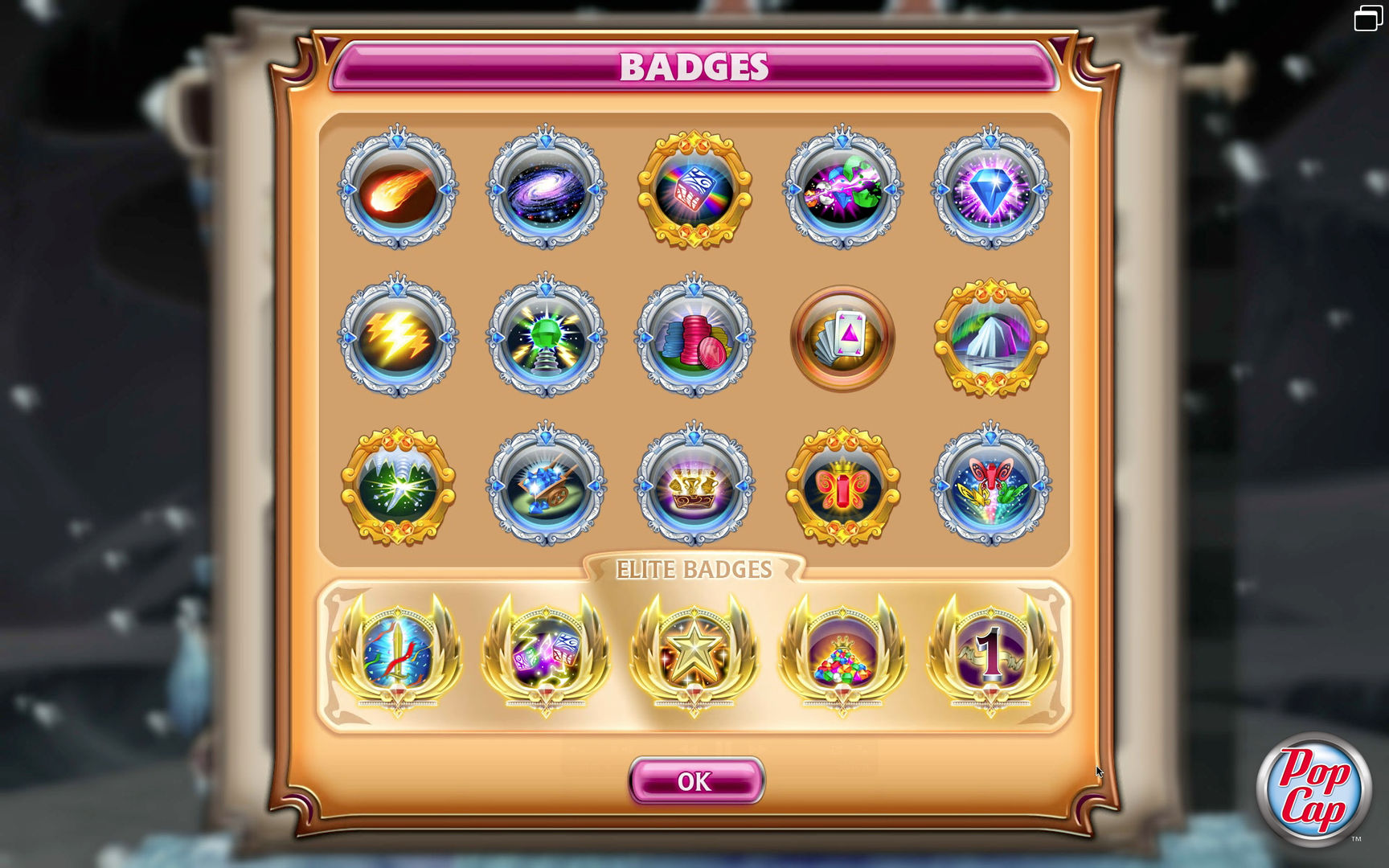
Progression runs on two tracks that are described separately. The first is unlocking: secret modes open as you play, so the mode list itself grows with time spent. The second is badges — up to 65 of them, framed as proof of multi-faceted skills. The store copy treats badges as a record of breadth across the different ways to play rather than a single high score, which gives the completionist something to chase that is spread across the mode roster instead of concentrated in one board.
Where to start, based on what the modes claim
The description does not hand out a recommended order, but its own framing points somewhere obvious. It describes easing into Classic Bejeweled for cascades of fun, then journeying through Quest, then charging into Lightning, with Zen offered as the retreat. If you want the mode that teaches the board's rhythm before adding a clock or a puzzle script, Classic is the one the copy positions as the on-ramp.
Practical advice beyond that — how fast to move, whether to chase combos or clear the board, which modes feed badge progress fastest — is not something the supplied material supports. Those are exactly the gaps a returning player would want filled, and they are flagged below as missing research rather than guessed at.
Presentation and feel
The visual argument in the store copy leans on high-definition graphics and a sparkling presentation, with the sounds described as part of the appeal rather than an afterthought. That matters more than it sounds in a game built on cascades: if the board is going to keep moving while you keep matching, the presentation is what makes the churn readable. The binaural-beat option in Zen is the clearest sign that the developers treated the audio layer as a design lever rather than decoration, since it is the only place in the description where sound is offered as something the player configures.
Platform and edition scope
According to the official profile, this entry lists Windows and macOS as supported platforms, with PopCap Games, Inc. as developer and both PopCap Games, Inc. and Electronic Arts as publishers. It is catalogued under the Casual and Strategy genres. Those two labels together are a fair summary of how the game presents itself — a casual matching foundation with puzzle-solving and mode-specific challenge layered on top.
Two cautions belong here. First, the 2010 date is the release year attached to this particular Steam entry; it is not offered as a claim about when the game first existed in any form, and no port or remake history is documented in the supplied material. Second, nothing here verifies how the game runs on current versions of those operating systems. The profile lists platforms, which is a statement about intended support, not a tested compatibility guarantee.
The takeaway
Bejeweled 3's identity, as far as the official material shows, is consolidation rather than reinvention: take one matching loop with cascading clears and smooth chaining, then dress it for eight different appetites, from a timed scramble to a configurable relaxation space, and hang a 65-badge progression system over the whole set. The mode roster and the badge economy are the parts most fully documented, and they are enough to explain why the game reads as a package rather than a single board. The moment-to-moment rules underneath — tile behaviours, scoring, how the secret modes actually differ — are the parts this description leaves open.
Scroll sideways to see the full table →
| Field | Value |
|---|---|
| Title | Bejeweled 3 |
| Release year (this Steam entry) | 2010 |
| Developer | PopCap Games, Inc. |
| Publishers | PopCap Games, Inc.; Electronic Arts |
| Platforms listed | Windows, macOS |
| Genres listed | Casual, Strategy |
| Advertised modes | 8 (4 named, 4 unlockable) |
| Badges | Up to 65 |
| Quest puzzles | 40 |
Sources & further reading.
- Bejeweled® 3 — official game profile Retrieved Oct 12, 2026
First published .