 THE GAME ARCHIVE
Basic Controls: Move, Jump, Whip, and Pause
The manual's Basic Controls section assigns distinct actions to the controller: the directional pad handles Move/Crouch/Climb stairs; the A button performs Jump; the B button triggers Whip/Use weapon, with a note indicating use alongside another input; START handles Start/Confirm/Pause/Resume; and SELECT covers menu navigation. These assignments define how Simon Belmont traverses stages, ascends staircases, times jumps, and attacks. Pausing and resuming through START lets play halt without losing progress, while SELECT is specifically reserved for menu navigation, separate from pause.
Movement, crouching, and climbing stairs share the directional input, while A jumps and B handles both the whip and sub-weapon use when available. Because the same B input serves Whip/Use weapon, the action changes depending on whether a sub-weapon is currently held, without requiring a separate button. START doubles as Start/Confirm/Pause/Resume, so the same button begins the game, confirms menu selections, and pauses active play. SELECT is limited to menu navigation, keeping pause and menu movement on separate inputs.
Castle Layout and Life Loss: 18 Stages, Dracula, and Hazards
The manual outlines the castle as a gauntlet of 18 stages divided into 6 levels. The player must fight through each stage and level to reach Count Dracula, who waits at the top of the castle. Defeating him is the final objective. This structure means the game is played in a linear sequence of stages grouped into levels, with the ultimate confrontation set at the castle's summit.
During play, a life is lost under three specific conditions: if the player's time runs out, if health runs out, or if the player falls into a hole. These rules create constant pressure to manage both the time limit and health while navigating the castle, where pits are immediate threats. Losing a life removes the player from the current attempt, reinforcing caution around every hazard.
Status Screen: Hearts, Lives, Health, and Boss Health
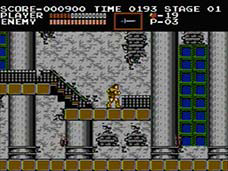
The status screen in Castlevania on NES is divided into five numbered elements on page 5 of the manual: equipped weapon, heart count, lives remaining, your health, and boss's health. Element 2, the heart count, tracks your current hearts, and the manual states that each time you use a weapon, you will lose one or more hearts. This heart count shares the display with the equipped weapon (element 1) and lives remaining (element 3), so you can see your current sub-weapon, your heart resource, and how many lives you have left in one place. The screen also shows your health (element 4) and the boss's health (element 5), letting you compare your remaining health directly against the boss's during encounters.
Element 3, lives remaining, is displayed separately from your health, so losing all health does not immediately remove the life count shown on the status screen. Element 4, your health, is distinct from the boss's health in element 5; both are listed as separate entries on the same screen. The heart count in element 2 decreases by one or more hearts per weapon use, meaning the status screen's heart display reflects a resource tied to weapon usage rather than to health or lives. Since the equipped weapon appears as element 1, the screen groups your current weapon choice with the hearts needed to use it.
Items That Restore and Extend: Hearts, Potion, Morning Star, Money Bag, Pork Chop, Crystal
The manual separates its heart refills by size on page 7. A small heart "will give you one heart," while a large heart "will give you five hearts." The invulnerability potion is documented the same way: "This will make you invulnerable for a few seconds." Those are the restorative pickups listed for this section. A pork chop also belongs to the manual's item list, but its page 7 description cuts off at "This will restore some of you," so the text never states which resource it refills or by how much. Only the small heart, large heart, and potion carry complete documented effects here.
The morning star changes your weapon itself. According to the manual, it "will turn your whip into a chain," and picking up another one increases its length. Money bags instead raise score, with color-coded values: "Red bags are worth 100 points, blue bags 400 and white bags 700." So the documented rules split these pickups cleanly. Hearts and the pork chop are restorative, the potion grants temporary invulnerability, the morning star upgrades whip reach, and money bags feed score. The manual gives no point value for hearts, no duration figure for the potion, and no upgrade cap for the morning star chain.
Sub-Weapons: Dagger, Axe, Holy Water, Boomerang, Watch
The manual lists five sub-weapons on page 6. The dagger has low attack power but can be thrown over long distances, and it disappears when it hits an enemy. The axe trades speed for damage: its attack power is high, but it is a little slow and flies in an arc. Holy water is thrown and explodes on the ground, burning enemies as they walk through the flames. The boomerang is described as a powerful weapon that returns to you after it is thrown. The watch stops enemies in their tracks and costs five hearts for each use.
The documented rules create clear trade-offs. The dagger disappears on hit, so each throw removes itself after striking one enemy. The axe is slow and travels in an arc rather than a straight line. Holy water leaves ground flames that burn enemies walking through them. The boomerang returns after being thrown, while the watch halts enemies but deducts five hearts per use. These traits cover long-distance throwing, high-power arcing attacks, ground-area burning, reusable returns and temporary enemy freezing, with only the watch carrying an explicit heart cost in the manual text.
Destructive and Restorative Item Effects: Cross, Pork Chop, Magic Crystal
The cross is a pickup that, as soon as you collect it, destroys all on-screen enemies. The official manual states: "Cross This will destroy all on-screen enemies when you pick it up." This effect is immediate and total, clearing every enemy currently displayed. Unlike other items that modify your weapon or restore resources, the cross acts as a one-time room-wide attack. It does not persist, and its destruction applies only at the moment of pickup. This makes it useful in crowded situations where multiple enemies occupy the screen simultaneously.
The pork chop and magic crystal both restore health, but differ in amount. The manual says: "Pork chop This will restore some of your health." and "Magic crystal This will fully restore your health." So the pork chop gives a partial heal, while the magic crystal refills your health completely. These restorative items are separate from hearts, which grant hearts rather than health. Unlike the cross, which only destroys enemies, both pork chop and magic crystal directly refill the health meter, with the crystal ensuring a full recovery.
Sources & further reading.
- Castlevania — official game manual Retrieved Oct 15, 2026
First published .