 THE GAME ARCHIVE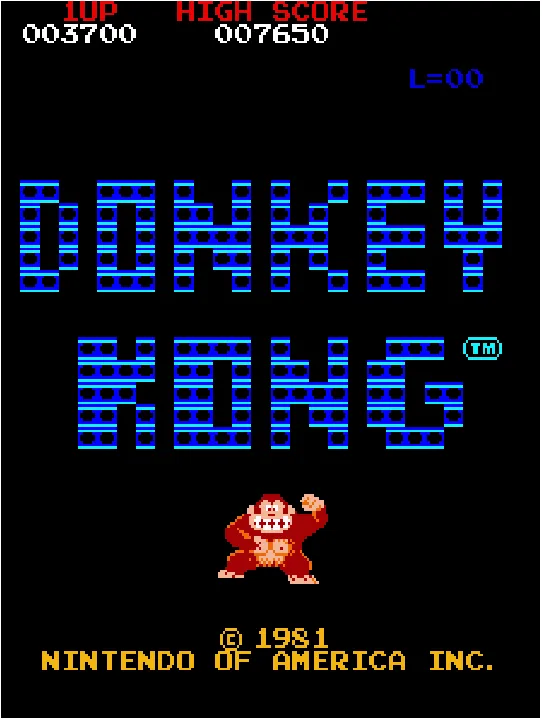
1981 Arcade Origins and Premise
In 1981, Nintendo released Donkey Kong as an arcade action game. The title appeared on arcade platforms exclusively, with Nintendo handling publishing duties. Players control a character who must navigate a series of platforms to reach the top of a construction site, avoiding obstacles thrown by a large ape. The game is structured around short, repeating stages that increase in difficulty. No home console version existed at the time of release; the arcade cabinet remained the sole format. The game's action genre label covers its focus on timed movement and hazard avoidance rather than exploration or narrative.
The arcade original presents a fixed set of stages where the player climbs ladders and jumps over barrels to rescue a captive. Donkey Kong himself appears at the top, rolling barrels down sloped girders. Each stage ends when the player reaches the damsel, after which the next screen begins with increased speed and additional hazards. The action genre reflects this cycle of precise jumps and dodges under time pressure. Nintendo's name on the cabinet marked its entry into arcade development and publishing. No save features, pause menus, or multiplayer options are part of the 1981 arcade release.
The Climb: Construction Site Obstacle Course
The arcade game drops the player into a construction site, where the objective is to head upward through the structure until reaching the top. Along this route, barrels and fire travel toward the player as obstacles to avoid. A hammer can be used to destroy those barrels and fire rather than only dodging them, and doing so also earns more points. The construction site is therefore both the pathway and the hazard field: the player moves through it, stays clear of what cannot be struck, and uses the hammer where destroying incoming threats is possible.
Reaching the top is tied directly to the rescue objective. The person to be rescued, identified as Lady, is located at the top of the construction site, so progressing upward through that structure is the route that leads to her. The player must avoid a variety of obstacles while climbing, and the hammer provides a way to destroy barrels and fire coming toward the player for additional points. These documented elements connect movement, hazard avoidance, hammer combat, and rescue into one goal: get through the construction site, reach its top, and rescue Lady.
Hammer Combat: Destroy Barrels and Fire
Nintendo's 1981 arcade documentation lists a hammer as an active tool for dealing with two specific hazards: barrels and fire. Both threats travel toward the player during the climb through the construction site. Rather than limiting the player to avoidance, the hammer lets the player destroy those incoming barrels and fire. This destruction is the documented function of the hammer, and it is tied directly to earning more points. The hammer is not described as affecting other obstacles, and the documentation names no other destroyable targets besides barrels and fire.
The documented rule structure puts the hammer in the same space as movement and rescue. A player heads through the construction site, avoids a variety of obstacles, and uses the hammer to destroy barrels and fire coming toward them for more points. The construction site is both the route to the top and the field where these hazards appear. Barrels and fire are the named hammer targets, so the tool addresses those two threats specifically while the broader obstacle set still requires avoidance. The scoring benefit from destroying barrels and fire provides a separate reward from simply dodging them.
Rescue Objective and Scoring Points
According to the licensed publisher documentation, the rescue objective in Donkey Kong involves reaching the top of the construction site to save Lady. Players must avoid a variety of obstacles while heading through this structure. The documented goal explicitly connects the upward climb with the rescue, as the text states to "Avoid a variety of obstacles while heading through a construction site to make it to the top and rescue Lady." This means the player's movement through the level is directly tied to the scenario's objective, with the construction site serving as the route to the captive.
The same description instructs players to use the hammer to destroy barrels and fire coming towards them to earn more points. This establishes a scoring mechanic where destroying these specific hazards provides a point reward, separate from simply avoiding them. The documentation does not list other destroyable targets for the hammer. Therefore, the rescue objective and the scoring system interact: progressing toward Lady involves navigating obstacles, and the hammer offers a way to actively remove two types of threats for additional points.
Modern Arcade Archives Reissue Context
The modern reissue of Donkey Kong appears through the Arcade Archives series, which reproduces classic arcade games while staying true to their original form. This release adds features that were absent from the 1981 arcade cabinet. Players can adjust the difficulty level to their preference, altering how challenging the construction site climb becomes. For visual presentation, the reissue offers an option to recreate the appearance of CRT televisions, matching how the game originally looked on older displays. These settings let players tailor the experience to their liking beyond what the arcade original provided.
Beyond customizing difficulty and display, the reissue introduces online rankings where players compete for high scores with others from around the world. This score competition is separate from the original arcade release, which had no such feature. The ranking system connects to the game's existing scoring mechanics, where destroying barrels and fire with the hammer earns more points than simple avoidance. Players can now compare their point totals against a global pool, adding a competitive layer to the climb toward rescuing Lady. The reissue thus combines faithful reproduction with modern score comparison.
Sources & further reading.
- DONKEY KONG — licensed publisher game documentation Retrieved Oct 16, 2026
First published .