 THE GAME ARCHIVE
FTL: Faster Than Light is a spaceship simulation roguelike-like developed and published by Subset Games, listed in 2012 for Windows, macOS and Linux. Its distinguishing quality is not the scale of its galaxy but the pressure it places on one small ship: you command a vessel and its crew, decide where limited power goes, choose what your weapons fire at, and navigate situations presented largely through text. Each run unfolds in a randomly generated galaxy, so plans rarely survive contact with the next jump.
What you are actually doing
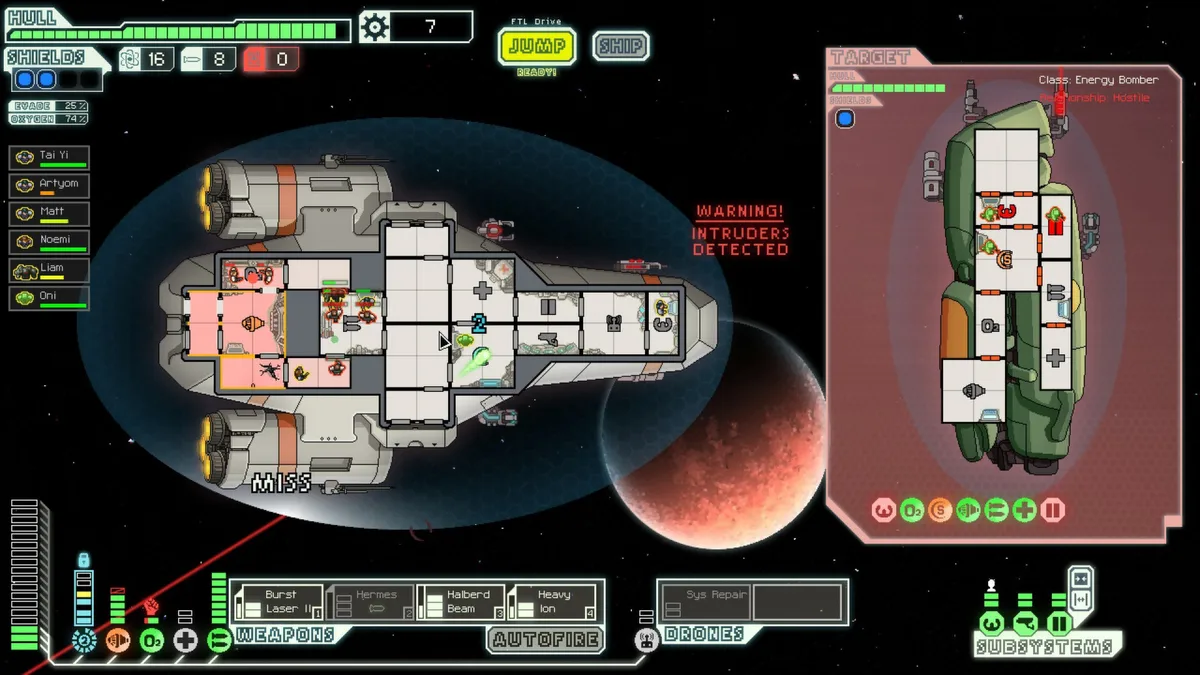
The moment-to-moment work is managerial rather than reflex-driven. You give orders to crew members, distribute power among ship systems such as shields, engines and weapons, and pick weapon targets during battle. The store description frames encounters as problems with several solutions: if a heavy missile barrage knocks out your shields, you might reroute power to the engines and try to escape, bring additional weapons online to destroy the attacker, or send a boarding party across. Those are three different answers to the same emergency, each with its own cost.
Crew members are not interchangeable tokens. They have specialized roles that affect how the ship operates, which makes where you station them a decision in the same family as where you route power. The pace is deliberately unhurried: you can pause combat mid-fight to evaluate the situation before committing to orders, turning each engagement into a small tactical puzzle rather than a test of reflexes.
 View full image ↗
The loop: jump, decide, survive
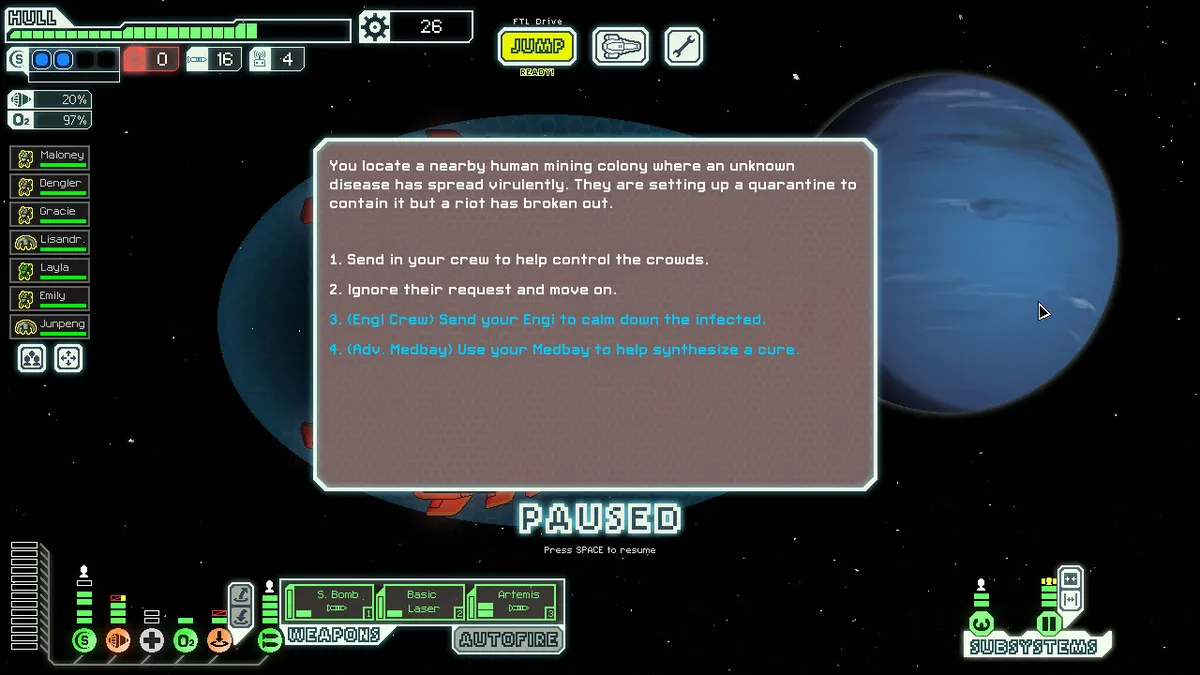
Between fights, the game leans on narrative choice. Hundreds of text-based encounters force tough decisions, and the results of those decisions carry into the run. Because the galaxy is generated randomly each time, enemies, events and outcomes differ from one play-through to the next. Practically, this means you are rarely solving a fixed map; you are learning to read situations and live with the consequences.
Permadeath is the spine of the loop. When you die, there is no coming back, and the constant threat of defeat gives every action weight. That single rule reshapes how resources are treated: a risky boarding action, a detour toward a distress signal, or a choice to invest in a system upgrade all have to be weighed against the fact that there is no reload.
Progression through ships rather than levels
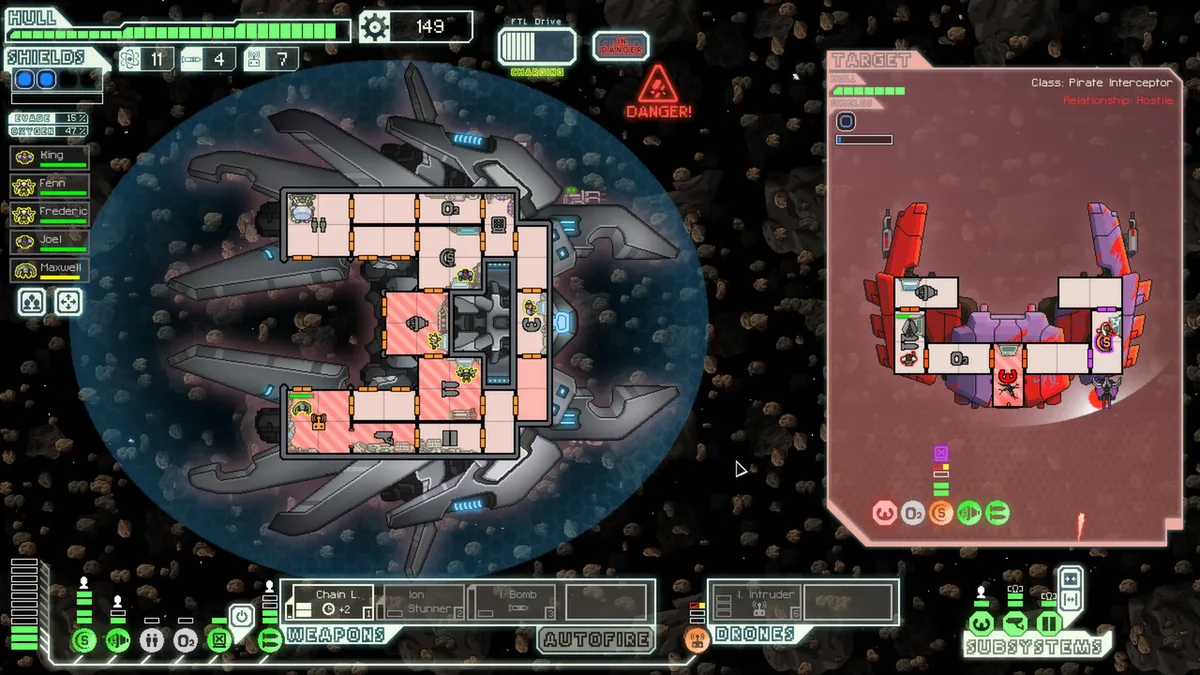
FTL's progression is expressed through ship unlocks and upgrades rather than a conventional campaign ladder. The supplied material describes upgrading your ship and unlocking new ones with the help of six diverse alien races, whose technologies provide distinctive lifeforms and equipment. Advanced Edition adds further alien races for ship upgrades and additional playable ship designs. The practical effect is that long-term goals arrive as variety: a new hull changes the questions you ask at the start of a run, not merely your power budget.
 View full image ↗
What Advanced Edition adds
FTL: Advanced Edition is a free expansion. Its documented content additions include a new alien race, new events, new weapons, new playable ships and drones, along with additional musical tracks by Ben Prunty and events written by Tom Jubert with guest writer Chris Avellone. Existing owners should receive the new content automatically, and the expansion is included free with purchases made from that point forward. For anyone reading about the game today, this means the widely discussed feature set — drones, the expanded event pool, the extra hulls — is part of the package rather than separate paid DLC. The source describes this content in general terms and does not specify how any individual weapon, drone or ship behaves, so those balance details lie outside what is documented here.
 View full image ↗
How to approach an early run
The documented systems imply a few sensible habits. Because combat can be paused, using that pause to issue crew orders and re-check power allocation costs nothing but attention, and the game explicitly treats pausing as the intended way to evaluate strategy. Because encounters offer multiple solutions, it helps to identify which of your systems is currently load-bearing: if shields are the thing keeping you alive, power moved to engines or weapons is a trade, not a free gain. And because outcomes vary between runs, it is more useful to plan around what you currently have than to chase a memorized route.
Crew specialization reinforces the same habit. If crew roles matter to ship operations, then which compartment a crew member occupies is a resource decision in the same family as power routing. Boarding actions extend that logic: sending crew to take an enemy ship shifts your own vessel's staffing at the same moment, so the maneuver is never free even when it succeeds.
What makes the design distinctive
The distinguishing design feature is the pairing of pause-driven tactical control with permadeath and procedural generation. Pausing preserves the strategic feel of managing power, crew and targeting without demanding quick fingers; permadeath gives those decisions permanent stakes; randomization keeps encounters, enemies and results from hardening into a solved script. Subset Games positions the result as a spaceship simulation roguelike-like, and the genre label describes the tension well: the simulation systems generate the problems, and the roguelike structure decides how harshly they land.
Taken together, those rules explain why FTL is often described as a game about managing decline as much as victory. You start with a ship that is already insufficient for what is coming, and every jump asks which weakness you are willing to tolerate. The text encounters and the randomized galaxy make the same point in different registers: the interesting decisions are the ones where the right answer depends on what you have left, not on what a guide remembers.
Scroll sideways to see the full table →
| Field | Value |
|---|---|
| Title | FTL: Faster Than Light |
| Release year (this Steam entry) | 2012 |
| Developer | Subset Games |
| Publisher | Subset Games |
| Platforms listed | Windows, macOS, Linux |
| Genres listed | Indie, Simulation, Strategy |
| Free expansion | FTL: Advanced Edition |
Sources & further reading.
- FTL: Faster Than Light — official game profile Retrieved Oct 10, 2026
First published .