 THE GAME ARCHIVE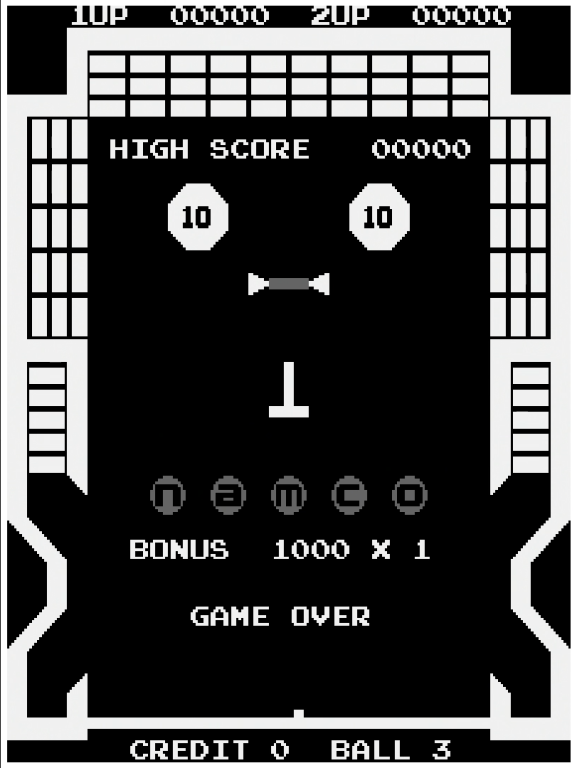
GEE BEE is Namco's 1978 arcade brick breaker with pinball elements. Its play centers on a ball, a linked pair of paddles, point blocks and additional scoring objects. Instead of treating every contact as the same event, the rules distinguish between clearing rows, hitting bumpers, spinning the spinner and lighting rollovers. The detailed rules below follow Gremlin Industries' 1979 owner's manual for its edition of the game. In particular, the circled G symbols described in the rollover section belong to that manual's presentation.
Moving both paddles and serving the ball
A single paddle knob moves both paddles horizontally. The pair therefore travels together as you turn the control, rather than being aimed independently. The ball rebounds from the top surface of either paddle, but can pass through the underside of the upper one. That one-way interaction is an important part of understanding the upper paddle's role. To put a ball into play, press the flashing SERVE button. If it is left alone, the ball appears automatically after ten seconds.
Ball speed changes during a turn
The ball begins at slow speed. After the fourth contact with the paddles, it changes to medium; after the eighth, it becomes fast. These changes are tied to paddle hits during the turn. The spinner provides another interaction with speed: when a fast ball passes through it, the ball becomes slow and then changes to medium after the first hit. Alongside the spinner's scoring role, that rule makes it relevant to the pace of play as well.
Clearing blocks and completing rows
A point block disappears when the ball hits it, adding its value to the score. The manual distinguishes top blocks and side blocks from the pocket blocks. For the top and left or right side groups, the outermost row, labeled A, gives 20 points per block. Row B gives 50, and row C gives 100. Erasing a complete row adds a 1,000-point bonus. This combines individual block values with a separate reward for completing a row, so a cleared row means more than the sum of its ordinary contacts.
Bumpers and the spinner reward cleared areas
The two bumpers at the top initially give ten points when hit. Clear a bank of side blocks and the bumper on that same side becomes worth 100. The spinner has a related link to the top blocks: it normally appears gray, with each revolution worth ten points, but clearing every top block turns it white and raises each revolution to 100. Clearing blocks therefore changes the value of other targets. Side-bank completion affects its corresponding bumper, while completion of the top blocks affects the spinner.
Lighting five rollovers for the multiplier
Five circled G rollovers sit near the bottom of the Gremlin playfield. Each starts gray and switches between gray and white when the ball passes through it. A change from gray to white awards 50 points. When all five become white, the multiplier display changes to X2 and doubles the score for that turn. This is a collection of linked targets: the special result depends on bringing all five to white, rather than merely passing through any one of them.
Opening a temporary safety gate
Clearing all the side blocks on either side switches on the safety gate at that side's exit. When the ball hits the gate, it rebounds into play, the gate disappears, and the score gains 500 points plus a 1,000-point bonus. The gate is therefore a temporary benefit earned through clearing a side bank. Its disappearance after that contact matters: the manual describes a single rebound from an active gate, rather than a permanent barrier that closes the side exit for the rest of the game.
Extra-ball chances and alternating players
Clearing the blocks in one pocket activates a flashing EXTRA BALL CHANCE arrow at the corresponding exit. If the ball leaves through the exit marked by that arrow, the game awards another ball and displays SAME PLAYER SHOOTS AGAIN. Only one extra ball can be awarded in a turn. For two players, play alternates, and each person's score is remembered between turns. The machine also offers an operator setting of three or five balls per game, so the starting ball allowance depends on the selected option.
Sources & further reading.
- GEE BEE — licensed publisher game documentation Retrieved Oct 16, 2026
- GEE BEE — Gremlin owner’s manual (1979), printed pages 7–9; archived publisher manual Retrieved Oct 16, 2026
First published .