 THE GAME ARCHIVE

Campaign Choices, Bonus Objectives and Mission Replays
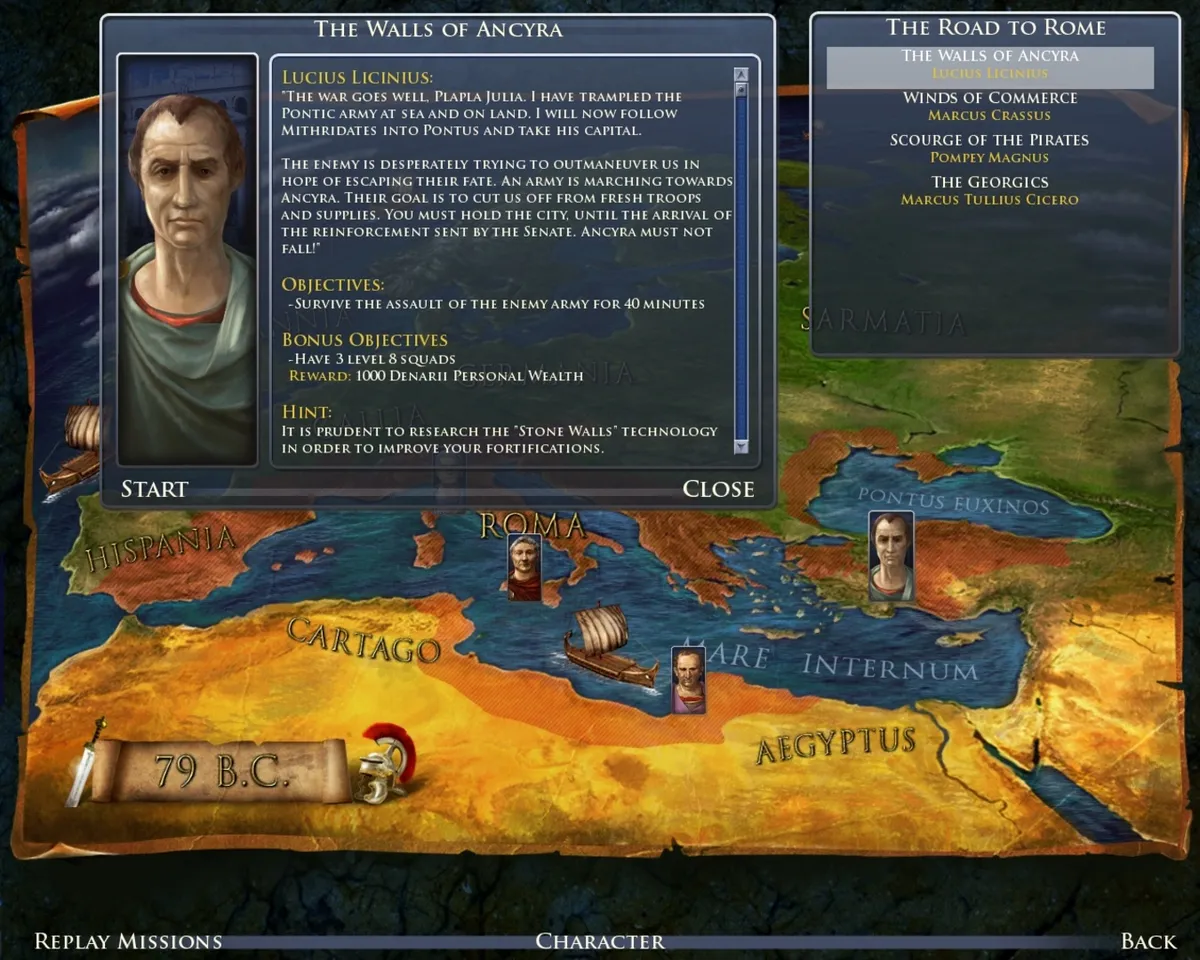
Grand Ages: Rome has a nonlinear single-player campaign spanning 40 missions, with victory tied to each mission’s main objectives. Bonus objectives sit alongside those requirements but are optional: completing the main set is enough to win. The important timing rule is that a bonus objective must be finished before victory to grant its additional reward. If you want those rewards, complete the relevant bonus tasks before finishing the remaining main objectives. This separates the requirements for clearing a mission from the extra tasks you can undertake within it, without making every listed objective compulsory.
Campaign choices can lock missions, but those locks do not prevent you from playing them through the campaign’s replay option. On the Campaign Map, select Replay Missions to access either missions already completed or missions locked by your choices. The same button therefore serves two distinct purposes: returning to a finished assignment and reaching one excluded by a campaign decision. That distinction matters in a nonlinear campaign, where the missions available through progression need not include every mission. For another attempt at completed content, or a look at a choice-locked assignment, use the Campaign Map’s replay function.
Five Families, Talent Builds and Resource-Producing Estates
Choose from five Roman noble families, each with different abilities, then develop your character through talents. Campaign mission completions and multiplayer victories award talent points, with a career limit of 20; the number earned also determines the character’s level. Open the character screen between missions to buy talents across three tabs. City and Military are shared by all characters, while Family contains talents unique to your chosen family. The City talent Free Buildings removes the Denarii cost of the first five buildings. Because new talents can only be purchased between missions, those purchases prepare advantages for subsequent assignments rather than changing your build mid-mission.
Personal wealth funds two separate character investments: revising talents and buying estates. Pay 10,000 Denarii from that wealth to redistribute all your talent points, letting you replace an earlier allocation rather than keeping it permanently. Estates provide another source of mission resources: a character can own up to five, and their extra resources apply in any mission that character undertakes. Purchase them with personal wealth, but account for the resale rule before selling one: an estate returns only 25 percent of its original price. Both systems use personal wealth, but estates supply resources while talent redistribution changes your purchased advantages.
City-Building Basics, Research Queues and Goal-Free Maps
The general tutorial introduces camera controls and the interface alongside resource gathering, employment, research and mission objectives. For construction, right-click anywhere on the screen to open the Build Menu, then choose a category to display its submenu of structures. This menu handles platforms and decorations as well as buildings, so those additions use the same entry point rather than a separate construction interface. The tutorial’s scope extends beyond placing structures: gathering resources and employing people are also among the basic city-building subjects it covers, together with the research system and the objectives used in missions.
Open the Research Screen to check the city’s total research-point generation, available research goals and the time remaining on the current project. Goals are divided among Architecture, Technology and Warfare; click a goal’s icon to select it, or arrange several goals in a research queue. For city building without prescribed objectives, Free Build maps set no specific goals and let you determine your own pace. Their starting conditions are not all identical: some provide a small city already built, while others offer plentiful resources. Those conditions establish different starting situations without adding a required objective list.
Recruit Limits, Squad Commands, Training and Morale
Recruits set the maximum number of squads you can control, and each Equite House adds 10 recruits to that military resource. Once squads are available, select them directly or through their icons in the Resource Bar’s Squads category. To assign several squads to a numbered group, hold Ctrl and press a number from 0 to 9; pressing that number later selects the assigned group. Selected squads take movement and attack commands through their Info Panel. Alternatively, right-click empty ground to order movement, or right-click an enemy to order an attack: the target distinguishes the two commands.
Squads gain experience by dealing damage, earning levels that improve damage against lower-level opponents and demoralize them faster; lower-level squads inflict less damage on higher-level enemies. The Info Panel’s Train button offers another way to raise levels, costing Denarii and time. Training normally stops at level 4, but building the Victory Column raises that ceiling to level 8. Morale falls under attack, and demoralized squads deal less damage, though morale recovers over time. Ordinary morale damage equals Attack; Archers have a passive ability that doubles their morale damage, giving their attacks a distinct role alongside the level-based combat advantages.
Multiplayer Victory Through Outposts, Denarii or Monuments
Multiplayer victory can depend on eliminating opponents or reaching a shared financial target. In Last Man Standing, defeat every other team by destroying all outposts belonging to their players: a player is defeated when none of their outposts remain. This mode requires at least two teams, so it cannot serve as a single-team cooperative challenge. The 40,000 Denarii mode instead awards victory to the first team to accumulate that total. Put everyone on the same team and the financial objective becomes cooperative, with players working together to reach the required sum in the shortest possible time.
All Monuments replaces the treasury target with a six-building construction objective. To win, your team must complete the Coliseum, Circus Maximus, Pantheon, Philosopher Academy, Courthouse and Victory Column before another team does. Every player on a team may contribute to the construction of any monument, so the objective is a team undertaking rather than a separate checklist for each participant. As with the Denarii condition, assigning everyone to one team changes the contest into cooperation: complete the required collection in the shortest possible time. Unlike Last Man Standing, both objective-based modes therefore accommodate a single team.
Sources & further reading.
- Grand Ages: Rome — official game profileRetrieved Nov 24, 2026
- Grand Ages: Rome — official game profile — publisher-supplied gameplay manualRetrieved Nov 24, 2026
First published .