 THE GAME ARCHIVE
Basic Controls: Move, Jump, and Swing Hammer
According to the official manual's Basic Controls list, the directional control does double duty: it is used to "Move character/Select stage." The A button is assigned two actions, listed as "Break overhead blocks/Jump." The B button performs a single documented action, "Swing hammer." The manual's control list therefore ties movement and stage selection to the same input, while separating the block-breaking and jumping action onto A and the hammer swing onto B. Each of these mappings is presented as part of the same Basic Controls section on manual page 2.
The documented button layout shows how the rules interact. Pressing A handles both breaking overhead blocks and jumping, so the same button serves two named actions depending on context. Pressing B swings the hammer, and the directional control moves the character or selects a stage. START is listed for "Start game/Pause game," and SELECT for "Select number of players." The manual does not describe which action A produces in a given situation beyond listing both roles, nor does it define conditions for the hammer swing.
Starting, Pausing, and Selecting Players
On the Ice Climber control listing, the START button carries two functions depending on where you are: it is used to start the game and to pause the game. That single button therefore does not merely begin play; once a run is underway, pressing it again pauses the action. The same manual page presents this alongside movement and combat inputs, but START is specifically documented for beginning and pausing, not for swinging the hammer or jumping. The control scheme lists STOP-type functions under the same heading as the action buttons, so the pause is part of the basic control set rather than a separate menu.
The SELECT button is documented for selecting the number of players. That assignment sits on the same manual page and in the same control block as START, alongside moving the character, selecting a stage, breaking overhead blocks or jumping with A, and swinging the hammer with B. In the order given, SELECT follows START, so the player chooses the participant count through SELECT rather than through the start or action buttons. The listing pairs SELECT directly with the number-of-players decision, making it the documented input for setting how many players will take part.
Core Objectives: Destroy Blocks, Defeat Enemies, Climb
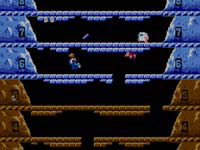
The objective centers on a hammer used to destroy blocks and defeat enemies while ascending the eight floors of each of the 32 mountains until the peak is reached. Staying on the screen is part of the task: contact with enemies or falling ice shards costs a life, so both hazards must be dodged during the climb. The documented actions and goals are tied together, since breaking blocks and eliminating enemies serve the same upward progress through the mountains' floors.
The rules use a lives system with a clear game over condition. A hit from an enemy or a falling ice shard, or failing to remain on the screen, results in losing a life. If lives run out completely, the game ends. These hazards and the life count operate alongside the climb, so the same enemies and ice shards that must be avoided also threaten the run when the player is trying to destroy blocks and reach each mountain's peak across the eight floors.
Progressing Through 32 Mountains and 8 Floors
The official manual sets the structure plainly: the aim is to use your hammer to destroy blocks and defeat enemies while climbing the eight floors of each of the 32 mountains until you reach their peak. Those two counts work together as the full route — every mountain is divided into eight floors, and the total journey spans 32 peaks. There is no separate stage select or warp described in the rules; progress comes from clearing each set of eight floors in turn until the summit of that mountain is reached.
Lives frame that climb. The manual warns you to do your best to stay on the screen and to try to avoid being hit by enemies and falling ice shards, because failure to do so results in losing a life. Running out of lives completely ends the run in game over. So the documented loop pairs upward progress against two hazards the manual names directly, enemies and falling ice shards, with leaving the screen treated the same as taking a hit: one life lost per failure.
Bonus Stage: Grab the Condor and Collect Vegetables
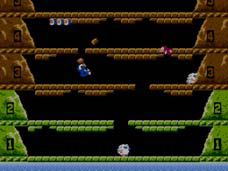
After scaling the full eight floors of the mountain, you enter a bonus stage with a time limit. The manual instructs you to work your way to the top of the mountain, where you must then jump up and grab onto the condor flying overhead. As you climb, don't forget to pick up the various vegetables lying scattered around to help increase your bonus score. The manual specifically notes to keep an eye out for the ears of corn, as the first one you collect will grant you an extra life. All of this must be done within the specified time limit.
The bonus stage ends under three documented conditions: if you run out of time, if you fall off the bottom of the screen, or if you successfully grab onto the condor. Upon any of these endings, your score will then be calculated before proceeding on to the next stage. The first ear of corn you collect grants an extra life, and vegetables add to your bonus score. The manual emphasizes that grabbing the condor is the goal, but the stage can also conclude prematurely by timer expiration or falling off the bottom of the screen.
Two-Player Mode: Cooperate or Race to the Peak
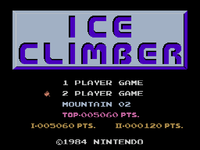
By selecting 2 PLAYER GAME, the manual establishes that it is possible to play the game with two players. The same page states that players can either work together to climb the mountain or race each other to the peak as rivals. This means the same mode supports both cooperative and competitive climbing between two participants, and the choice is described as being available after selecting 2 PLAYER GAME rather than through separate menu options. The manual does not mention a single-player alternative in this excerpt.
The manual warns that as you progress through the floors the screen will shift up along with the player. Players are told to be careful not to disappear off the screen, because doing so will result in a lost life. This rule applies in the 2 Player Game mode and interacts directly with the two-player setup: a player left behind as the view rises can vanish from view and lose a life, regardless of whether the pair is cooperating or racing to the peak.
Sources & further reading.
- Ice Climber — official game manual Retrieved Oct 15, 2026
First published .