 THE GAME ARCHIVE

Eight Outer Towers Before the Central Stronghold
Impossible Mission II sets its infiltration inside a futuristic fortress built to protect Elvin Atombender. The central tower is the destination, but reaching it requires conquering all eight outer towers first. That gives the fortress a specific progression rule: access to the main stronghold depends on completing the surrounding towers, rather than simply finding the central building. Each outer tower has its own theme and difficulty level, so the eight required stages differ in both setting and challenge while serving the same larger objective.
Use the pocket computer’s map to guide your movement through those towers. Navigation takes place inside a security-equipped complex: the towers contain surveillance cameras, robot guards and passageways protected by secret security codes. The map supplies guidance through the fortress, while the guards and coded passages form part of the defenses encountered within it. Moving toward the central stronghold therefore combines two documented tasks at different scales: navigating individual towers with the pocket computer and conquering the full outer set to gain access to the center.
The Secret-Code Hunt and Its Coded Music
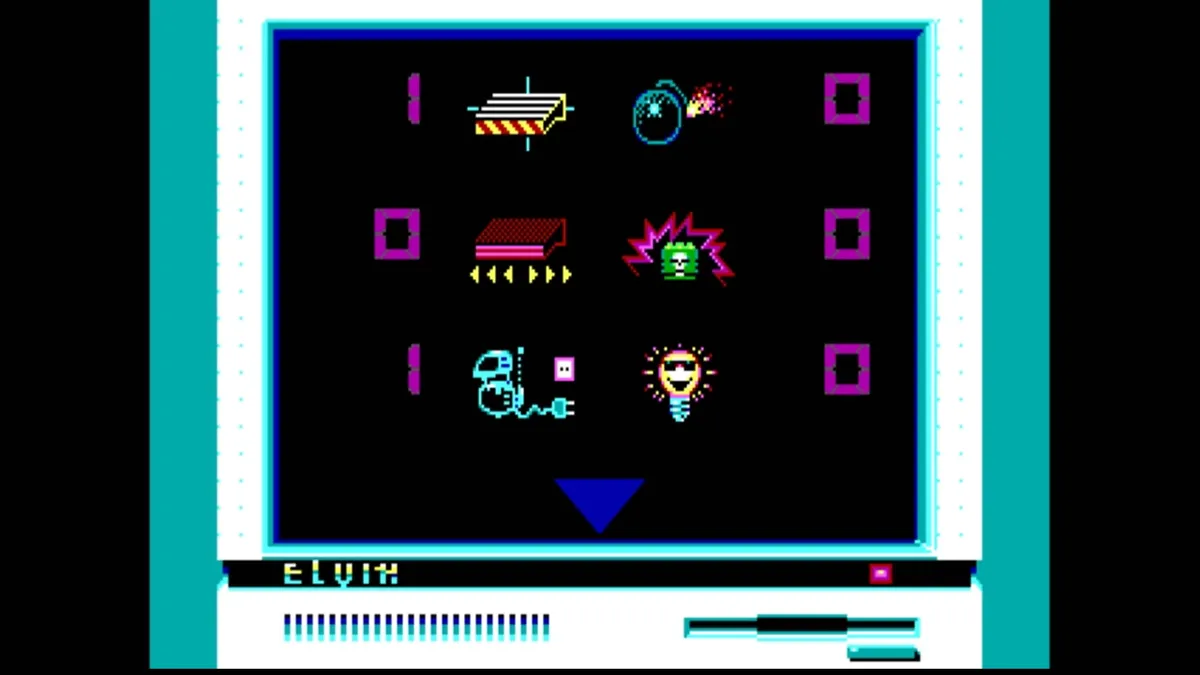
The investigation has a specific target: find the secret code that grants access to Elvin Atombender’s stronghold. Searching objects on the screen turns that objective into a concrete task, since those objects can contain secret code numbers. The hunt therefore extends beyond finding a way through the fortress: its contents are also sources of information. Inspecting objects is part of the mission’s investigative work, with code numbers among the things you are looking for.
The tape player supplies a separate way to examine collected material. During play, you gather coded pieces of music and use the player to listen to them. These musical finds give the secret-code hunt an audio component alongside the search for numbers in objects. The two documented actions are distinct: search the scenery for code numbers, and play the coded music you have collected. Listening is thus an explicit use of equipment, not merely background accompaniment to the investigation.
Office Clues, Lightning Push-Bots and Garage Mine Layers
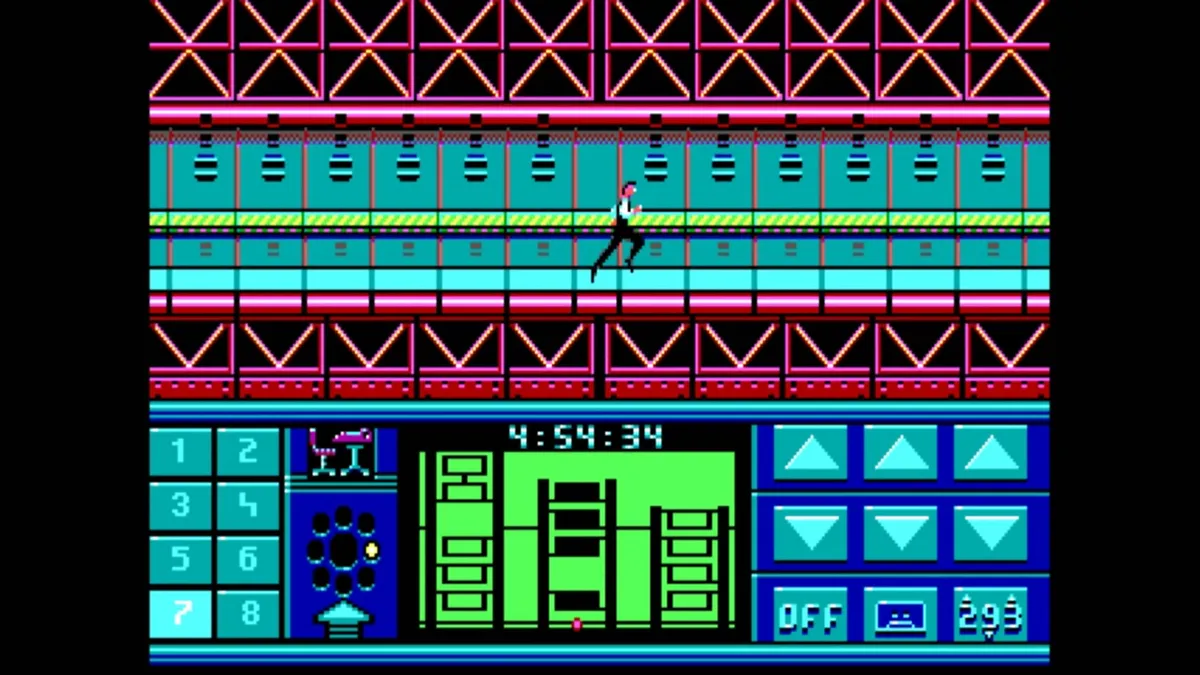
The executive office suites pair clue hunting with a specific robotic threat: lightning-shooting push-bots. Your task here is to uncover clues while avoiding their electrical attacks. These offices are therefore both an investigative setting and a guarded space, with the search taking place in the presence of enemies that can zap you. Looking for information and staying clear of lightning are the two documented demands of the suites.
The parking garage offers another search setting, this time threatened by mine layers rather than the office suites’ lightning-shooting push-bots. Searching remains the stated activity, but the named opposition changes with the location. The useful distinction is between the two enemy types: electrical attacks belong to the office encounter, while mine layers are the hazard identified for the garage search.
Searching for Weapons Behind the Tower Defenses
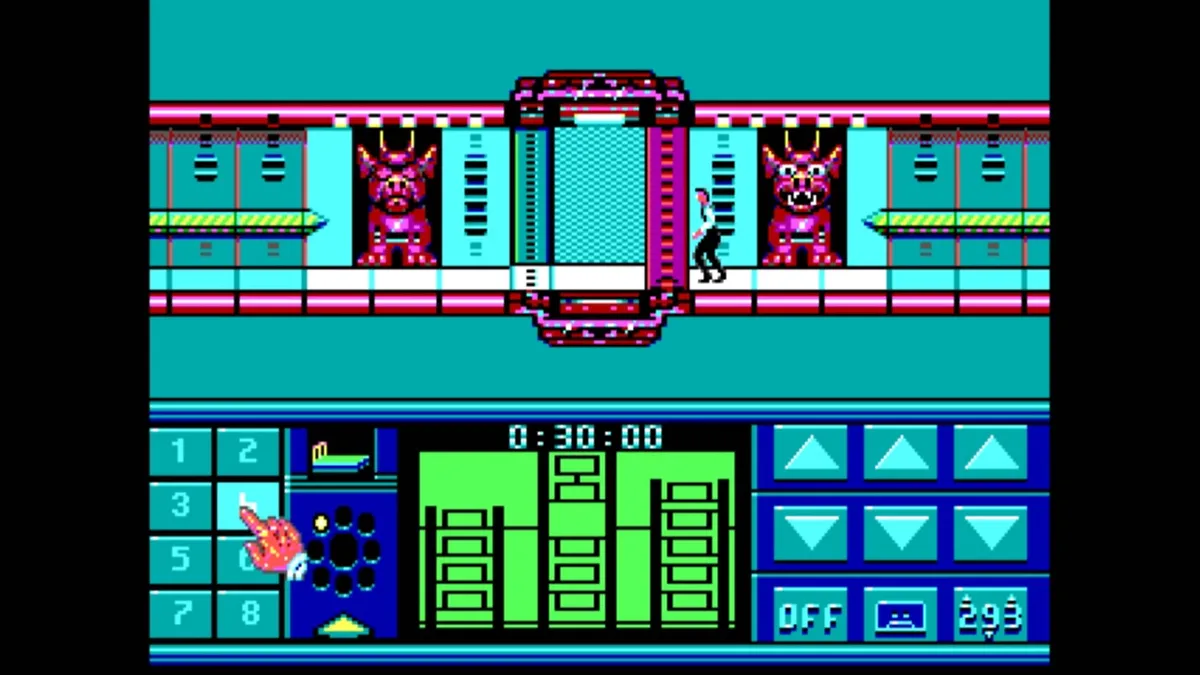
Weapons are another reason to inspect objects during the infiltration. Alongside the code numbers needed for the investigation, the scenery can conceal equipment for destroying enemy robots. Searching therefore serves a combat purpose as well as an information-gathering one: you are looking for something to use against the guards, not just another clue. The documented source of those weapons is the objects on each screen, making inspection part of arming yourself inside the fortress.
Finding a weapon adds destruction to the ways you can deal with robotic opposition, but avoiding guards remains an explicit task. These are distinct actions within the same infiltration: steer clear of robots as you move, and search for weapons capable of eliminating them. Their stated targets are enemy robots; the tower defenses also include surveillance cameras and security-coded passageways. Weapon hunting addresses the robotic threat within that larger security system, rather than replacing the investigation.
Sources & further reading.
- Impossible Mission II — official game profileRetrieved Nov 17, 2026
First published .