 THE GAME ARCHIVE
Just Cause 2 is an action-adventure game developed by Avalanche Studios and published by Square Enix, listed on its Steam catalog entry as a 2010 Windows release. That year and platform scope belong to this store entry; the article stays within it and does not assert broader release history. What the source describes is a free-roaming adventure set across a large island playground, and its identity rests on how the player moves through that playground as much as on what they are told to do there.
The premise: an island full of ways to make trouble
As agent Rico Rodriguez, you are ordered to find and kill a friend and mentor who has disappeared on the island paradise of Panau. The stated goal is to cause maximum chaos by land, sea, and air to shift the balance of power. The environment is framed as an island paradise spanning more than 400 square miles, with sprawling cities, secluded beaches, and towering mountain peaks. The store material presents this as a personal playground rather than a corridor: the world is the mission board, and the game's verb is disruption.
The core loop: move freely, then escalate
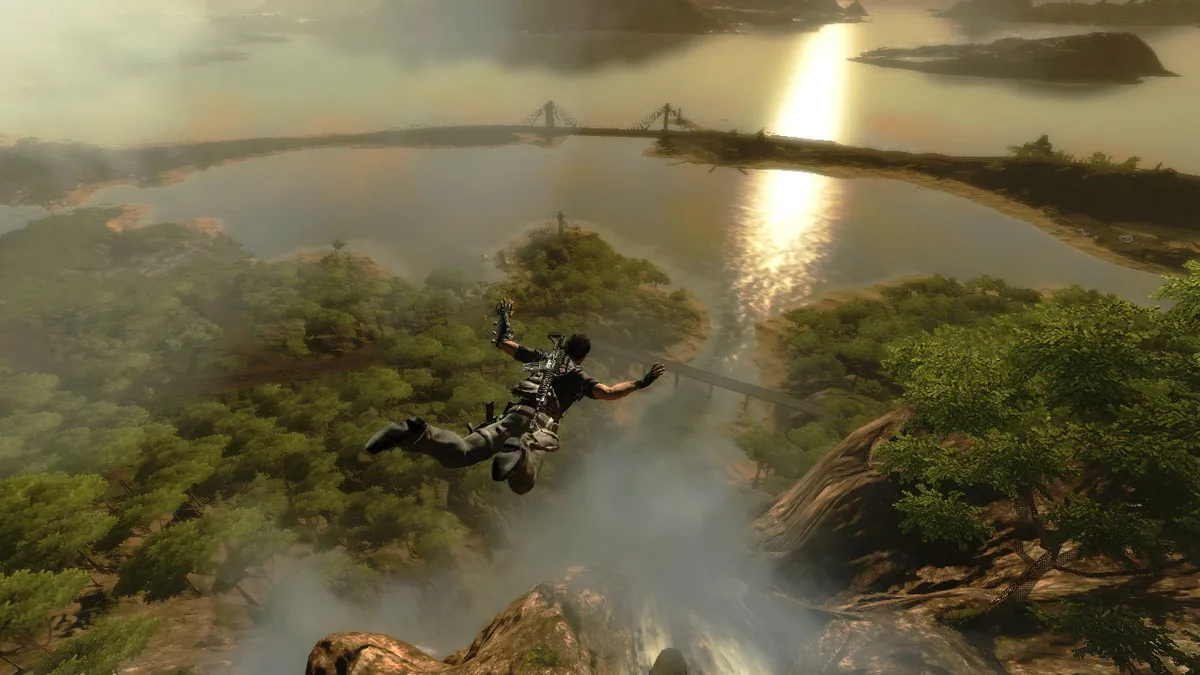
At its center, the game is a free-roaming adventure across rugged terrain with hundreds of weapons and vehicles. Travel is the connective tissue of play, and it is deliberately exaggerated. The unique grapple and parachute combo is the signature tool for BASE jumping, hijacking, and creating high-speed stunts. Together these mechanics give the game total aerial freedom: chain a grapple pull into a parachute glide, drop onto a moving vehicle, and move on. Because the traversal itself is expressive, ordinary trips between objectives become their own kind of play, and the shortest route is rarely the most interesting one.
Mechanics: the grapple as a toolkit, not just a way up
The upgraded dual grapple turns the game's best movement tool into a weapon. You can fire two shots with the grapple hook and attach unwilling enemies to high-speed vehicles, hang them upside down from buildings, or tether objects in mid-air. That makes the environment interactive in a way that goes beyond scenery: objects and enemies become variables you can combine. The stunt list reinforces the same philosophy — free fall, BASE jump, vehicle surfing, parasailing, skydiving, grappling, slingshotting, leaping between vehicles, hanging from helicopters, and scaling buildings. None of these is a scripted set piece; they are the vocabulary the game hands you and then trusts you to combine.
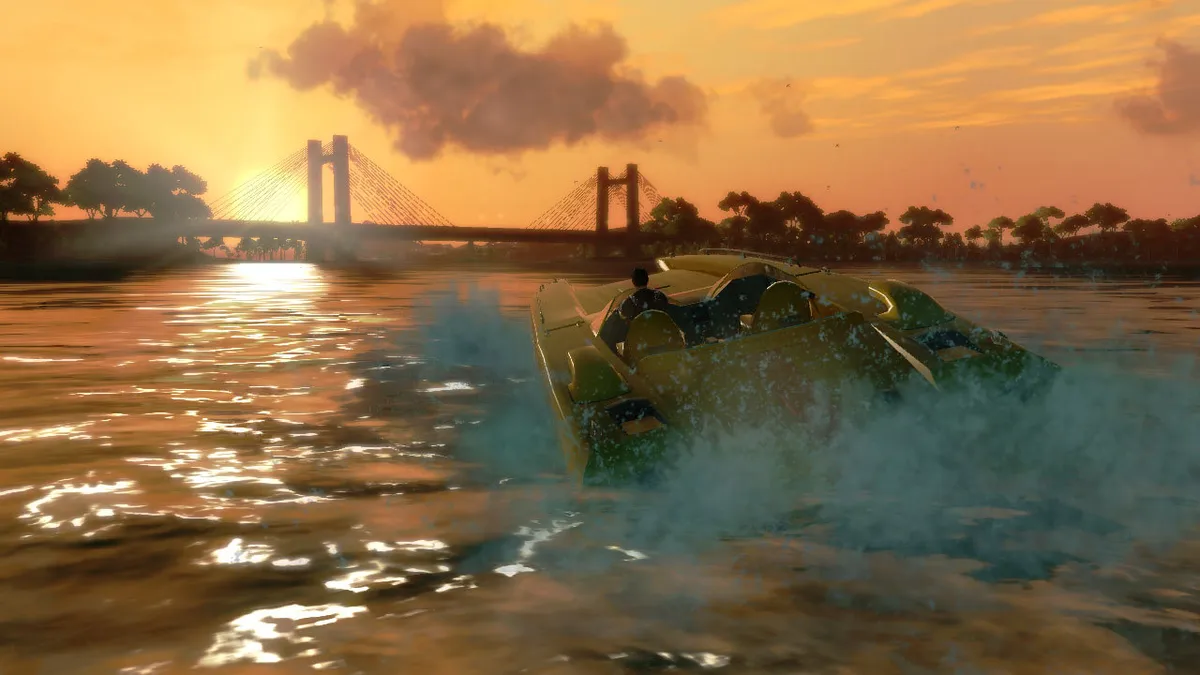
Vehicles support the same breadth. The source describes more than 100 land, sea, and air vehicles, giving examples such as a high-speed dirt bike, a power boat, and an attack chopper that can fire a spread of rockets. Because the roster spans earth, water, and sky, it functions as a set of approaches to the same terrain rather than as a checklist of cars. Hijacking is explicitly part of the mechanics, so vehicles are not only vehicles — they are also things to be taken, chained into stunts, and used as tools in the chaos-making loop.
Progression: hundreds of objectives, any order
The store text states that hundreds of objectives can be completed in any way or order you choose, and that progression comes through completing objectives. This is a meaningful design choice for a game of this scale. A world of more than 400 square miles risks feeling like a chore if its tasks must be taken in sequence; by framing objectives as open-ended, the game lets the player's curiosity set the itinerary. The freedom is not only spatial but procedural: because the objectives are completable in any order, the route through Panau is itself a player-authored decision, and the moment-to-moment question becomes which point on the map looks worth causing trouble in next.
How the supported mechanics fit together
Read together, the supported mechanics describe a coherent design: a large island, a movement system built around grappling and gliding, a weapons tool that doubles as manipulation of enemies and objects, a large and varied vehicle roster, and objectives that can be pursued in any order. The action-adventure genre label is accurate but undersells how much of the game is about movement and improvisation. The world is the instrument; the grapple is the hand that plays it; and the chaos requirement gives the player a reason to keep improvising rather than settling into a routine.
Distinguishing design choices
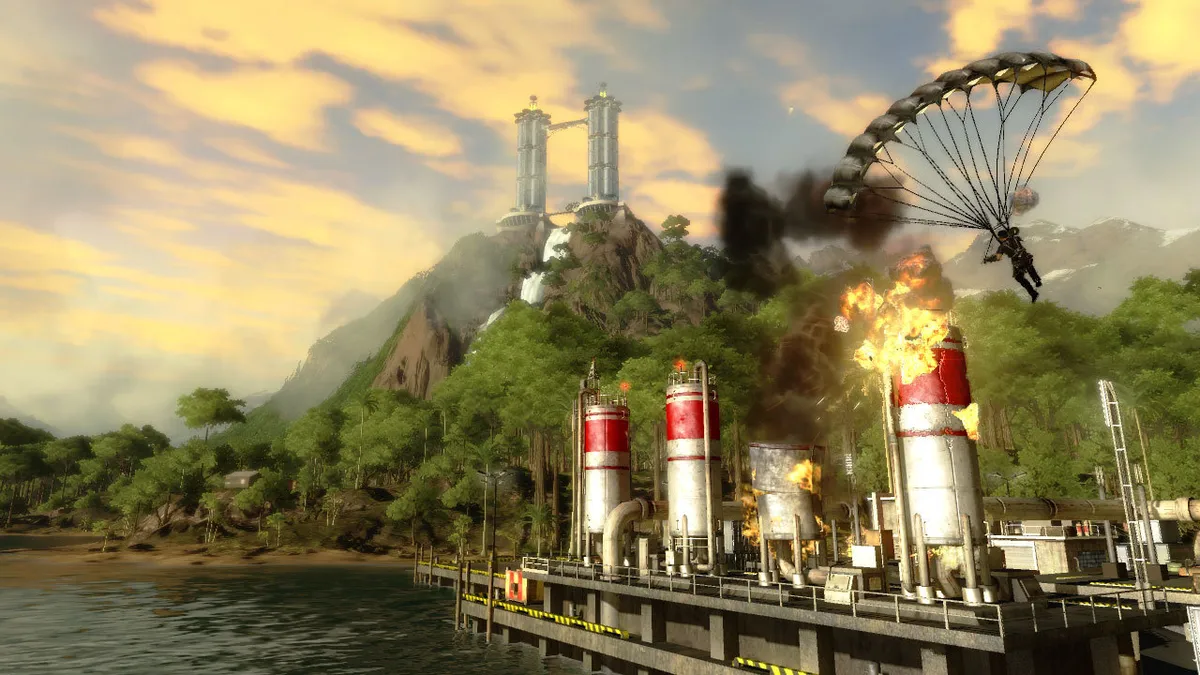
Two choices stand out. First, the game treats verticality as a first-class part of the design puzzle, not a gimmick: the dual grapple and parachute are described as the tools for total aerial freedom, and the stunt list persistently sends the player upward. Second, it treats enemy and object interaction as a tethering problem. Attaching enemies to vehicles, hanging them from buildings, and tethering objects mid-air are unusual, sandbox-flavored expressions of the same underlying mechanic. Together these push the game toward creative, physics-driven mischief rather than toward a strict shooting-gallery loop.
Getting started from the source material
The supported material does not include control mappings, opening missions, difficulty settings, or step-by-step routes, so this article cannot supply them. What it can say is more general: the game presents a very large map, hundreds of objectives, and a traversal toolkit built around the grapple and parachute. A player entering Panau should expect movement and stunt-making to be a major part of the experience, and should expect the order of objectives to be their own decision. Anything more specific would be speculation beyond the source.
Scroll sideways to see the full table →
| Field | Value |
|---|---|
| Game title | Just Cause 2 |
| Release year (Steam entry) | 2010 |
| Platform (Steam entry) | Windows |
| Developer | Avalanche Studios |
| Publisher | Square Enix |
| Genres | Action, Adventure |
| Open world size | More than 400 square miles |
| Vehicles | More than 100 land, sea, and air vehicles |
Sources & further reading.
- Just Cause 2 — official game profileRetrieved Oct 11, 2026
First published .