 THE GAME ARCHIVE
Boot Up and Basic Controls
The manual gives PAC-MAN on the NES a compact control scheme. The D-pad handles movement, steering Pac-Man's direction through the maze, so turns are made by pressing the corresponding direction rather than by any separate action button. Alongside it, the START button carries three functions listed together as Start, Pause, and Confirm: it begins a session, pauses and resumes play, and confirms selections on screen. The SELECT button is reserved for menus rather than movement, and the manual shows SELECT mapped separately from the directional input.
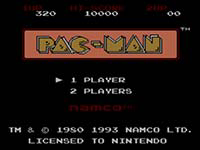
Starting a game runs through the SELECT and START pair in sequence. The manual's Getting Started section states: "Use SELECT to change the number of players and then press START to start." So SELECT cycles the player count, and START both confirms that setting and begins play, matching the confirm role it holds in the control listing. No other button is documented for changing players or for launching the game, which makes START the single commit point before the maze appears.
Selecting the Number of Players
Before the maze appears, the getting-started instructions describe a two-step sequence on the control pad. The manual's Basic Controls chart assigns Move to the directional input that shifts Pac-Man through the stages, while SELECT is listed with its own dedicated function. On manual page 3, the Getting Started section states: "Use SELECT to change the number of players and then press START to start." So the player count is not fixed at boot; pressing SELECT cycles or changes that value before play begins, and only then does pressing START launch the game with the chosen setting.
The same controls reference gives START three documented roles beyond launching a game. On page 2, START is labeled "Start/Pause/Confirm": it pauses and resumes an in-progress stage, and it confirms selections in menus. That label interacts directly with the player-selection step on page 3, where SELECT changes the number of players and START then begins play. Because START also confirms, the same button that finalizes a menu choice is the one that later stops and restarts the action, while SELECT is not described as handling pause or confirmation.
The Core Objective: Eat the Maze
The manual states that you guide Pac-Man through the maze and eat all the Pac-Dots to clear the stage. Beyond the dots, the same page lists Power Pellets, fruits and ghosts as edible objects that build up your score, and by extension your number of lives. The stakes are stated plainly: if a ghost catches you, you lose a life, and when you run out of lives, your game ends. The screen display groups the high score, Player 1's score, current stage, and remaining lives, so progress through stages and stock of lives are both visible during play.
Warp Tunnels are the named mechanic for horizontal traversal: the manual instructs you to use them to travel to the other side of the maze. They appear as item 2 in the screen guide, alongside the high score, Player 1's score, current stage, and remaining lives, so the tunnels exist within the same fixed maze layout that Pac-Man crosses while eating the dots. Clearing the stage therefore means working through the maze's dots, fruit and ghosts while using the Warp Tunnels to reach the far side.
Power Pellets and Eating Ghosts
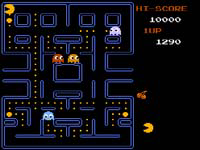
Eating a Power Pellet changes the behavior of every ghost on the screen. According to the manual, "If you eat a Power Pellet, the ghosts will weaken for a little bit, and you'll be able to eat them." During that weakened period, touching a ghost is no longer fatal; instead Pac-Man consumes it. The manual also states, "Eating consecutive ghosts will boost your score," so the reward grows as you clear multiple weakened ghosts in a single Power Pellet window rather than catching just one.
The manual documents what happens after a ghost is consumed: "Ghosts that have been eaten will return to the centre of the screen and reappear in their normal state." That means an eaten ghost is not gone permanently; it re-enters play at the center, no longer weak. A separate warning covers ghosts you fail to catch: "Ghosts that have not been eaten will return to normal once the Power Pellet wears off, so be careful." Both rules share the same timing, so a Power Pellet only helps until its duration ends.
Meet the Four Ghosts
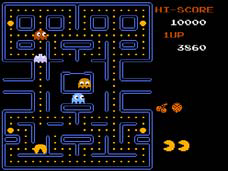
Four ghosts occupy the maze, each with a documented movement pattern. Shadow 'Blinky' aggressively pursues Pac-Man, while Speedy 'Pinky' tries to ambush him. Bashful 'Inky' moves whimsically, and Pokey 'Clyde' does things at his own pace and likes to play dumb. These behaviors are distinct from one another, so the position and identity of a ghost determine how it approaches Pac-Man's current location.
Eating a Power Pellet weakens the ghosts for a little bit, making them edible. Ghosts that have been eaten return to the center of the screen and reappear in their normal state. However, ghosts that have not been eaten return to normal once the Power Pellet wears off, so the weakened period ends for any remaining ghosts. Eating consecutive ghosts during that window boosts the score.
Lives, Score, and Clearing Stages
In this NES version, each stage is cleared by guiding Pac-Man through the maze and eating every Pac-Dot. As the manual instructs: “Guide Pac-Man through the maze and eat all the Pac-Dots to clear the stage.” This action directly advances the game because stages only progress once the Pac-Dot count reaches zero. The manual does not specify the exact number of dots or the maze layout, but the condition is absolute: no other action clears a stage. The same page also notes that losing a life occurs when a ghost catches Pac-Man, and running out of lives ends the game entirely.
Score accumulates through four specific actions listed on manual page 4: eating Pac-Dots, Power Pellets, fruits, and ghosts. The same passage states that this score build-up can increase your number of lives, though the exact threshold or mechanism is not detailed. Lives are lost when a ghost catches Pac-Man; when the life counter reaches zero, the game ends. Thus, clearing stages and avoiding ghosts preserve lives, while scoring through consumption may replenish them. The manual’s wording ties score directly to potential life gain but leaves the exact conversion unstated.
Sources & further reading.
- PAC-MAN — official game manual Retrieved Oct 15, 2026
First published .