 THE GAME ARCHIVE
Painkiller: Black Edition is a Windows action shooter from developer People Can Fly, published by Prime Matter and dated 2007 in the official profile. What the publisher material actually documents is a set of interlocking combat rules: every weapon carries two fire modes, a fixed soul count gates a transformation, and a physics layer changes how fights look and react. This feature walks through those documented systems, how they reinforce one another, and what the Black Edition package adds over the base campaign.
Paired Weapons: One Pickup, Two Fire Modes
The core weapon rule is one of the clearest in the source material: all weapons come in pairs, with a primary and secondary fire. The arsenal numbers 14 weapons, and the publisher singles out the famous stake-gun and the mythical Painkiller among them. Read literally, that means the player is never holding a single-mode tool — every gun on the rack presents a choice between two discharges. In a shooter built around mobs pressing in from all sides, that choice is the basic tactical unit of the game.
Because each of the 14 weapons splits into two firing behaviors, the effective loadout is broader than the weapon count suggests: the player is always deciding not just which gun to hold but which of its two modes suits the moment. The documented combat framing — non-stop action with hundreds of enemies to decimate and gigantic bosses — is what gives that decision weight. The same system has to serve both crowd control and the boss encounters at the end of the fighting, so cycling between a weapon's primary and secondary fire becomes the moment-to-moment rhythm of play rather than a novelty.
Every 66 Souls: The Possessed-Creature Morph
Painkiller's second documented rule is a fixed soul threshold. The player's unholy pact gives them the power to morph into a powerful possessed creature with every 66 souls collected. Two details matter for how this plays out. First, the trigger is a count, not a meter or an upgrade tree — the transformation arrives once the tally reaches the required number. Second, the count resets implicitly with each trigger, since the rule is stated per 66 souls rather than as a single unlock. The result is a repeating transformation rather than a one-time ability.
That design only works if the game supplies a steady stream of fodder, and it does: hellish monsters swarm in seemingly endless mobs. Every kill is therefore doing double duty. It clears space against the immediate threat while pushing the soul counter toward the next morph, so a player who keeps momentum in a dense encounter is also building toward the moment they become the possessed creature. The documented loop links mob density, soul accumulation and the transformed form into one repeating cycle rather than three separate features.
The soul rule also sits inside the game's stated framing: the player is stranded in a place between Heaven and Hell, the Underworld stands on the verge of unholy war, and the player is a pawn in the infernal battle fighting for purification. The source does not spell out what the possessed form does in combat or how long it lasts, so the safest way to read it is as a reward for sustained clearing — the payoff that arrives when a wave has been worked through long enough to fill the counter.
Havok 2.0 and the Deformable Arena
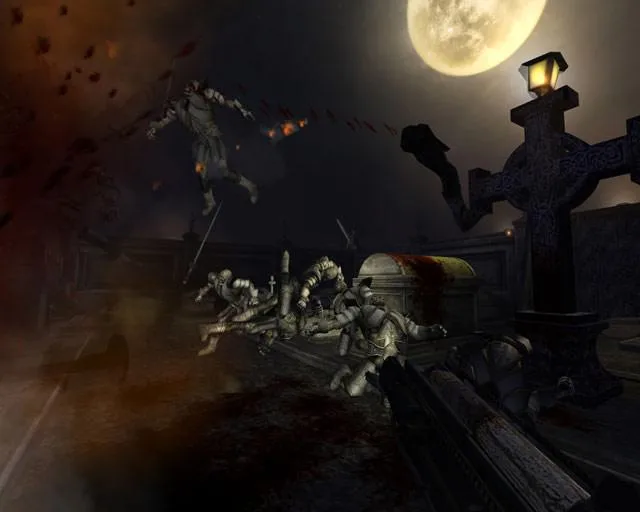
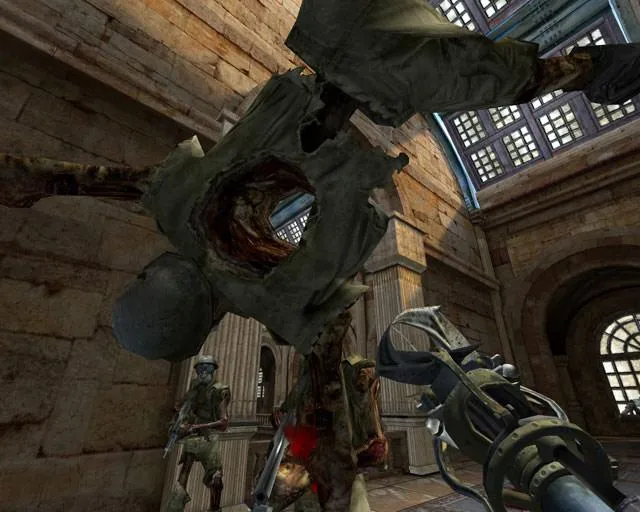
The third documented pillar is the physics layer. Painkiller employs the Havok 2.0 physics engine, which the publisher describes as allowing inverse kinematics — rag-doll physics — and deformable, interactive environments. In practice this means defeated bodies react through the simulation instead of freezing into fixed poses, and the spaces themselves can be altered during a fight. That gives each encounter a visual and spatial texture beyond hit points and ammo, and it ties the carnage of dense mob fights to something the player can see and affect.
The environment layer also changes how arenas read. Deformable, interactive surroundings mean the battlefield is not a static backdrop; the same set that hosts a wave of hellish monsters can shift as the fight proceeds. Combined with the two-mode weapons, that pushes players to think about the space as something to exploit rather than just navigate — the physics responds to the combat, and the combat changes the space.
Levels, Enemy Variety and the Boss Wall
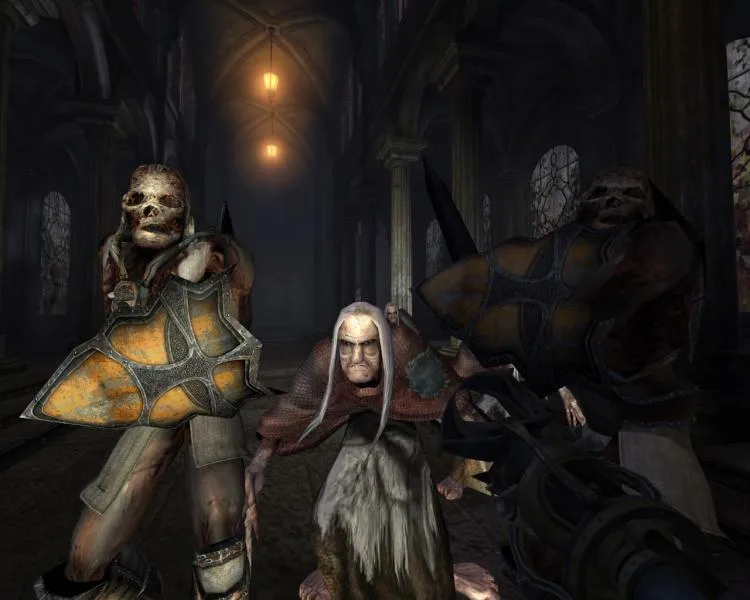
The publisher lists over 30 levels of fierce action, populated by dozens of different enemies in completely unique and varied environments. That combination matters for pacing: the mob system rewards sustained clearing, but different settings and different enemies keep a 30-plus-level campaign from feeling like one arena repeated. The player's weapon choices have to hold up across a wide spread of encounters rather than being tuned to a single room type.
The documented climax of that progression is the boss: gigantic bosses stand at the end of the fighting. Because the described tone is hundreds of enemies to decimate across non-stop action, the boss sequences read as the counterweight — the point where sheer mob-clearing meets a single large threat. The pair of fire modes on each weapon is the documented toolset the player carries into both kinds of fight.
What the Black Edition Adds
The Black Edition bundles the base game with the Battle Out of Hell expansion, which adds 10 additional single-player levels and many new villains to the main scenario. Layered on top of the standard single-player campaign are additional modes meant to encourage replay. So the package contains three tiers of content: the main 30-plus-level run, the expansion's 10 extra levels with its new adversaries, and the replay modes that give players reasons to return after the purification arc is finished.
Starting Guidance Built on the Documented Rules
The systems suggest a few straightforward habits for a new player. Treat each weapon as two tools and learn the secondary fire early rather than falling back on the primary alone, since the paired-fire design is the documented core of combat. Keep clearing mobs deliberately: endless waves are the fuel for the 66-soul counter, and the morph only arrives with souls collected. And expect the physics to matter — rag-doll reactions and deformable surroundings are part of how encounters look and respond, not a separate layer to ignore.
Why the Systems Fit Together
Seen as a whole, Painkiller's documented design pushes every system toward the same place: the dense encounter. Paired fire gives each weapon two answers to a crowd; the 66-soul count turns that crowd into progress toward a transformation; Havok 2.0 lets the crowd and the room react visibly as it is dismantled; and boss fights cap the sequence. None of those pieces is presented as a management screen or a menu of upgrades — they are all resolved in the middle of the fight, which is what gives the publisher's high-adrenaline, non-stop-action framing something mechanical to stand on.
Scroll sideways to see the full table →
| Fact | Documented detail |
|---|---|
| Title | Painkiller: Black Edition |
| Release year | 2007 |
| Platform | Windows |
| Developer | People Can Fly |
| Publisher | Prime Matter |
| Genre | Action |
| Weapons | 14, each with primary and secondary fire |
| Morphing trigger | Every 66 souls collected |
| Physics | Havok 2.0: rag-doll physics, deformable interactive environments |
| Levels | Over 30 in the base campaign |
| Expansion | Battle Out of Hell: 10 additional single-player levels and many new villains |
Sources & further reading.
- Painkiller: Black Edition — official game profile Retrieved Oct 19, 2026
First published .