 THE GAME ARCHIVE
Rayman Origins is a 2D side-scrolling platformer developed by Ubisoft Montpellier and published by Ubisoft, listed on Steam for Windows and macOS with a 2012 release year. It belongs to the action and adventure genres, but its identity rests on something narrower: a return to hand-drawn 2D platforming, built around four-player co-op where friends can come and go mid-session without disrupting anyone else's save.
The Premise: A Glade Overrun, a Hero Not Quite There
When the Glade of Dreams is overrun by creatures the store description calls "nefurrious" Darktoons, the Fairy Council summons Rayman to save the day — except the hero of light is, as the description puts it, not quite all there. To compensate, he teams with his best friend Globox and two crafty wizards, the Teensies. The framing matters for play: the story is deliberately comic rather than solemn, which is consistent with a game whose co-op pitch is built around a shared, loud, slightly chaotic playground rather than a single scripted protagonist.
The store materials frame this as a return to roots: the character's initial launch came roughly 15 years before Origins, and Origins brings back many classic characters in their original 2D form alongside new characters and environments. That framing is the useful anchor for the whole design — the game is a re-declaration of 2D platforming rather than an evolution of it.
The Core Loop: Run, Rescue, Revisit
At its core, Rayman Origins is a platformer — the store copy says so explicitly, while noting the game also borrows from many other genres. The documented loop is: move through 2D stages, use the movement abilities the game grants, and gradually unlock new abilities that change what older levels allow. That last part matters more than it sounds. Because abilities unlock progressively, earlier stages are not finished objects; they are partial ones that you return to once your character can reach further, find new paths, and uncover secrets that were physically out of reach the first time.
The structure supports that loop generously: Origins includes over 60 levels of 2D platforming gameplay, described as designed for all ages and playing styles. Over 60 levels plus backtracking-oriented unlock design is a specific pairing — it means the level count is not just raw volume, it is a bank of revisit targets.
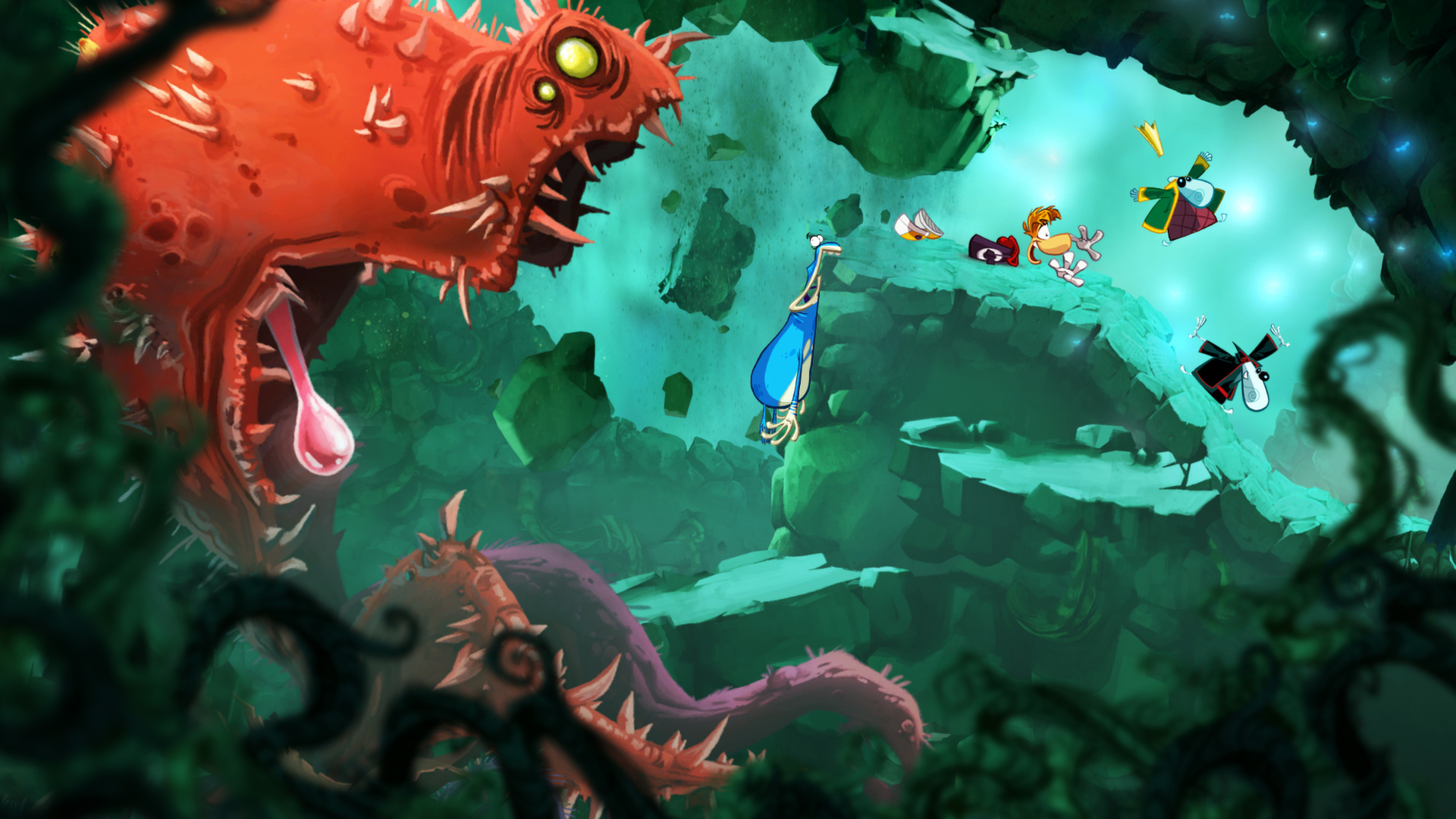
Boss fights punctuate the run. The store copy advertises a giant pink monster with hundreds of eyes, a possessed mountainous golem, and an evil daisy-turned-carnivorous-plant, and says these and more challenging boss battles put players to the test. So the pacing is not purely continuous platforming; it alternates between traversal stages and larger set-piece encounters.
Mechanics and Abilities
Rayman, Globox, and the Teensies gain unique abilities as they progress through the adventure. The specific abilities named in the store materials are swimming, diving, and the "HairlyCopter" — the last being described as sensational. These are not cosmetic: swimming and diving imply underwater traversal sections with their own movement rules, while the HairlyCopter implies slow-descent or extended-air-control moments. Combined with the level-revisit design, each ability is effectively a key that opens previously blocked geometry.
The game is a platformer first, but the copy names action, adventure, and beat-'em-up as additional elements. Beat-'em-up, specifically, suggests close-range combat sequences sit alongside jumps — a useful expectation for players who assume the game is purely about running and hopping.
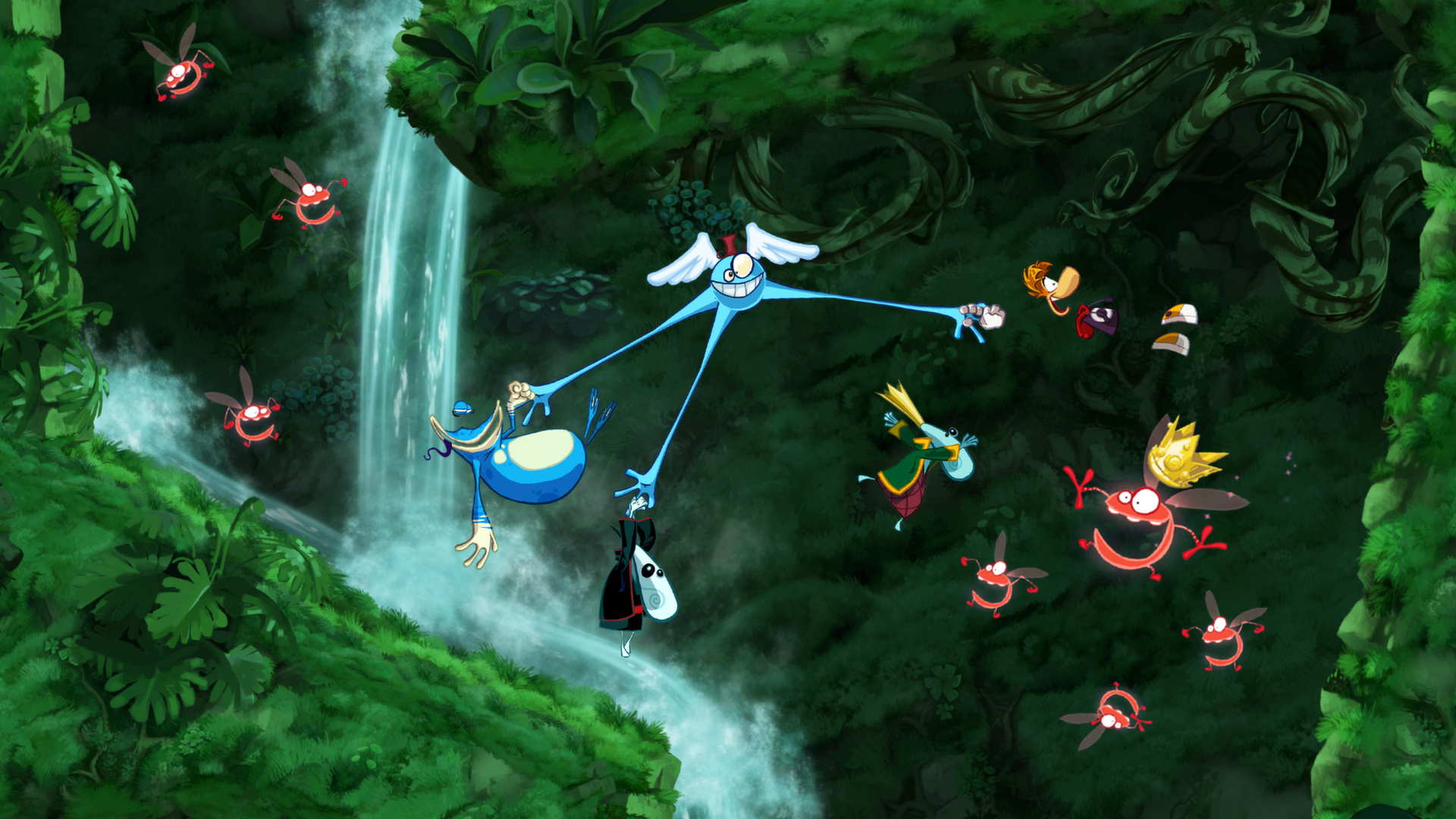
Separate from abilities, the world itself is presented as a feature: over 100 characters and 12 unique environments, credited to reputed artists and animators. For a 2D platformer this is a meaningful statistic — twelve environments is a statement about visual variety across the campaign rather than a handful of repeated backdrops.
Modes: Solo, and Four Players Who Can Leave
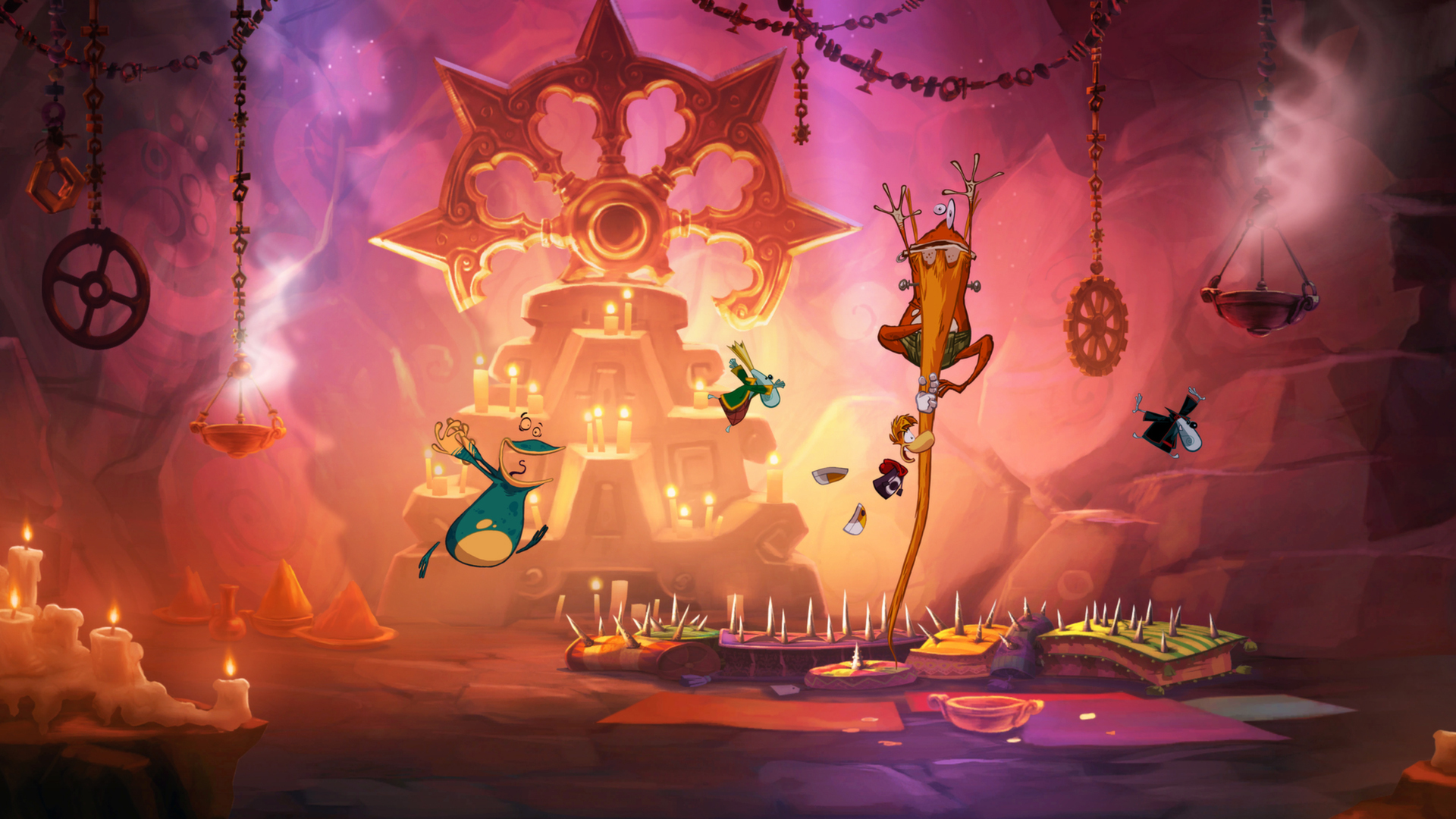
You can play as Rayman in the solo campaign, or up to three friends can jump in at any time as Globox or one of the two Teensies. That is four-player, jump-in/jump-out co-op. The critical design detail is the departure rule: players can leave at any time without affecting the others' progression. In practice that means the co-op is not a lockstep commitment — one player's decision to quit mid-level does not strand the rest of the group or force a save-state negotiation.
The character-selection options are documented as Rayman, Globox, and the Teensies. Anyone expecting a roster of unlockable characters should recalibrate: the draw here is not a large cast of playable heroes but the drop-in nature of sharing a single campaign with friends on short notice.
Source-Backed Starting Guidance
The supplied materials do not document controls, difficulty options, level routes, or recommended order of play, so any specific advice about where to begin would be invented rather than sourced. What the sources do support is a reasonable expectation-setting sequence. Start solo if you want to learn movement and ability behavior without coordination overhead, because the solo campaign is explicitly documented as available. Treat the ability unlocks as the spine of your playthrough: when a stage looks impassable, that is a signal to continue rather than grind, since progression is designed around returning to previous levels with new abilities.
For co-op sessions, the sources support one practical plan: because friends can join at any time and leave without affecting others' progression, you can treat the campaign as an open session that people slide in and out of rather than a scheduled commitment. That is the documented behavior, and it is the strongest structural argument for playing this with a rotating group.
Design Character: Hand-Drawn 2D and a Small Team
Origins was developed by the UBIart team in Montpellier and built on the UBIart Framework, described in the store copy as an open-source game engine designed by Michel Ancel to let much smaller teams of artists and developers produce high-quality graphics and gameplay quickly and efficiently. The copy calls this a "garage-game" approach and credits it with strides in creativity and innovation.
Whatever the internal history, the visible consequence is the art direction: a rich 2D world with over 100 characters and 12 unique environments, drawn by artists and animators the copy describes as reputed. The design goal stated is to recapture platformer fans while introducing a new generation to the character in his original 2D form. That is a dual-audience pitch, and the ability-unlock-return loop is the mechanical half of it — accessible entry stages, with optional depth for people who come back.
Current Official Access and the Online Feature Change
The Steam listing carries an Ubisoft Online Services Decommission update stating that, from 25 January 2024, online features are no longer available for this product. This is an important boundary for modern readers: the single-player campaign and local co-op behavior described in the store materials are the documented content, while anything that depended on the decommissioned online services is not available. The copy does not enumerate which features were online-only, so the precise scope of what was removed is not established by the supplied sources.
At a Glance
The compact reference below collects the store-level facts that frame the rest of this feature. It is a supplement, not a substitute for the sections above.
Why Origins Still Reads as a Distinct 2D Platformer
Strip away the marketing language and the documented design holds together as a coherent package. A 2D platformer with over 60 levels, twelve environments, and abilities that progressively unlock and retroactively open old stages is a game built around revisitation rather than linear consumption. Layer four-player jump-in/jump-out co-op on top, with a rule that departing players do not disrupt anyone else's progression, and you get a platformer explicitly designed to be shared casually.
What the supplied sources do not cover is equally clear, and worth stating plainly: there is no documented information here about controls, difficulty tuning, individual level design, performance, or the original non-Steam release history of the game. Those are the gaps a reader would need filled by separate research. The store listing establishes the shape of the game's design; it does not establish how it feels in the hand.
Scroll sideways to see the full table →
| Field | Value |
|---|---|
| Title | Rayman Origins |
| Release year (per Steam listing) | 2012 |
| Developer | Ubisoft Montpellier |
| Publisher | Ubisoft |
| Genres (store categories) | Action, Adventure |
| Listed platforms (Steam) | Windows, macOS |
| Documented level count | Over 60 levels of 2D platforming |
| Documented environments | 12 unique environments |
| Co-op | Up to four players, jump-in/jump-out |
| Playable characters | Rayman, Globox, Teensies |
| Named abilities | Swimming, diving, HairlyCopter |
| Online features | Decommissioned from 25 January 2024 |
| Hands-on testing | Not performed for this feature |
Sources & further reading.
- Rayman® Origins — official game profile Retrieved Oct 12, 2026
First published .