 THE GAME ARCHIVE
Command & Conquer: Red Alert 3 is a real-time strategy game released in 2009 for Windows, developed by EA Los Angeles and published by Electronic Arts. Its genres are listed as Action and Strategy. Within the Red Alert line, it is distinguished by a premise that resets the series' alternate history and by a design push that treats warfare on water as a first-class part of the battlefield rather than a flanking afterthought.
A Time-Travel Mission That Rewrites the War
The premise begins with the desperate leadership of a doomed Soviet Union traveling back in time to change history and restore the glory of Mother Russia. The time travel mission goes awry, producing an alternate timeline in which technology has followed an entirely different evolution and a new superpower has been thrust onto the world stage. World War III is raging, and the Empire of the Rising Sun has risen in the East, turning the conflict into a three-way struggle between the Soviets, the Allies and the Empire. Each side fields its own mix of weapons and technologies, from Tesla coils and heavily armed War Blimps to teleportation, armored bears, intelligent dolphins, floating island fortresses and transforming tanks.
The Core Loop: Land, Air and a Contested Sea
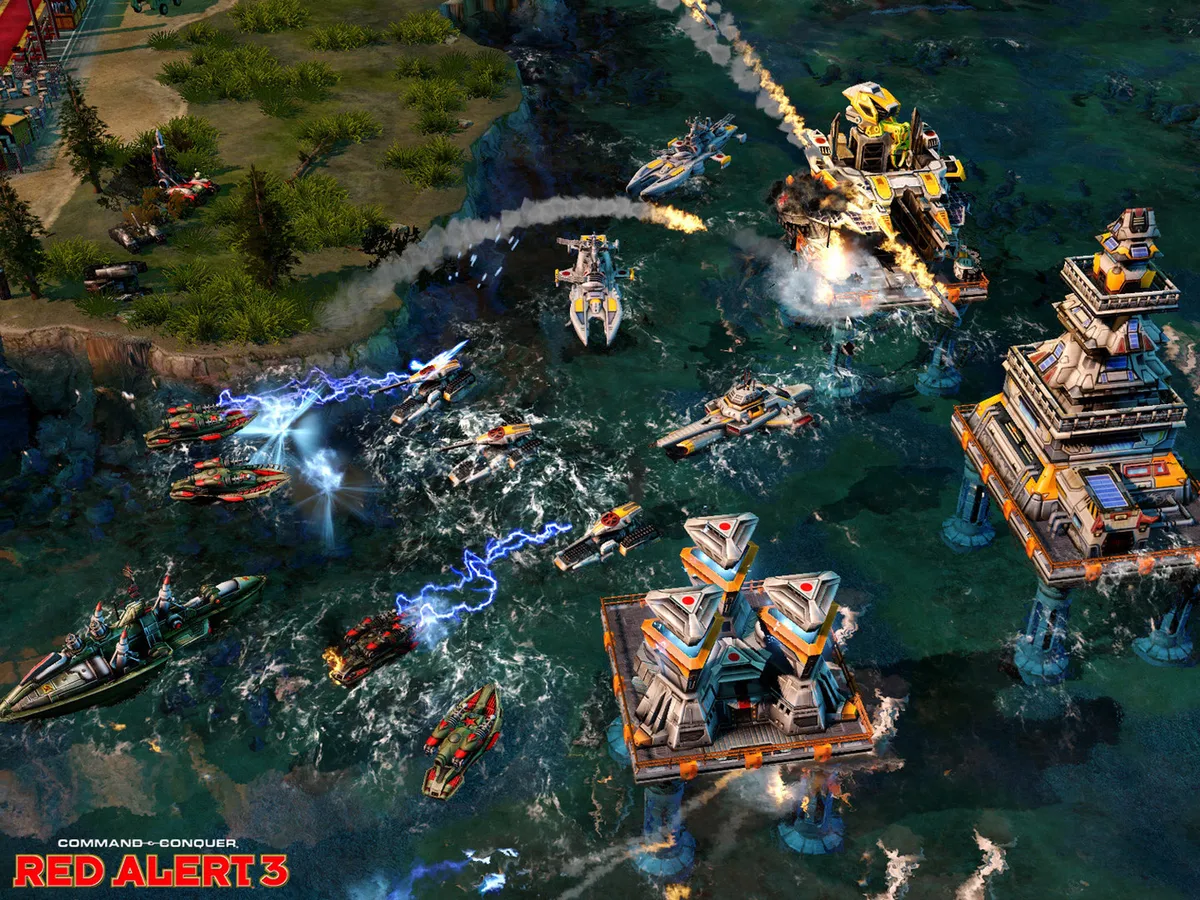
Red Alert 3 follows the recognizable real-time strategy rhythm of building a base, producing an army and contesting the map, but it changes where that contest happens. Waging war on the water is presented as being every bit as important as dominating by land and air. Controlling resources in the seas yields strategic advantages, and those advantages support mounting three-pronged attacks from all directions. In practice, that reframes water from a boundary or a shortcut into an economic and military layer: sea-based resources can fund expansion, while naval forces threaten positions that ground-only armies cannot easily reach.
The consequence for a match is that sea control and map pressure become linked rather than parallel tracks. A player who secures sea-based resources can convert that control into broader pressure, and the threat of attacks arriving from land, air and water forces an opponent to defend multiple vectors at once. That is the central gameplay idea the available source supports: the sea is not background scenery but a contested layer of the battlefield that shapes where a player can safely expand and where an opponent must commit forces.
Three Factions, Three Design Languages
The three-faction structure is the clearest way Red Alert 3 differentiates itself within its own frame. The Soviets, the Allies and the Empire of the Rising Sun do not merely reskin shared units; they field distinct technologies and military identities. The Allies face technological rivalry against the Empire of the Rising Sun, which is described as a technological terror whose designs draw on a mixture of anime, science fiction, martial arts and robot culture. The Empire's futuristic units can transform into alternate forms and specialize in naval warfare, tying its identity directly to the game's broader emphasis on water.
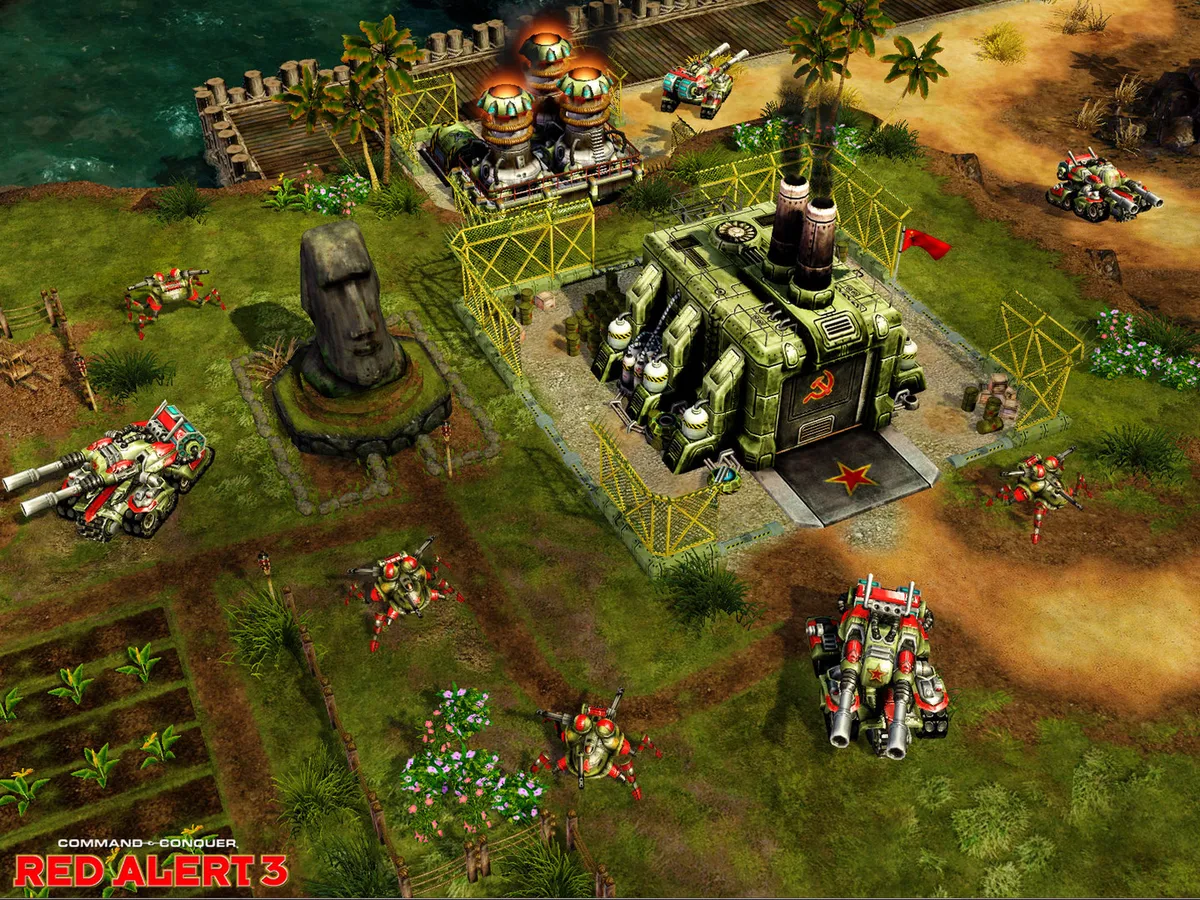
The unit roster leans into the series' established tone of deliberate excess. Supported descriptions reference Tesla coils, heavily armed War Blimps, teleportation, armored bears, intelligent dolphins, floating island fortresses and transforming tanks. Armored War Bears and anime-inspired psychic school girls join returning Red Alert favorites such as Sonic Dolphins, Tesla Troopers, Attack Dogs and the ever popular Tanya. These are not only cosmetic flourishes; they signal different tactical roles, from airborne bombardment and area denial to specialized infantry and naval support. The combination of transforming Empire units and an Ally roster facing that technological rivalry gives each side a distinct way to approach the same contested map.
How the Systems Interlock
Sea control, resource access and faction asymmetry give Red Alert 3 a recognizable strategic rhythm. Naval warfare is described as a core component of gameplay, and the Empire of the Rising Sun specializes in it. A player who controls sea-based resources can convert that control into broader map pressure, while the threat of three-pronged attacks forces opponents to defend multiple vectors at once. The Allies and Soviets must answer the Empire's naval specialization with their own tools, and the Allies in particular are positioned against the Empire's technological rivalry. This is the central idea the source supports: the sea is a contested layer where economy and military pressure intersect.
Starting Out: What the Source Supports
If you are approaching Red Alert 3 from the official store description, the most reliable starting point is to treat naval control as a core objective rather than an optional one. The described mechanics repeatedly tie sea-based resources and naval positioning to strategic advantage and to the ability to mount attacks from multiple directions. A new player should therefore expect water maps to reward active contesting of sea-based economy points, and should not assume that land and air dominance alone will decide a match. Because the available source does not detail campaign structure, mission count, difficulty settings or specific build orders, those specifics remain outside what can be supported here.
Design Character and Tone
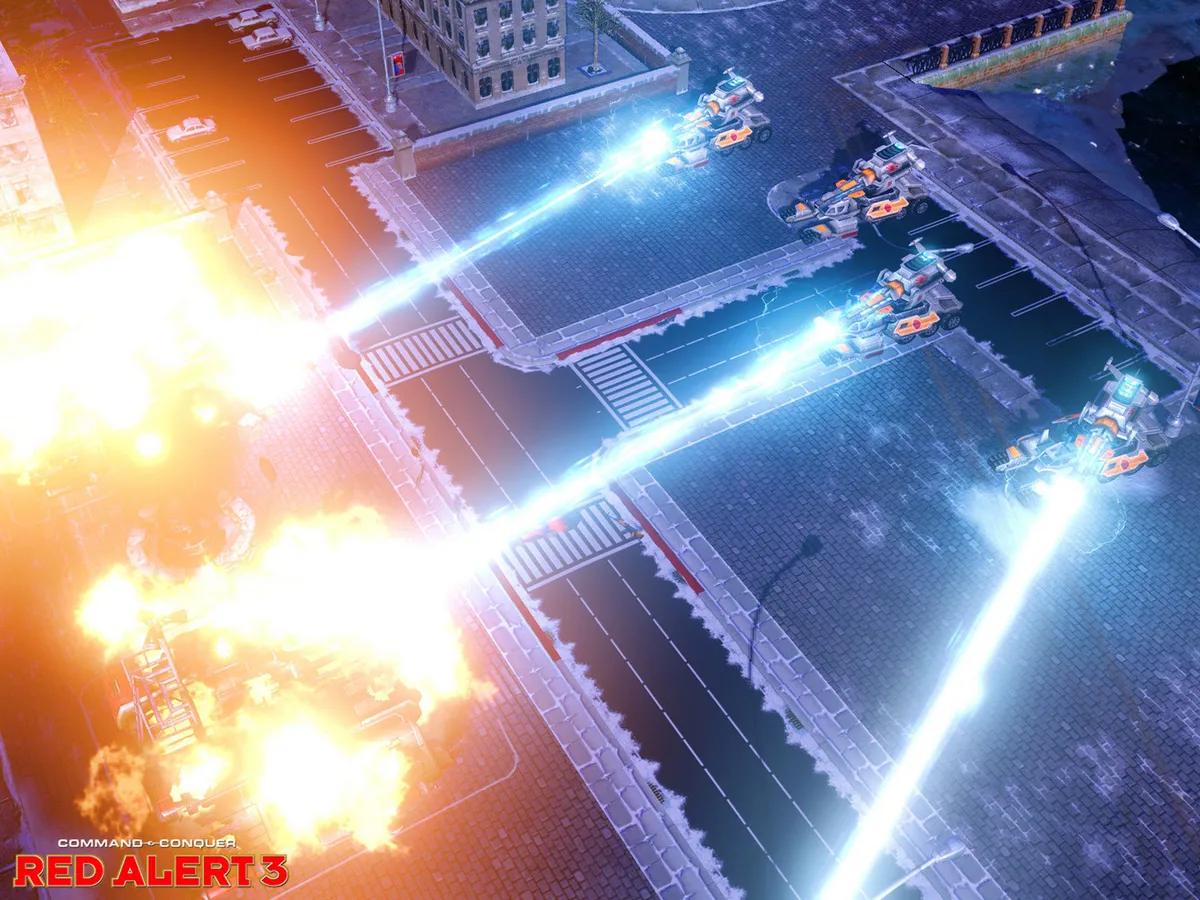
The visual and mechanical identity of Red Alert 3 comes from the collision of alternate-history science fiction and intentional excess. The Empire of the Rising Sun is described through anime, science-fiction, martial arts and robot-culture influences, and its transforming units make that identity legible on the battlefield. At the same time, the game retains familiar Red Alert units and tropes, including Tesla technology, Attack Dogs, Tanya and armored bears. The result is a strategy game that mixes recognizable real-time strategy structure with a theatrical unit roster, and it uses the naval layer as the place where those factions collide most directly.
Edition and Access Notes
This profile is based on the 2009 Steam entry for Command & Conquer: Red Alert 3, listed for Windows and associated with EA Los Angeles as developer and Electronic Arts as publisher. The release year here should be scoped to that Steam listing rather than treated as a complete release history for every edition or platform. The official store description also references Steam Workshop support for user maps, which is the only workshop detail supported by the available source.
Scroll sideways to see the full table →
| Field | Value |
|---|---|
| Title | Command & Conquer™ Red Alert™ 3 |
| Release year (Steam entry) | 2009 |
| Platform | Windows |
| Developer | EA Los Angeles |
| Publisher | Electronic Arts |
| Genres | Action, Strategy |
Scroll sideways to see the full table →
| Faction | Supported design notes |
|---|---|
| Soviets | Part of the three-way struggle; associated with returning Red Alert units and technologies such as Tesla coils and Armored War Bears. |
| Allies | Face technological rivalry against the Empire of the Rising Sun; associated with units such as Sonic Dolphins, Attack Dogs and Tanya. |
| Empire of the Rising Sun | Described as a technological terror with anime, science-fiction, martial arts and robot-culture influences; units can transform and specialize in naval warfare. |
Sources & further reading.
- Command & Conquer™ Red Alert™ 3 — official game profile Retrieved Oct 10, 2026
First published .