 THE GAME ARCHIVE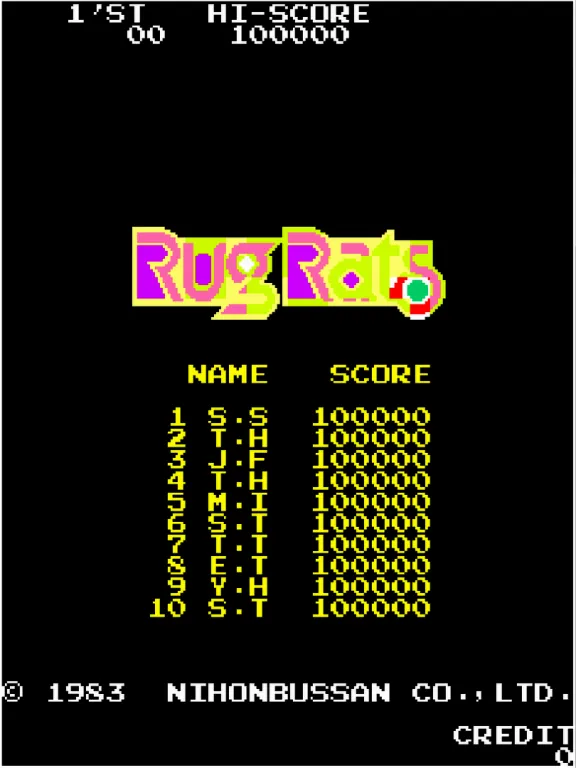
Becoming KOOMIL the Vacuum Cleaner
In Rug Rats, the 1982 arcade action game from publisher Nichibutsu, the player does not control a person at all. The character under the player's direction is KOOMIL, a vacuum cleaner. That single fact shapes everything the cabinet asks of you: the screen role is a cleaning appliance moving through a space occupied by germs, and the central task is defeating those germs because they get in the way of cleaning. There is no separate avatar to switch into and no second character layered over the first. From the moment play begins, the vacuum cleaner is the actor, and the germs are the opposition standing between it and a finished job.
Becoming KOOMIL also fixes the relationship between the player and the germs. The documented rules state that firing the soap stuns a germ, and only then can the vacuum cleaner inhale it; the stun is the condition that makes the inhale succeed. The mat is a further part of the same routine, since getting all of the germs involved in its rotation produces a high score. So the role of the vacuum cleaner is not simply to sweep: it fires soap, waits for the stun, inhales, and works the mat to convert a full set of germs into points.
Soap, Stun, Inhale: The Core Attack Loop
The attack loop in Rug Rats runs on a fixed two-step sequence. KOOMIL fires soap, and that soap stuns a germ; the stunned germ can then be inhaled by the vacuum cleaner. Neither action works alone. Firing soap at a germ that is not yet hit does nothing lasting, and inhaling a germ that has not been stunned fails, because the stun is the condition that makes the inhale succeed. So play alternates between the soap shot and the suction action, and each germ must be hit by soap before the vacuum cleaner can take it in.
The germs themselves are the only documented opposition, and defeating them is the stated objective: they are what gets in the way of cleaning. The mat adds a second condition to the same routine. If all of the germs are involved in the rotation of the mat, the result is a high score. That means the loop is not only soap, stun, and inhale one germ at a time; the player also has to route the germs into the mat's rotation so the full set is caught up in it, converting the whole group into points.
Mastering the Mat Rotation for High Scores
The mat is not a passive floor covering in this arcade game; it rotates, and its motion is the mechanism behind the highest possible reward. According to the documented rules, if you can get all of the germs involved in the rotation of the mat, you will get a high score. That means the mat's spin must catch every germ on screen, not just a single target. The task is to herd or funnel the germs into the mat's rotation so the entire group is engaged at once. The high score is therefore not earned by simply inhaling each stunned germ one after another, but by arranging for all of them to be simultaneously caught up in the mat's turning motion. The game's objective ties directly to this condition: defeating the germs that get in the way of cleaning leads to high scores only when the mat rotation sweeps up the full set.
The documented high-score condition changes how the basic attack loop is applied. Firing soap stuns a germ, and only a stunned germ can be inhaled by the vacuum cleaner; that two-step sequence remains the way to remove each germ. But to achieve the high score, the player must go further and involve all of the germs in the rotation of the mat. That means the routine cannot end with a single inhalation. Instead, the player must keep germs in play long enough to route them into the mat's rotation, then ensure the whole group is caught in it. The mat rotation and the soap-stun-inhale loop are not separate systems; they interact because the full set of germs must be present and engaged with the mat at the same time to trigger the high score.
A 1982 Nichibutsu Arcade Action Game
Rug Rats arrived in 1982 as an arcade action game from the publisher Nichibutsu, and its catalog entry places it squarely in the arcade platform family with an action genre label. That classification matters for how the cabinet presents its single documented conflict. The player directs KOOMIL, a vacuum cleaner, against germs that obstruct cleaning, so the opposition is defined by its interference with the job rather than by any human rival. Every documented mechanic feeds that confrontation, keeping the action game identity grounded in the appliance-versus-germ framing rather than in a broader adventure structure.
Inside that action framework, the documented rules describe two mechanics that must be sequenced together. Firing soap stuns a germ, and only a stunned germ can be inhaled by the vacuum cleaner, so neither the soap shot nor the suction succeeds in isolation. The mat adds a second layer: its rotation, when it involves all of the germs, produces a high score. The loop therefore combines the soap-stun-inhale sequence with arranging the whole germ group into the mat's turning motion, and the objective of defeating the germs that get in the way of cleaning runs through both.
Sources & further reading.
- Rug Rats — licensed publisher game documentation Retrieved Oct 16, 2026
First published .