 THE GAME ARCHIVE
Star Wars: The Force Unleashed II continues the story of Starkiller, the fugitive apprentice of Darth Vader, in the period between Star Wars: Episode III and Episode IV. According to the game's official store description, Vader is no longer trying to train his apprentice as a ruthless assassin; instead, he is attempting to clone his former apprentice to create the Ultimate Sith warrior. The chase that follows is simple but effective as a setup: Starkiller is in pursuit of Juno Eclipse, and Darth Vader is hunting Starkiller. The game's on-page metadata identifies it as a 2010 Windows release developed by Aspyr Studios, with LucasArts, Lucasfilm and Disney listed as publishers and the genre marked simply as Action.
The Premise: Clone, Pursuit, Identity
The framing is notable because it puts identity at the center of the sequel. Starkiller's journey is described as a search to discover his own identity and reunite with Juno Eclipse. The clone premise sharpens that: if Vader can grow another apprentice for the same purpose, then what makes the returning Starkiller the real one? The official description leans into this as story motivation rather than providing branching narrative or player-choice evidence, so it should be read as the premise for a linear action campaign and not as freedom to steer outcomes.
The Core Loop: Cut a Swath, Then Cut a Wider Swath
The store descriptor for the combat loop is unusually direct: Starkiller cuts a swath through deadly new enemies across worlds drawn from the Star Wars films. With all-new devastating Force powers and the ability to dual-wield lightsabers, the play loop is Force-assisted melee offense, supported by an improved targeting system and combos. The setting rolls through multiple worlds from the films, which suggests a sequence of distinct combat arenas rather than a single continuous location, but the official text does not provide a level list, route, mission order or boss roster, so specific encounter structures should not be assumed.
The description also credits skillfully managed combat techniques as part of the loop — using the right tool at the right moment to defeat brand-new enemies before reaching boss battles. That implies the player is expected to read enemy types and switch between Force abilities and saber combos, rather than mashing a single attack. The supported evidence stops at that intent; the source does not describe health systems, resource drains, cooldowns or difficulty settings, so no judgement about how demanding the combat actually is can be made here.
Force Powers, Fury and Mind Trick
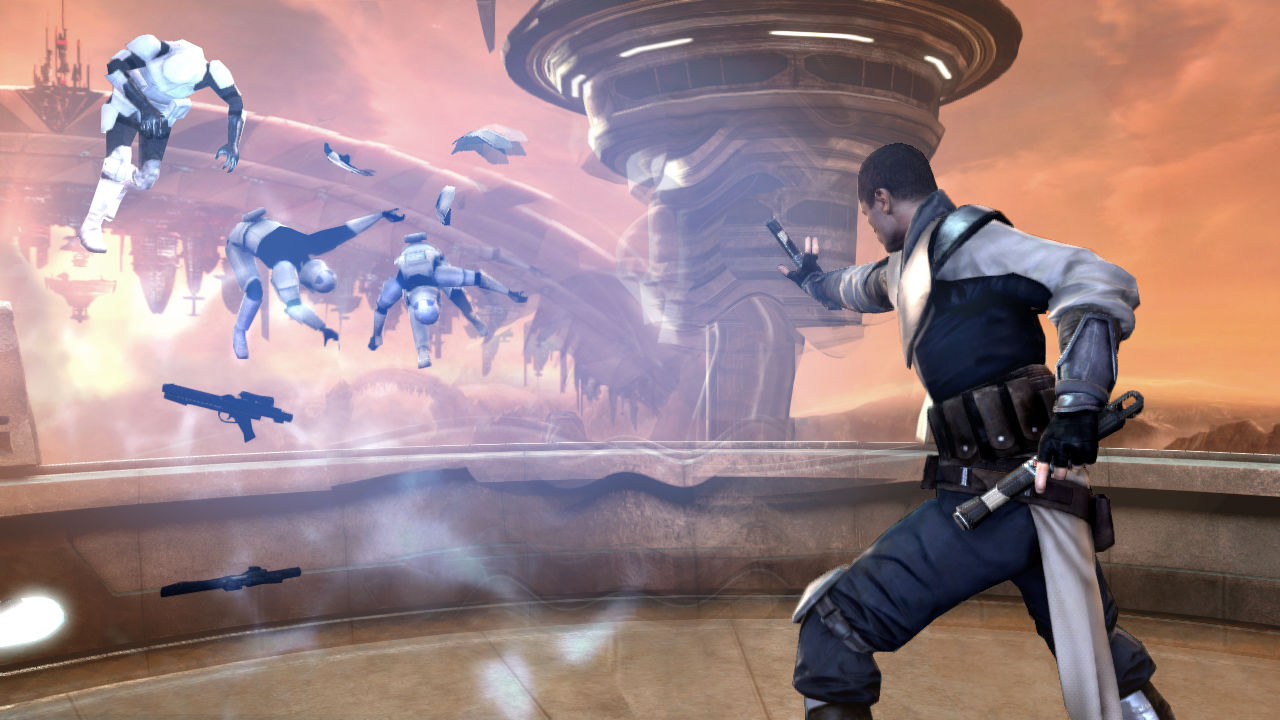
The headline addition is Force Fury. When triggered, Starkiller's attacks and Force powers are exponentially increased. The official description frames this as the moment the player reaches the character's true power, which in practical terms means Fury functions as a temporary power spike layered on top of the normal Force kit. New powers are also described as arriving with improved controls and more precision.
The clearest example of a new ability is Mind Trick, described as deceptive and as turning enemies against their allies. That changes the tactical texture of combat: instead of only killing each enemy directly, the player can recruit one to thin out a group. Combined with the improved targeting system, the supported picture is a combat sandbox where Force powers are aimed with more deliberate precision — hitting the enemy or puzzle object the player actually intends to hit.
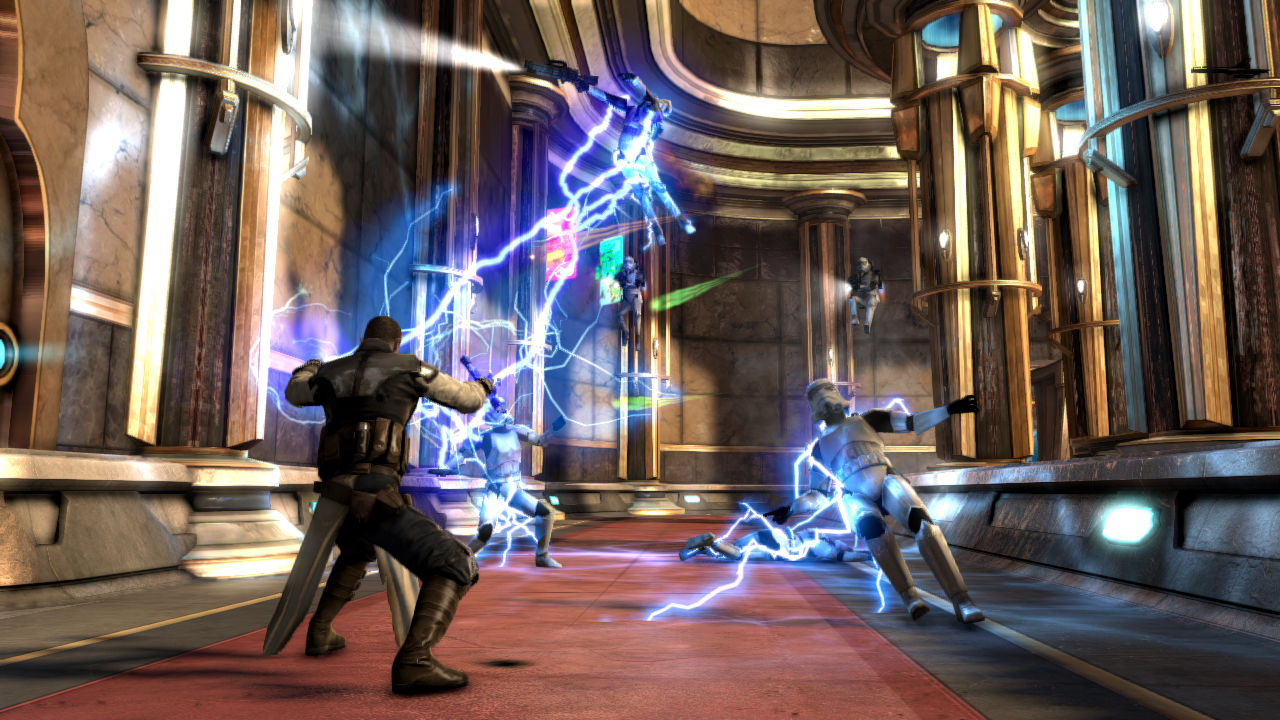
Dual-wielding lightsabers and all-new combo attacks expand the melee side of the loop, while greater interaction with puzzles and the environment extends the Force kit beyond combat. The description couples that environmental use to Digital Molecular Matter (DMM) from Pixelux Entertainment, along with the Havok Physics system and euphoria from Natural Motion Ltd. Those middleware names describe the underlying simulation and animation technologies — they do not, on their own, establish that every object is entirely destructible or that reactions play out consistently in every encounter, and the description should not be over-read that way.
Progression, Customization and Challenge Levels
Customization is expanded with new costumes and power-enhancing lightsaber crystals. The exact wording matters: the crystals are described as power-enhancing, which implies a stat or ability effect tied to the saber rather than purely cosmetic decoration, while the costumes read as broader appearance options. The source does not detail how many crystals exist, the size of their bonuses, or whether costumes carry gameplay effects, so the safe reading is that the sequel offers more personalization than its predecessor without claiming a specific build-crafting depth.
Separate from the main campaign, the description lists all-new challenge levels designed to test and hone the player's fighting and Force power skills. Those read as a skill-focused mode alongside the story, giving the combat systems a second context beyond campaign fights and boss battles. The source does not confirm how that progression is structured, so treat this as an additional mode rather than a claim about unlock chains, scoring rules or replay incentives.
The story campaign is framed as building toward boss battles, with the combat techniques and Force powers feeding into those encounters. That gives the loop a recognizable escalation pattern: learn enemy behaviors and Force applications in normal fights, then apply them against a named threat. The store text does not name the bosses or describe their mechanics, so evaluation of those encounters must wait for first-hand testing.
Source-Backed Starting Guidance
Given only the official store description, the most reasonable guidance is behavioral rather than prescriptive: expect a story-driven action campaign that moves through multiple film-linked worlds, expect Force Fury to serve as a burst of increased attack and Force power, and expect Mind Trick and the improved targeting system to reward deliberate aim and enemy manipulation. The description points to dual lightsabers and combo attacks as the melee backbone and to crystals and costumes as the customization layer. The source does not describe button mappings, movement rules, currency or save systems, so no control or economy guide can honestly be written from it.
Visual and System Character
The distinctive character of the sequel, as the store text presents it, comes from three interacting layers: the exaggerated Force kit, the physical simulation, and the environmental reaction. Over-the-top Force powers are stated plainly, DMM and Havok are named as the systems behind life-like interactions, and puzzles and the environment can be affected by Force use. Taken together, the intended feel is less about realistic combat than about playful, physical cause and effect — yanking, breaking, slamming and improvising with the world as the Force improves.
Editions, Ports and Access
This article is scoped to the Steam entry for the Windows release and does not attempt to reconstruct the original multi-platform release history or later reissues. The catalog metadata attached to this entry lists Aspyr Studios as developer, with LucasArts, Lucasfilm and Disney as publishers, and Windows as the platform. Anyone trying to line up this version against other releases should treat the metadata as tied to this page, not as a universal history of the game.
Where the Source Ends
The official description gives a clear enough skeleton for the sequel: a clone-chase story, a Force-heavy combat loop, Fury and Mind Trick as headline abilities, dual lightsabers, sim-backed interactions with puzzles and environments, expanded customization, and challenge levels as a skill outlet. It is not enough to map the game's controls, level order, resource economy, save systems or objectives. Rather than pad those gaps with assumptions, this feature stops at what the cited store text establishes.
Scroll sideways to see the full table →
| Field | Value |
|---|---|
| Game title | STAR WARS™: The Force Unleashed™ II |
| Release year (this Steam entry) | 2010 |
| Platform | Windows |
| Developer | Aspyr Studios |
| Publishers | LucasArts, Lucasfilm, Disney |
| Genre | Action |
Scroll sideways to see the full table →
| Documented feature | What the source states |
|---|---|
| Force Fury | Temporarily increases attacks and Force powers |
| Mind Trick | Turns enemies against their allies |
| Improved targeting | More precise Force power use; better interaction with puzzles and the environment |
| Dual lightsabers | Wield two lightsabers with all-new combo attacks |
| Simulation systems | Digital Molecular Matter (Pixelux), Havok Physics, euphoria (Natural Motion) |
| Customization | Expanded costumes and power-enhancing lightsaber crystals |
| Challenge levels | Separate tests of fighting and Force power skill |
Sources & further reading.
- STAR WARS™: The Force Unleashed™ II — official game profileRetrieved Oct 11, 2026
First published .