 THE GAME ARCHIVE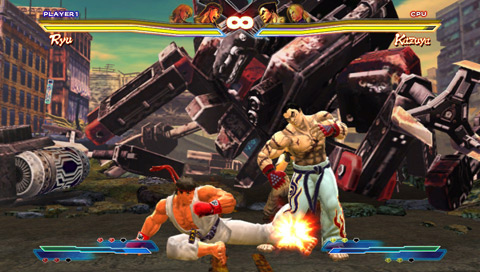
The Vita Edition and Its Player Counts
Street Fighter X Tekken was released for PlayStation Vita on October 23, 2012, and the official product information lists the hardware as PlayStation®Vita. Under the Players entry, the standard configuration is one player, which covers the single-player fighting setup. The fighting game genre listing applies to this Vita version, and the ESRB rating recorded alongside it is TEEN. These details come from the Product Information block on the official site, which also points to the Vita-specific URL under the Street Fighter X Tekken official site. The platform listing is the only supported hardware entry for this release in the documentation.
Beyond the one-player setup, the same Players line documents two additional multiplayer configurations. Ad Hoc Mode supports 2-4 Players, and Online Play supports 2-7 Players. Both ranges sit beside the base "1 Player" figure in the Product Information listing, so the mode you pick determines how many participants can join. The ad hoc option is the local wireless count, while the online option is the networked count, and each has its own ceiling. Nothing else in the supplied documentation expands these counts or describes alternate rules for them.
Punch, Kick, and the Direction-Plus-Button Special
Pressing the punch and kick buttons executes Normal Moves, and which move appears depends on your character's stance and the button you press. Special Moves are performed by combining direction key and button commands. Two documented properties distinguish them from normals: Special Moves inflict some damage even when your opponent is blocking, and you can quickly execute a Special Move by inputting its command while your character is performing certain Normal Moves. In the command list, special moves marked with a symbol are called EX Moves, which are Special Moves with stronger power and performance.
To execute an EX Move, simultaneously press two punch or kick buttons, depending on the move, when inputting a Special Move; this consumes one block of the Special Gauge. Blocking is separate: pressing the direction key away from your opponent blocks attacks, divided into upper standing and lower crouching blocks, and you must use the correct block to fend off the incoming attack. Characters cannot block while in the air. These rules sit alongside the command-list notation, where marked specials are EX Moves with stronger power and performance.
Blocking, Cross Cancel, and Life After a Knockdown
Blocking begins by pressing the direction key away from your opponent. The game divides blocks into upper (standing) and lower (crouching) blocks, so you must use the correct block to fend off an attack, and characters cannot block while in the air. After a successful block, Cross Cancel lets you input a command to execute a counterattack. These will move your character or attack the opponent, depending on the character, and Cross Cancel consumes one block of the Cross Gauge. Dan's Notes mark onscreen COUNTER and REVERSAL text, which appear when you counter an opponent's attack with your own or perform a well-timed Special Move after taking a hit or blocking.
After your character falls from a blow, Knockdown Recovery is available by pressing two buttons simultaneously or pressing the directional key down just before you hit the ground. Success decreases your time on the ground and lets you prepare for the next attack, but some attacks, such as Throws, will not allow knockdown recovery. Instead, Rolling Forward uses the directional key toward your opponent while you are down. You roll forward and are invincible for a moment, making it possible to avoid an incoming attack and reposition before standing.
Getting In Close: Dashing, Throws, and Tag Switching
Dashing begins with a double directional press: quickly press the directional key twice either toward or away from your opponent. The toward dash closes distance; the away dash escapes attacks. Throws use Light Punch and Light Kick simultaneously while standing next to the opponent. The directional key changes the Throw's direction. To escape, execute a Throw command just as you are being thrown. Some characters can throw opponents in mid-air, and Air Throws cannot be dodged, setting a clear limit on evasive options.
Tag switching is performed by pressing Medium Punch and Medium Kick simultaneously. This switches partners and lets the reserve character recover some damage. You can also switch partners during an attack by consuming one block of the Cross Gauge. In two-player co-op, the reserve player can force a switch with the same Medium Punch and Medium Kick input, consuming one block of the Cross Gauge. These rules tie positioning, throw timing, and gauge spending into three distinct close-range actions.
Launchers and the Light-Medium-Heavy Cross Rush
The Launcher is executed by pressing Heavy Punch and Heavy Kick simultaneously while on the ground. During a Launcher, you are impervious to lower attacks from your opponent. A Cross Rush is formed by pressing L-M-H, L-H, or M-H, then adding one more Heavy attack to activate a Launcher. This sequence combines attacks of light, medium, and heavy punches or kicks. The Launcher itself serves both offensive and defensive purposes: it throws the opponent and then changes characters.
Super Arts consume two blocks of the Special Gauge. Their commands differ per character, and a Normal Move can be canceled into a Super Art. Special Moves with a mark in the command list can be strengthened over three levels—Special Move, EX Special Move, Super Arts—by holding the Special Move button. Quick Combos, set up under Customization, require at least one block of the Cross Gauge to launch.
Gauge Spenders and the Pandora Gamble
Cross Assault and Cross Arts both consume all three blocks of the Cross Gauge, but they differ in who fights and how control is divided. Cross Assault is a special attack in which you call your partner to fight alongside you; during solo play, the CPU will control the summoned character, while when playing with a partner, the other player will have control. Cross Arts are powerful combo attacks you can activate by cooperating with your partner, and if the Cross Art lands, your partner will automatically be switched in.
Pandora is a last-ditch attack you can use once your vitality falls below 25%. Using a Pandora will wipe out your current character, but will have effects on your partner; tag actions become unavailable once a Pandora has been activated. Cross Arts can also be used to completely wipe out your opponent's recoverable damage, unlike most attacks, which inflict recoverable damage. Both Cross Assault and Cross Arts require all three blocks of the Cross Gauge, meaning the same meter funds different three-block spends.
Sources & further reading.
- Street Fighter X Tekken — official gameplay documentation Retrieved Oct 15, 2026
- Street Fighter X Tekken — official gameplay documentation Retrieved Oct 15, 2026
- Street Fighter X Tekken — official gameplay documentation Retrieved Oct 15, 2026
First published .