 THE GAME ARCHIVE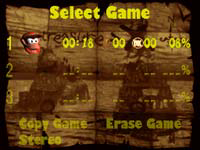
Stage Clear & Life System Basics
In the action screens, you control Diddy and Dixie directly. The manual states that jumping onto the goal target clears the stage. This is the basic completion rule for every stage, and it applies in both solo play and when two characters are present. The goal target is the specific object you need to land on, not simply reaching the end of the area or defeating all enemies. Once you jump on it, the stage is considered cleared, and the game moves forward.
When two characters are active, hitting an enemy removes the leading character, not a life. However, if you fall into a hole or hit an enemy while only one character remains, the remaining life count decreases by one. The manual specifies that the life count reaches zero, the game ends in a game over. This means losing the second character is a warning, while losing the last character while alone costs a life. Manage both characters carefully to avoid the game over condition.
Game Modes: Solo and Two-Player Options
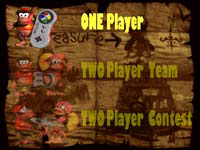
After pressing Start on the title screen, you reach the file-selection screen. Choose a file and confirm, and the game-mode selection screen appears. It lists "ONE Player," "TWO Player Team," and "TWO Player Contest." The same screen also offers "Copy Game" to copy data and "Erase Game" to delete data, and the manual warns that once data is erased it cannot be returned. Two-player team is cooperative, with 1P controlling Diddy and 2P controlling Dixie, while two-player contest has the players alternate play and compete over how many stages they clear.
The mode list ties each option to a distinct structure: one-player mode for a single player, two-player team where 1P is Diddy and 2P is Dixie and both cooperate, and two-player contest where the two players play alternately and compete over cleared stage counts. File management sits on the same selection flow: "Copy Game" copies data and "Erase Game" deletes it, with the caution that erased data cannot be restored. The screen is reached by selecting a file with the d-pad and confirming with a button from file selection.
Controlling Diddy and Dixie
The basic movement controls are identical for Diddy and Dixie: walking or crouching is done with the same button; jumping and swimming share another; and running, holding, and throwing are mapped to a third button. This button assignment lets either Kong traverse stages, crouch under obstacles, leap across gaps, swim through water sections, and pick up or carry objects. Dixie also has a unique ability: while jumping, holding the run button makes her descend slowly, allowing her to cross wider gaps or land precisely. These core mechanics ensure that switching between the two characters does not require relearning basic navigation.
When both characters are present, pressing the jump button lets the active Kong lift the partner, and the run button throws them; throwing upward while holding up, or placing them down while holding down, are also possible. The thrown partner can attack enemies or reach areas otherwise inaccessible. To mount an Animal Friend, jump with the jump button; dismount by pressing the dismount button. Enguarde can be mounted simply by approaching it. Additionally, pressing the run button triggers Diddy’s rolling attack or Dixie’s pony tail spin to defeat enemies, though some enemies cannot be defeated this way.
Earning Extra Lives: Bananas and KONG Letters
On action screens, a running banana counter sits beside the remaining life count, and the manual's item list states that gathering 100 bananas raises the remaining life count by one. Bananas therefore function as a per-stage stockpile that the game tracks continuously, displayed on screen as the number of bananas taken. A single banana counts as one, but the loose bunches placed around stages are worth 10 bananas apiece, so ten such bunches complete the 100 needed for the next extra life. Because this counter appears during play, you can judge how close you are to the threshold without leaving the stage.
The letter panels work on a different rule: one stage holds four panels marked K, O, N and G, and collecting all four within that same stage adds one to the remaining life count. Unlike bananas, which accumulate from any source and use a fixed 100-item threshold, the letter method demands that a single stage yield every one of the four panels before any life is awarded; the manual's evidence does not describe letters carrying across stages. Both rewards feed the same remaining life count shown on the action screen, so bananas and KONG panels raise lives through separate documented conditions.
Coins and Animal Containers
Animal Containers are breakable objects: smash one and the Animal Friend pictured on the box emerges, and you can ride it. The manual lists five such friends with distinct actions. Rambi the rhino dashes by holding the dash button and pressing left or right, jumps with the jump button, and performs a super dash by holding the super button and releasing it. Enguarde the swordfish dashes with the same left/right plus dash input and super dashes by holding and releasing the super button, but has no listed jump. Squawks the parrot spits eggs when you press the dash button and flaps with the jump button. Rattly the snake jumps with the jump button and super jumps by holding and releasing the super button. Squitter the spider attacks by pressing the dash button to shoot webs. Additionally, jumping into an Animal Barrel transforms you into the animal drawn on it.
Coins serve separate roles. Banana Coins are used when listening to advice. Crum Coins are hidden in bonus stages; collecting them lets you go to the Lost World. Cranky's DK Coin appears once per stage. Bananas also interact with the life system: collecting 100 bananas increases the remaining life count by one, and each bunch counts as 10 bananas. Life balloons add to the remaining life count, with the amount varying by color. Letter panels work per stage: if you collect all four panels spelling K, O, N, G within a single stage, your remaining life count increases by one. The DK Barrel appears when either Diddy or Dixie is missing; breaking it brings that character back.
Barrels: Explosives, Invincibility, and Checkpoints
TNT barrels are thrown, and they explode when they hit an enemy or an obstacle. Continue barrels, when broken, let the player retry from that spot after a miss, making them checkpoints. Invincibility barrels grant temporary invincibility when broken. The manual also describes other barrels: barrel cannons launch the player far when jumped into, bonus barrels take the player to a bonus stage when jumped into, and Diddy & Dixie barrels are cannons usable only by the character drawn on them.
Breaking a continue barrel sets a restart point. If the player then misses, that spot becomes the retry location. Breaking an invincibility barrel makes the player invincible for a set time. Throwing a TNT barrel causes an explosion upon contact with an enemy or obstacle. Jumping into a barrel cannon fires the player from the barrel and moves them a long distance. Jumping into a bonus barrel sends the player to a bonus stage. Diddy & Dixie barrels are cannons that only the character drawn on the barrel can use.
Sources & further reading.
- スーパードンキーコング2 ディクシー&ディディ― — official game manual Retrieved Oct 15, 2026
First published .