 THE GAME ARCHIVE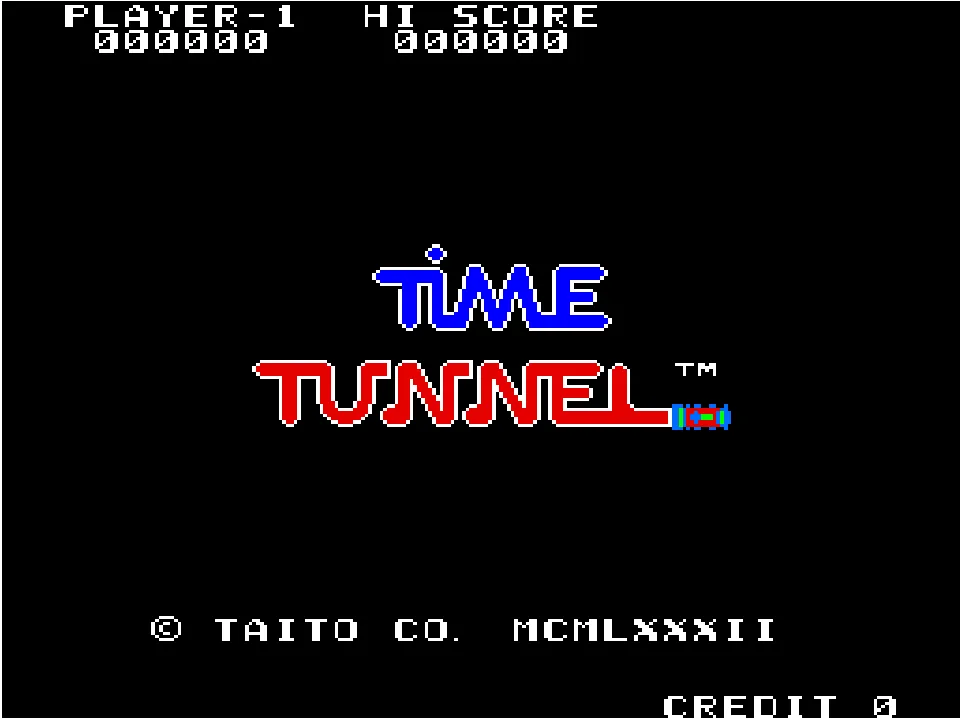
TIME TUNNEL: Taito's 1982 Arcade Train-Routing Game
TIME TUNNEL is an action game released by TAITO in 1982 on arcade platforms. The premise is deliberately unusual: you do not steer the locomotive directly. Instead, you change the railway points to maneuver the train around the track. On each stage you must connect train carriages, pick up passengers, and transport them to a space station, all while avoiding obstacles. Only after you pass the stage objectives does the train proceed through the TIME TUNNEL to the next stage.
What makes the game distinctive is that single indirect-control verb. The publisher's description of the task is a sequence of steps — skillfully change the railway points to maneuver the train, connect train carriages, pick up passengers, transport them to the space station, and avoid obstacles along the way — rather than a set of steering inputs. The tone of the original text treats the space-station destination as a genuine surprise, and the whole run works as a routing problem in which the player manages the track network instead of driving the vehicle.
The Core Loop: Points, Carriages, Passengers, and Obstacles
Each stage begins a run that has to be completed before the train can pass through the TIME TUNNEL. The documented interaction available to the player is changing the railway points so the train is maneuvered along chosen paths. That single control layer drives everything else: the same switches that send the train toward a carriage also determine whether it reaches a passenger pickup or clears an obstacle. Because the routing is controlled only through the points, the meaningful decision at each junction is which path the train should take next.
Connecting train carriages and picking up passengers are the two collection tasks the game documents. The passengers become the payload that has to reach the space station, and obstacle avoidance is stated as a constraint running through the whole activity. The core loop therefore asks you to route the train through the network so that the collection and delivery tasks are satisfied without a collision spoiling the run.
The delivery step closes the loop: passengers must be transported to the space station, and once the stage objectives are passed the train goes through the TIME TUNNEL. The tunnel is the transition between stages rather than a separate mode. In the publisher's framing, the station and the tunnel are the two endpoints of a successful run, with point-switching and obstacle avoidance filling the space between them.
How the Mechanics Interlock
The documented mechanics are chained: the carriage-connection task gives the train carriages to link, the passenger task gives it people to carry, the point changes determine where the train actually travels, and obstacle avoidance constrains every choice. Because just one verb governs the whole system, every switch serves several purposes at once and the player has to weigh the pickup, the carriage, and the hazard against the same junction.
The skill the game asks for is reading the track and choosing where the train should go, since the player's influence is limited to the railway points. The published description calls for changing those points skillfully to maneuver the train, which makes the choice of path, rather than any direct movement input, the thing the player actually controls. Obstacles add a second consideration to each of those choices: a path that serves the collection tasks still has to be one the train can travel without hitting anything.
The space-station delivery is the goal that ties the loop together. Carriages and passengers are not separate mini-games; they are parts of a single transport job whose endpoint is the station, and the stage objectives have to be passed before the TIME TUNNEL opens. That is why obstacle avoidance matters inside the same system: the train carries the passengers the run is meant to deliver, and a collision works against the job the player is trying to complete.
Stage Progression and the Time Tunnel
Progression in TIME TUNNEL is documented as a sequence of stages. Each stage presents the same basic contract: pass the objectives, then pass through the TIME TUNNEL. The tunnel therefore sits between stages, appearing after the player has connected carriages, picked up passengers, and transported them to the space station. The supplied material describes no branching or alternate routes, so the documented progression runs stage by stage through the tunnel.
That structure gives the routing decisions cumulative weight. A stage is only cleared when its objectives are satisfied, so the player cannot skip the carriage connection or the delivery to rush the tunnel. Each stage requires the documented sequence — change the points to maneuver the train, connect carriages, pick up passengers, avoid obstacles, transport the passengers to the station — before the tunnel opens. How difficulty scales from one stage to the next is not described in the supplied material.
The Modern Arcade Archives Edition
TIME TUNNEL appears in the Arcade Archives series, which reproduces classic arcade games for modern platforms. The series documentation describes customization options — adjusting the difficulty level and, depending on the title, recreating the look of CRT displays — along with online rankings that let players compete for high scores with players around the world. These are features of the modern licensed release, not of the original 1982 arcade cabinet.
For players approaching the reissue, the difficulty setting is the main documented lever available before play, since the note about CRT visuals is a display preference rather than a change to how the game is played. Online rankings frame a run as a comparable performance, and because the game advances stage by stage through the same routing loop, a score is a measure of how far a player carried the carriage and passenger tasks. How the difficulty setting changes stage layouts or obstacle behavior is not described in the supplied material.
Source-Backed Starting Guidance
The documented mechanics suggest treating each stage as a routing plan. Since the player changes the railway points to maneuver the train, the core skill is deciding the path the train should take through the track so that the carriage and passenger tasks are served and obstacles are avoided. A route that accomplishes everything in one pass is the ideal, but the published description makes clear that all of the tasks — collection, delivery, and obstacle avoidance — belong to the same run, so each path choice has to be weighed against the others.
It also helps to prioritize. Connecting carriages and picking up passengers are both part of the documented stage objectives, so neither can be skipped. The passengers must then be transported to the space station, and only once the objectives are passed does the train go through the TIME TUNNEL to the next stage. Keeping that order in mind — connect, collect, deliver, then advance — is the clearest guidance the source supports.
Design Characteristics and Documented Limits
The game's most distinctive detail is the combination of a railway setting with a space-station destination. The player is changing railway points to maneuver a train, yet the passengers are bound for a space station, and the stage ends when the train passes through the TIME TUNNEL. That juxtaposition frames the routing puzzle as a transport job with an unexpected endpoint rather than a simulation of railway operation. The Action genre label fits the game's documented description.
What the source does not describe matters for setting expectations. It documents no specific obstacle types, no scoring formula, no life or continue system, and no detailed control scheme beyond point manipulation. The genre is listed as Action and the platform as Arcade, but those labels do not supply the missing specifics. Readers should treat the routing loop described here as the confirmed core and recognize that finer details of stage layout, scoring, and difficulty scaling remain outside the documented record.
Sources & further reading.
- TIME TUNNEL — licensed publisher game documentation Retrieved Oct 16, 2026
First published .