 THE GAME ARCHIVE
US and THEM makes territorial expansion an intelligence operation rather than a military invasion. You position spies, assassins and experts, gather information and destabilize rival countries until their governments change allegiance. Money, oil and technology support that struggle, while covert operations include sabotage, bribes, revolutions, arrests and interrogations. The distinctive challenge is coordinating political pressure with agents whose locations and attributes are often hidden: acquiring information is part of building the opportunity to act, not simply background preparation for a conventional war.
Population Support and Government Control
A new campaign begins with a Communist or Capitalist choice. You command one bloc's secret services against the other, with the Soviet Union and United States leading their respective sides. Ideology and difficulty are separate decisions: the manual describes the Communist campaign as generally harder, but also offers Easy, Normal and Hard settings. For a first campaign, that distinction matters more than assuming the two sides are equivalent starts with different symbols; the manual also recommends completing the tutorial at least once.
Assimilation follows a sequence: influence a country's population toward your ideology, then change its government. Public sympathy and official allegiance are not interchangeable; a government can support one ideology while most inhabitants favor the other. Government allegiance determines which bloc receives the country's resources. Victory, meanwhile, requires world population support of 85 percent for Capitalists or 75 percent for Communists, who begin with about one third of the countries. Taking the opposing motherland offers an alternative victory even when only a handful of countries remain on your side.
Resources and Borders Apply Political Pressure
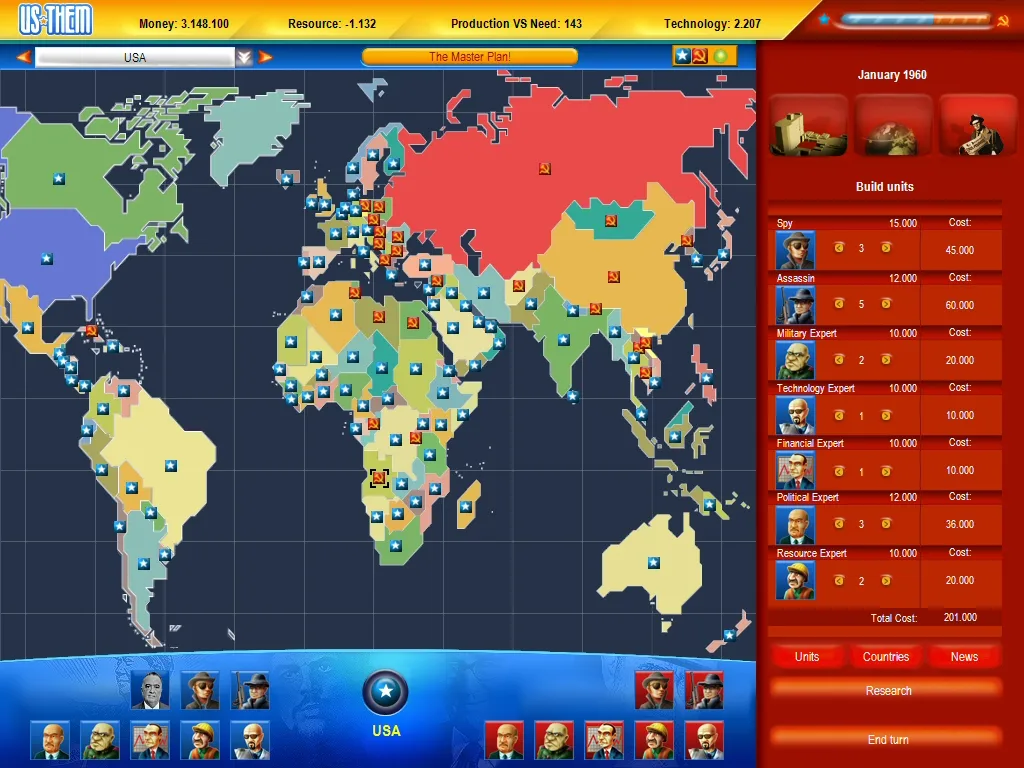
Energy connects economic management directly to ideological stability. Countries that consume more energy than they produce cover the gap from their bloc's total stocks. If those stocks become insufficient, the population starts drifting toward the opposition. A resource shortage is therefore more than an accounting problem: it can undermine the popular support your political operations seek to build. When weighing expansion, consider the shared stockpile as well as the prospect of another friendly government, because countries draw on that common reserve when local supply falls short.
Geography supplies another continuing pressure. Bordering countries with different governments influence each other, and strategic importance is the leading factor: the country with the higher value wins that interaction. Its results appear in the country panel, making that a useful place to examine a contested frontier. Conditions also affect personnel. The manual says units generally have better morale and loyalty in countries with high luxury levels. A posting thus has both a geopolitical context and working conditions, rather than being merely a location from which to launch operations.
Spies Gather Intelligence; Specialists Change Conditions
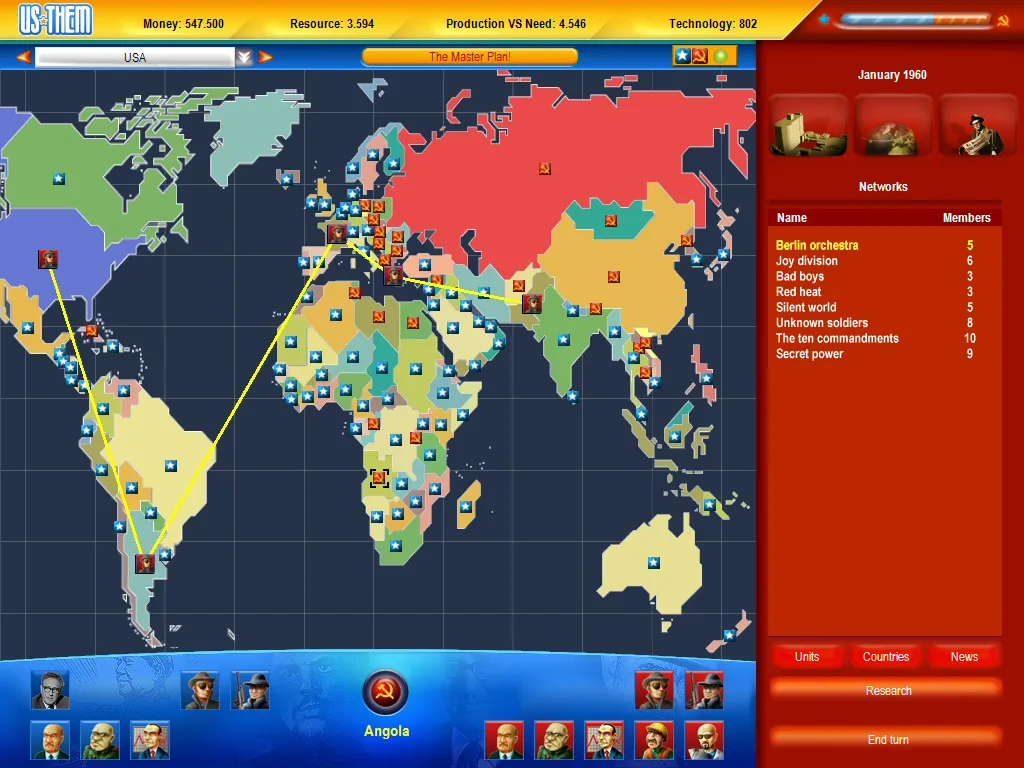
Initially, most detailed country information is available only for your own side. Enemy countries receive a broad evaluation on a five-point scale. Units abroad gradually reveal their host countries' characteristics, vaguely at first and more precisely over time. This knowledge has a practical purpose: the manual links precise calculation of an action's success probability to knowing the relevant country characteristics. Keeping agents in place can therefore improve the information behind a decision, rather than merely adding another operative to the map.
Spies create networks, reveal country information, arrest or bribe enemy units and expose undercover opponents. Specialists come in Financial, Military, Political, Resource and Technology categories. In enemy territory they sabotage their area of expertise; in friendly countries they act as production-enhancing experts. Political specialists are the exception, converting a percentage of the population toward their ideology on either side of the border. Deployment consequently involves choosing between improving friendly conditions and disrupting an opponent, while political work directly serves the population-conversion stage of expansion.
Network Size and the Cost of Restoring Secrecy
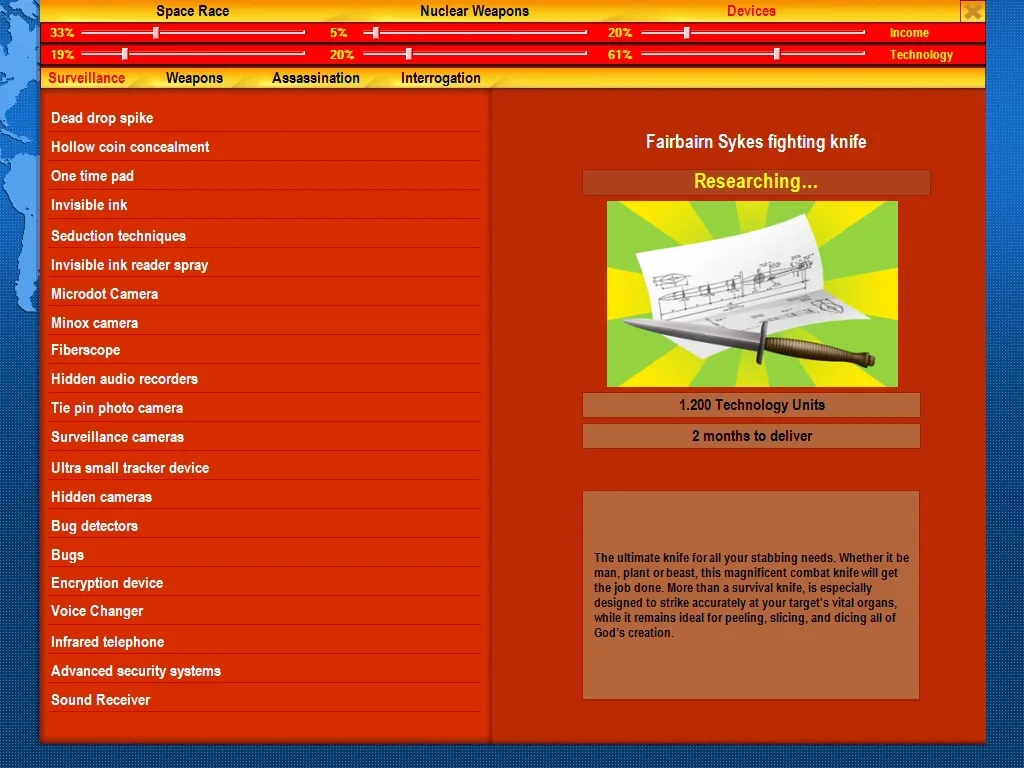
Networks improve unit efficiency, but growth brings exposure. Larger, more extensive organizations are easier to reveal and neutralize, and their effectiveness relative to membership declines. The manual consequently favors several smaller networks over one or two enormous ones. This is not a rule against expansion; it is a reason to distinguish greater collective efficiency from efficient use of each additional person. The Networks screen lists names and membership counts and lets you select a network to see it on the map, helping you review that distribution.
An exposed unit can regain invisibility by withdrawing from the map to the Force Pool for at least one turn. That escape has a cost: abilities depend on uninterrupted time in a country, and a unit cannot act before spending at least one turn there. Restoring secrecy therefore interrupts established work and requires time before action resumes after deployment. Treat withdrawal as a trade-off between concealment and continuity, not an immediate reset that leaves the agent's operational position unchanged.
Reinforcements, Experience and Risk
Building units is a forward-looking decision. The Build Units screen uses arrows beside each available type to set production, with arrivals delivered to the Force Pool at the beginning of the next turn. Existing agents also develop: performing an action increases experience regardless of success, and lower-probability actions award larger increases. Yet dangerous assignments can reduce loyalty if agents feel expendable. Failure can kill or arrest an operative, with arrest potentially exposing others. Faster experience gain must therefore be weighed against the survival and security of the wider force.
Sources & further reading.
- US and THEM — official game profileRetrieved Nov 14, 2026
- US and THEM — official game profile — publisher-supplied gameplay manualRetrieved Nov 14, 2026
First published .