 THE GAME ARCHIVE

Feeding the Blob: Jelly Beans as Transformation Currency
In A Boy and His Blob, the boy's central interaction with his companion is feeding the blob jelly beans. Doing so transforms the creature into objects, and those objects are the tools used to solve puzzles and escape danger. The jelly bean is therefore not a collectible curiosity but the action that drives each transformation, with the choice of bean determining what the blob becomes. The game frames this exchange as the heart of the boy-and-blob partnership, the bond through which the adventure proceeds.
The documentation treats jelly beans as the currency of transformation: each bean spent on the blob converts him into one of the useful objects the puzzles require. Because the transformation follows directly from the feeding, the boy's supply of beans sets the terms of each obstacle. Solving a puzzle or escaping danger depends on matching a bean to the object the situation calls for, so the mechanic pairs a simple feeding action with the practical outcome of a new form.
Fifteen Transformations: Caramel Cannon, Bubble Gum Bouncer and More
The blob's transformation set contains fifteen useful items, each reached by feeding him a jelly bean. The named examples split into new creations and returning classics, and the distinction helps map the lineup. The new additions are the Caramel Cannon and the Bubble Gum Bouncer; the classic beans include the Licorice Ladder, the Apple Jack and the Tangerine Trampoline. Each bean corresponds to one object, so the player is choosing among a fixed catalog of fifteen possible forms rather than a generic power-up.
The transformation rule is uniform across the catalog: feed a jelly bean, and the blob becomes an object that is meant to solve puzzles and escape danger. What changes between forms is the object itself, from a ladder to a trampoline to a cannon, while the feeding action stays the same. The practical consequence is that the player faces each obstacle by picking the bean whose object fits, and the fifteen-item roster defines the full range of answers available in the levels.
Puzzles and Peril: Putting Objects to Work
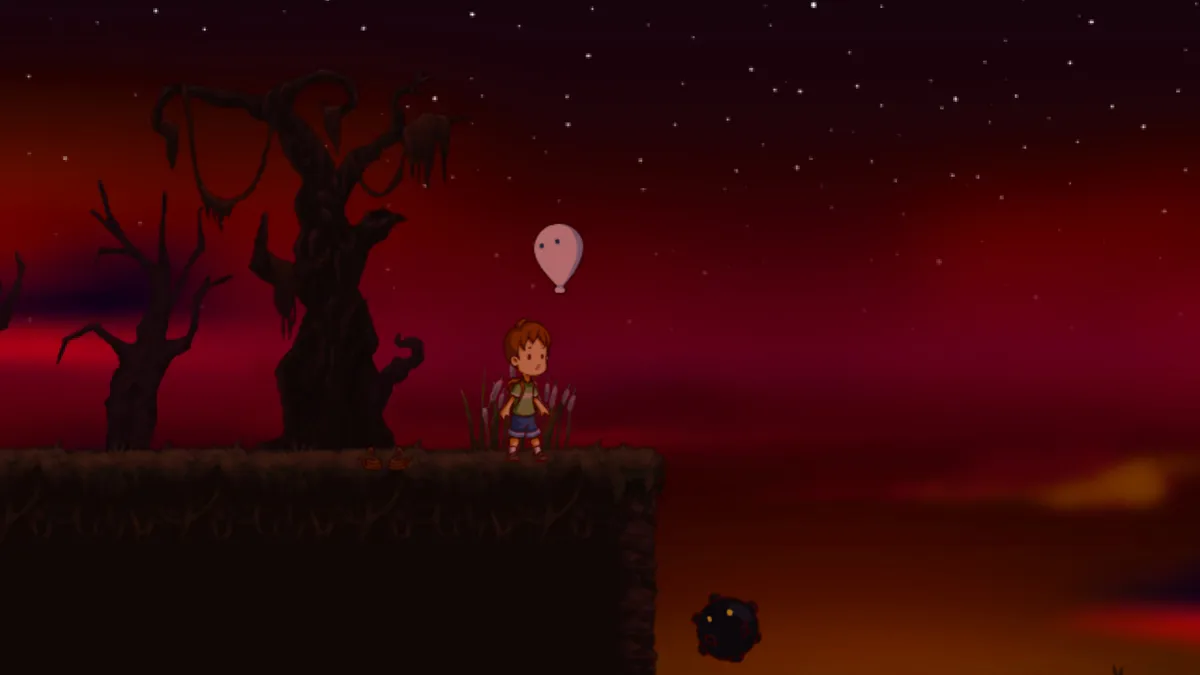
Once the blob has changed, the resulting object becomes the working answer to the level's obstacle. The documented rule is narrow but exact: feed jelly beans, watch the blob transform into useful objects, and use those objects to solve puzzles and escape danger. Danger and puzzles are treated as the same problem type for the transformation system, so the player responds to a hazardous passage or a blocked route by producing the object the situation calls for. The feeding action is followed by a visible transformation, and the new form is the tool applied to the puzzle.
Because the set of forms is fixed, puzzle-solving runs through object transformations rather than through a single generic ability. The player feeds a bean to trigger a change, the blob becomes one of the useful objects, and that object is what addresses the puzzle or the danger at hand. The rules connect in a short chain: jelly beans feed the blob, the blob transforms, and the resulting object is used to solve puzzles and escape danger. Choosing which bean to spend is therefore the moment the puzzle response is selected.

40 Levels, Hidden Treasures and Unlockable Challenge Stages
The adventure spans 40 levels, and those stages are stocked with hidden treasures rather than serving as plain corridors between transformations. The journey crosses distinct terrain types, with woods, swamps, caves, the Blobolonian Outskirts and the Emperor's Citadel identified as the settings the boy and blob traverse. Treasure hunting therefore runs alongside the jelly-bean puzzle solving: each area can conceal caches the player must find, and the level count sets the scope of that search across the full campaign.
Collecting treasure is not an end in itself, because the documented rule ties it to a second tier of play. Gather the treasure, and 40 additional challenge levels unlock, separate from the main campaign's 40 stages. The two numbers mirror each other, but the second set is described as a skills test, so the reward for thorough exploration in the woods, swamps, caves, outskirts and citadel is a further 40 stages. Finding hidden treasure thus gates access to the challenge tier rather than merely padding a completion tally.
Dethroning the Emperor: Story, Objectives and Friendship
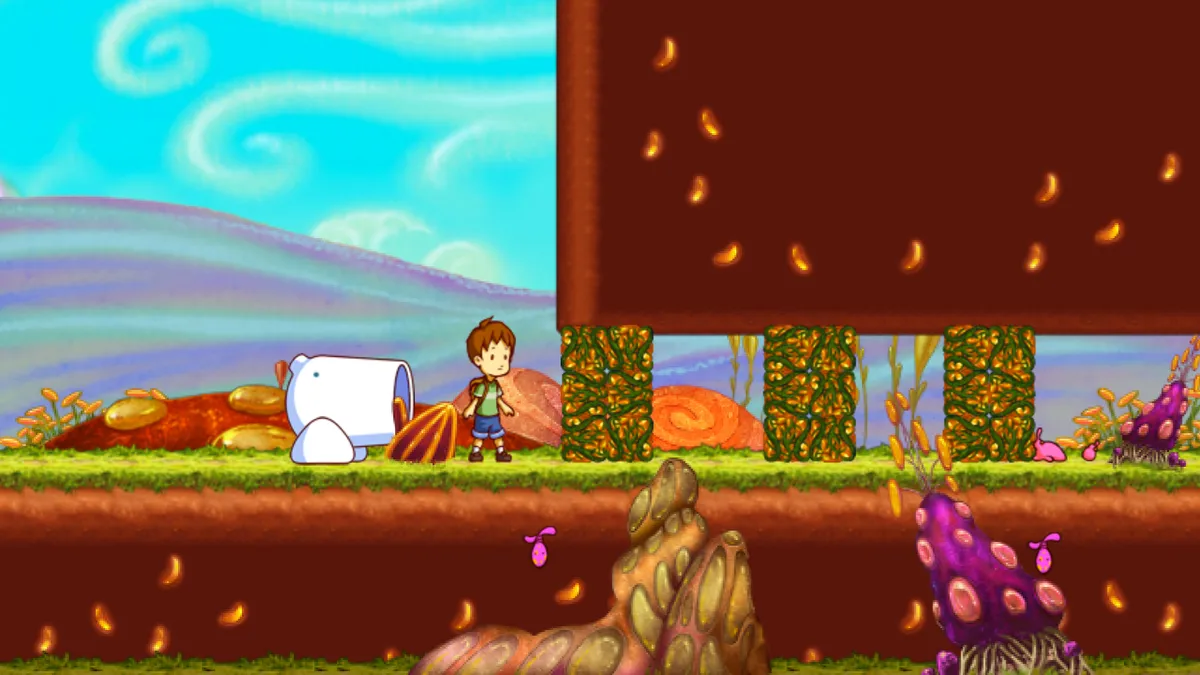
The adventure begins with a threat to Blobolonia: an evil Emperor terrorizes the blob's homeworld, so the blob travels to Earth seeking help. What he finds instead is a young boy, and the two become partners. The boy's objective is to dethrone that Emperor, and the story frames that goal alongside a second aim: establishing a friendship between the boy and the blob that is meant to last a lifetime. Both threads — the campaign against the Emperor and the bond between companions — define what the player is working toward across the journey.
That story is delivered through a hand-drawn, animated presentation, which the documentation describes as an all-new look for the heartwarming narrative. The route to the Emperor runs across distinct settings — woods, swamps, caves, the Blobolonian Outskirts and finally the Emperor's Citadel — spread over 40 levels. Each stage holds hidden treasures, so the march toward the Citadel is also a search through each terrain type. The objectives therefore join two kinds of work: traveling the 40 levels toward the Emperor's stronghold, and collecting the treasure concealed along the way.
Sources & further reading.
- A Boy and His Blob — official game profileRetrieved Oct 30, 2026
First published .