 THE GAME ARCHIVE
Blowing Yourself Up as a Movement and Combat Tool
Explodemon treats its hero's self-destructive nature as the core mechanic rather than a penalty. Detonating the character damages enemies in combat, and the same explosion doubles as propulsion, launching Explodemon through the air. That single action therefore serves both offense and movement, letting a player break up a fight and then reposition above the battlefield. The detonation also feeds into the puzzle layer: the profile describes physics-based puzzles forming a huge variety throughout the game, so the blast is a tool for manipulating the environment as well as clearing enemies.
The presentation draws on 16-bit platform games and Japanese action titles, while the surrounding structure borrows from more modern games through upgradable skills and hidden collectables. These pieces sit alongside twelve large levels, full keyboard support and full controller support, plus a set of achievements and collectables to discover. In practice, the self-destructive combat and flight described for Explodemon run through that retro-styled framework: the player fights, flies and solves physics puzzles across the twelve levels, with upgradable skills and hidden collectables available to find along the way.
Physics Puzzles Between the Firefights
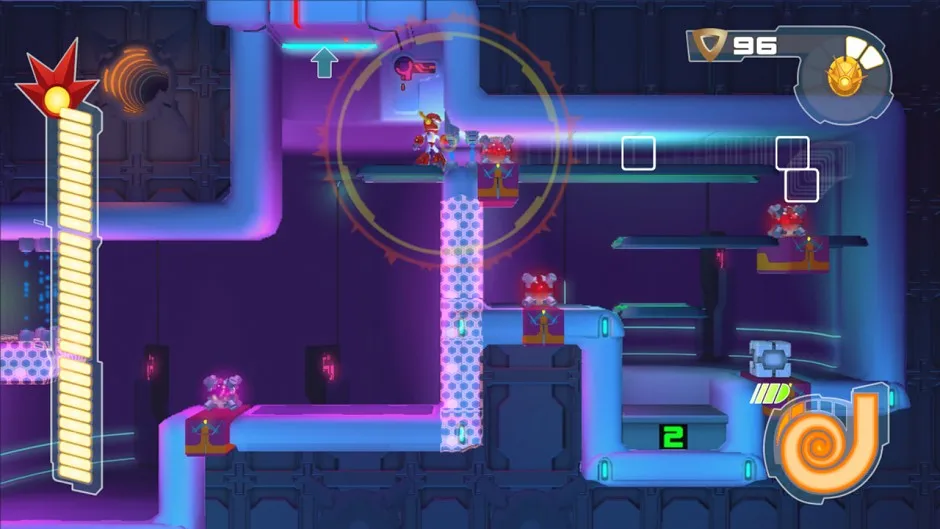
Between the combat encounters, Explodemon sets physics-based puzzles across its twelve large levels. The documented rules tie the hero's self-destructive nature directly to this puzzle layer: the same detonation that damages enemies and launches the character through the air is applied to a huge variety of physics puzzles. So a level can alternate between fighting and airborne movement, then ask the player to work out how the blast should be used against the environment. The profile stresses that this puzzle variety is huge, spread through the twelve levels rather than confined to a single mode.
The puzzle content is presented as one of the modern elements layered onto the retro framework, alongside upgradable skills and hidden collectables. That framing matters for how the pieces combine: the twelve large levels hold combat, flight and physics puzzles, while upgradable skills and collectables sit in the same structure. The profile does not describe specific puzzle objects, solutions or how individual upgrades change a puzzle, so the documented relationship stays at the level of the self-destructive ability being used for combat, flight and physics-based problem solving throughout the game.
Twelve Levels Across Three Worlds
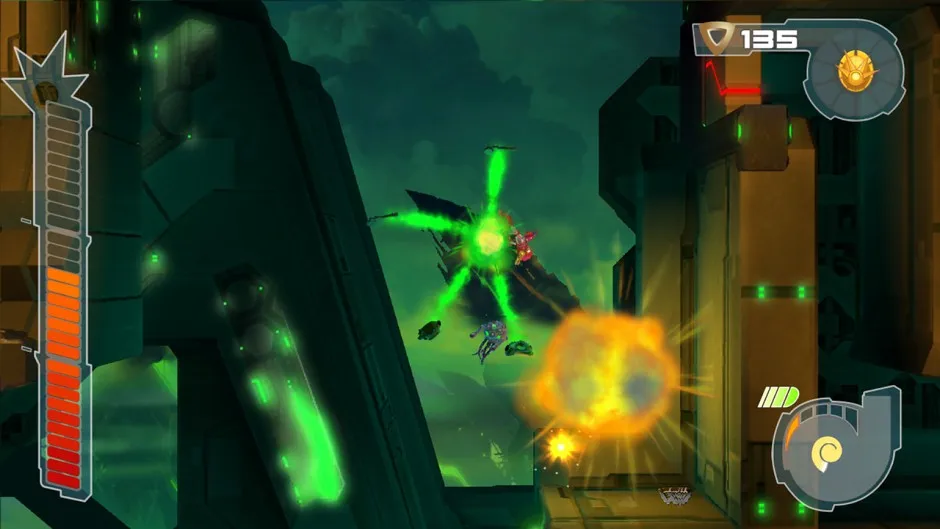
The campaign is built around twelve large stages, and those stages are grouped into three separate worlds. Each world introduces a different set of hazards and skills, so moving from one world to the next changes what the player encounters in the platforming rather than repeating the same threats. Within those stages, the documented loop mixes combat, flight and physics-based problem solving, and the profile describes the experience as constantly changing as new skills and hazards arrive. Upgradable skills, hidden collectables and achievements sit alongside that level structure.
Because the twelve levels are split across three worlds, progress is organized into blocks of stages rather than one continuous run. The profile does not specify the order of the worlds, what hazards belong to each, or how individual upgrades affect play, so the documented structure stays at the level of twelve large stages arranged in three worlds. That frame holds the self-destructive combat, airborne movement and physics puzzles together, with new skills and hazards appearing as play continues through the stages.
Upgrades, Hidden Collectables and Achievements
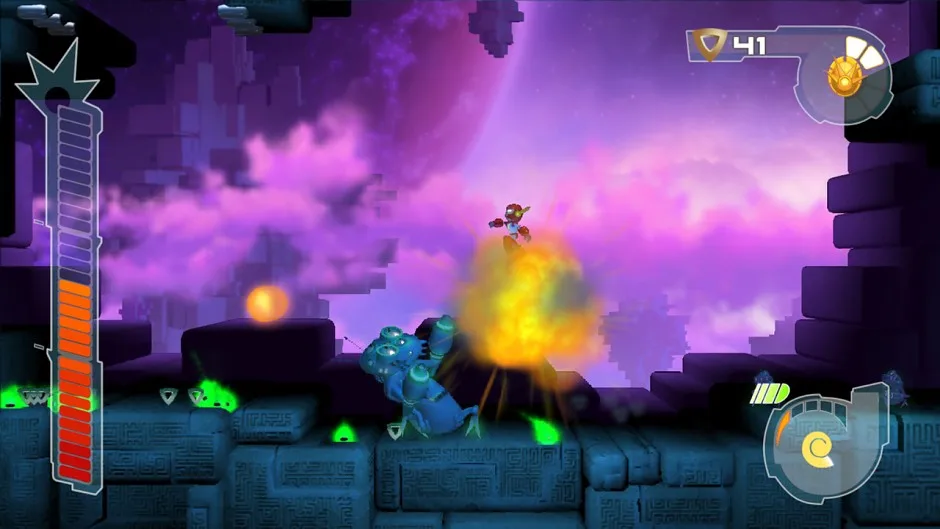
Alongside the combat and physics puzzles, Explodemon carries a progression layer built on upgradable skills. The game takes that element from more modern titles and sets it inside a 16-bit-style platform framework, so the abilities the player uses for aerial movement and for environmental problem solving are open to improvement rather than fixed from the start. The twelve large levels provide the space in which those upgraded skills are put to use, and the documented structure keeps the upgrades within the same stages that hold the fighting, flying and puzzle solving.
Two collecting layers sit alongside the skills. Hidden collectables are scattered through the levels for players to seek out, and a full set of achievements and collectables adds a second set of discovery targets tied to the same progression framework. The profile treats these modern elements as part of the game's depth, layered onto the retro presentation rather than replacing it. It does not describe individual collectable locations, what each achievement requires, or how particular upgrades alter play, so the documented picture stays at the level of skills, hidden collectables and achievements existing within the twelve large levels.
Playing It Your Way: Keyboard and Controller
Explodemon supports two input methods: the full keyboard and a controller. The game profile lists both without ranking one above the other, so the choice belongs to the player rather than to a prescribed setup. Either way, the inputs feed into the same self-destructive action set: detonating the hero to damage enemies, using the blast to fly through the air, and applying that same explosion to physics-based puzzles. Keyboard and controller support therefore cover the combat, airborne movement and puzzle solving that run through the twelve large levels.
The input flexibility sits within the broader structure of twelve huge levels, upgradable skills, a full set of achievements and collectables, and physics puzzles described as a huge variety. Because the profile documents only the existence of full keyboard and controller support, not specific bindings or mappings, the concrete control scheme is left unstated. What is documented is that both options are available across the campaign, so a player can detonate, fly and solve environmental puzzles using either a keyboard or a controller while working through the stages.
Sources & further reading.
- Explodemon — official game profileRetrieved Oct 30, 2026
First published .