 THE GAME ARCHIVE
Assassin's Creed 2 is an action-adventure game from Ubisoft Montreal, published by Ubisoft, listed for Windows with a 2010 release year on its Steam entry. Its official store description frames it as the follow-up to a record-setting new intellectual property and describes an epic of family, vengeance and conspiracy set against Renaissance Italy. For a retrospective read, the interesting material is not the metadata row but what the description says you actually do: roam an open-ended world, move through crowds, and grow Ezio from a betrayed young noble into a master assassin.
Premise: a new hero in a new era
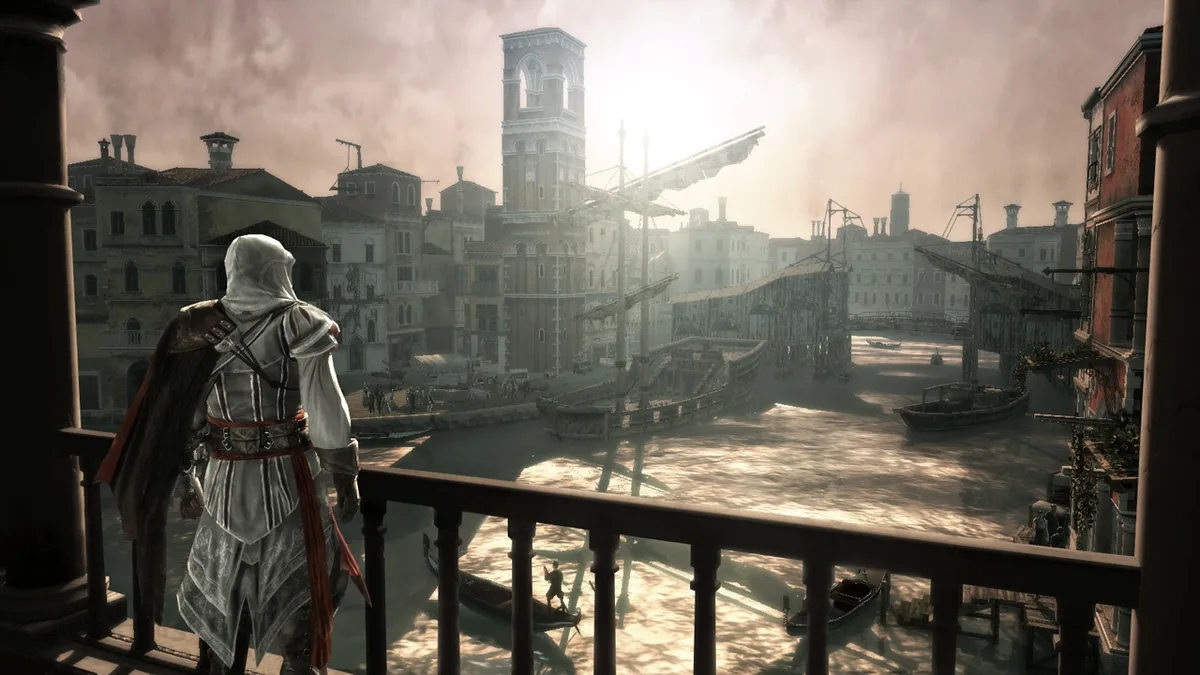
The store description introduces Ezio Auditore da Firenze as a young Italian noble who learns the ways of the assassins after his family is betrayed, and who sets out to seek vengeance. It paints him as a lady's man and a free soul with panache, yet with a very human side, and says that through him you become a master assassin. The backdrop is a Renaissance Italy that the description describes as less a single country than a collection of city-states, where families with political and economic strength took leadership roles in cities such as Florence and Venice.
That premise does more than set dressing. A revenge story centered on a noble family gives the open world a personal stake: the cities the description names, Florence and Venice, are where Ezio takes on Florence's most powerful families and ventures through the canals of Venice. The description also notes that he befriends Leonardo da Vinci. It describes the period as a time when culture and art were born alongside some of the most chilling stories of corruption, greed and murder, which is the emotional contrast the game leans on.
 View full image ↗
The core loop: free-running, crowds and blades
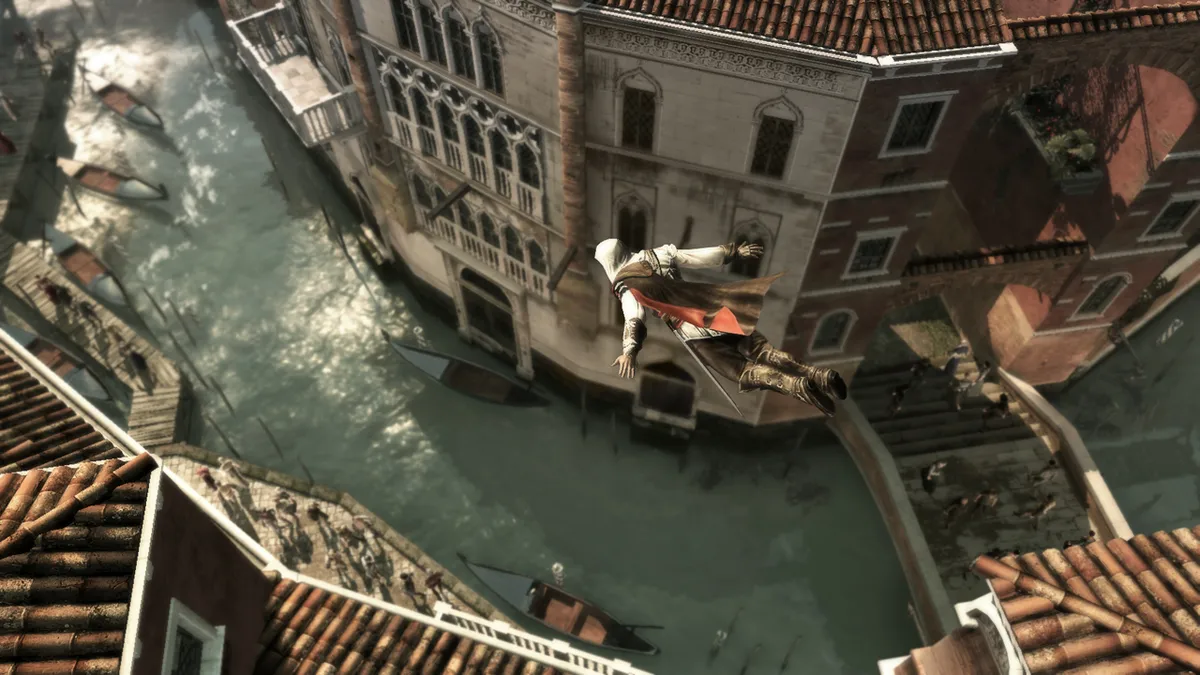
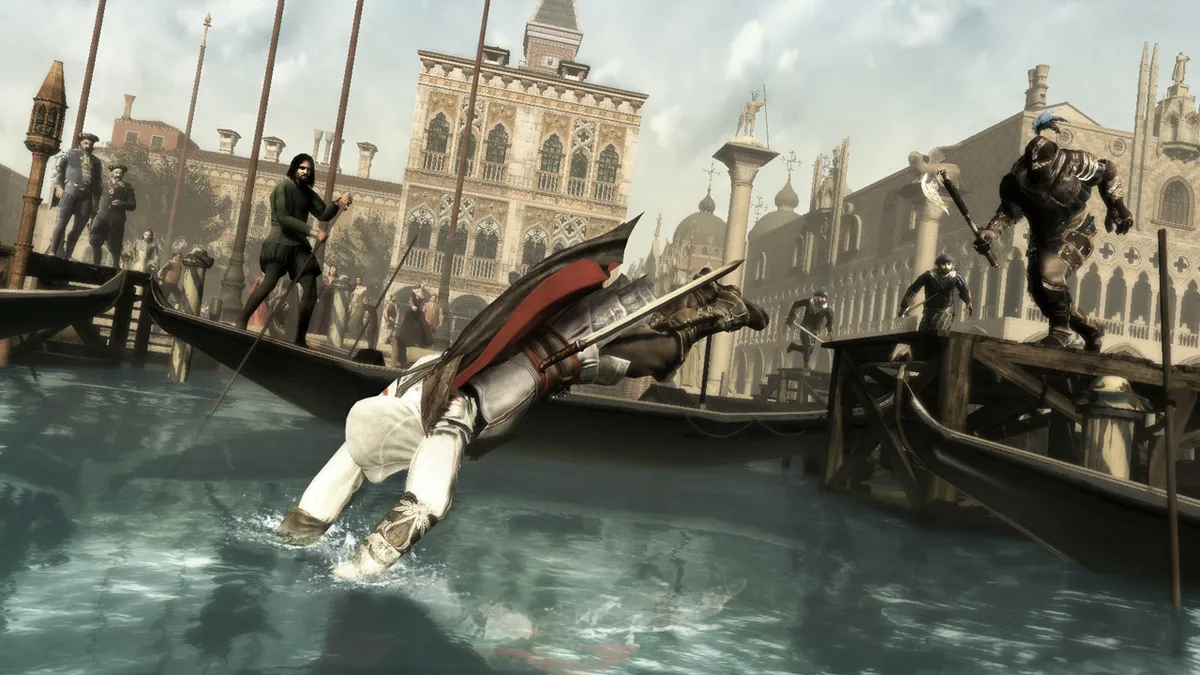
The description frames the moment-to-moment game as an open-ended world in which you perform missions when you want and how you want. It says the game brings back free-running and adds elements such as swimming and even flying to the adventure. It also highlights a dynamic crowd: a living, breathing world where every character is an opportunity for the player, blending in with the crowd is easier, and working with in-game characters provides ample rewards but can also lead to surprising consequences. On the combat side, the description says you perfect your skills to become a master assassin, brandish new weapons, learn to disarm enemies and then use their weapons against them, and assassinate enemies using both hidden blades.
Read together, those documented systems describe a loop built on approach rather than route. The crowd is not scenery; the description treats every character as an opportunity, so blending in is a tool and interacting with people is a decision with possible rewards and possible consequences. Free-running covers the movement between objectives, while swimming and flying are explicitly listed as additions to that movement set. Combat offers a choice of expression: brandish weapons, disarm an enemy and turn their own weapon against them, or finish with the hidden blades. The description summarizes the result as variety that lets you play through the game any way you choose.
Progression and modes: becoming a master assassin
Progression is framed as personal growth rather than a stat sheet. The description says Ezio learns the ways of the assassins after his family is betrayed, and that through him you become a master assassin; separately it says you perfect your skills to become a master assassin. That arc is the spine of the experience the store page describes. On modes, the description is unusually direct about what is no longer available: as of November 19, 2018, the online features for this game are no longer supported, and the multiplayer mode and co-op mode are no longer accessible. In other words, the documented mode set today is the single-player campaign; the describable multiplayer is historical, not current.
That retirement of online features matters for a retro feature because it changes the shape of the game the store page now advertises. Anyone approaching the Windows version should expect the campaign and its open-world systems, not a multiplayer or co-op component. It is also worth separating the base game from any later packages, ports or remakes: the description here documents this Steam entry, and its specifics should not be assumed to carry over unchanged to other releases.
 View full image ↗
Source-backed starting guidance
The description supports a few safe conclusions for a first approach. Expect missions that can be performed when you want and how you want, so there is no documented need to rush a linear path; the open-ended world is the point. Expect to spend time in crowds, because blending in is described as easier and interacting with characters is described as a route to rewards and consequences. Expect to practice the movement set, since free-running returns and is joined by swimming and flying. In combat, expect to be able to work toward disarming enemies and using their weapons against them, and to assassinate with both hidden blades. Beyond that, the description does not document controls, difficulty settings, mission order or a recommended early route, so this article does not invent them.
 View full image ↗
Design character: crowds as systems
The distinctive design idea in the description is that the crowd is a system with two faces. It is presented as a place to hide, where blending in is easier, and as a place to act, where every character is an opportunity and working with in-game characters provides ample rewards while also risking surprising consequences. That dual role is what turns Renaissance streets from a backdrop into part of the decision space. The same logic extends to movement: the open world is meant to be crossed by free-running, with swimming and flying broadening the ways you can traverse it. The result is a sandbox whose identity comes from choosing how to move through a populated city, not from a single prescribed route.
This Steam entry and what it does not tell us
The documented facts for this entry are the title, a 2010 release year, Windows as the platform, Ubisoft Montreal as developer, Ubisoft as publisher, and action and adventure as genres. The description also advertises a new low price and states that online features ended on November 19, 2018, taking multiplayer and co-op with them. What the source does not provide is close to as important as what it does: there is no documented technical breakdown, no performance testing, no compatibility confirmation for current hardware, and no first-hand account of how any of these systems feel in play. Those gaps are the honest boundary of this retrospective.
Assassin's Creed 2 is remembered here not for a single novel mechanic but for how its documented parts interlock: a personal vengeance story, a city-state Renaissance setting, an open-ended mission structure, a crowd that is both cover and opportunity, movement expanded with swimming and flying, and combat that lets you disarm and turn enemies' weapons, or finish with hidden blades. That combination is what the store description sells, and it is enough to explain the game's identity without inventing detail the source never supplied.
Scroll sideways to see the full table →
| Field | Value as listed |
|---|---|
| Game | Assassin's Creed 2 |
| Release year (this Steam entry) | 2010 |
| Platform | Windows |
| Developer | Ubisoft Montreal |
| Publisher | Ubisoft |
| Genres | Action, Adventure |
| Documented online features | No longer supported as of November 19, 2018 |
| Documented multiplayer / co-op | No longer accessible |
- Open-ended world with missions performed when you want and how you want
- Free-running movement
- Swimming
- Flying
- Dynamic crowd: blending in is easier; characters offer opportunities, rewards and possible consequences
- Combat: brandish new weapons, disarm enemies and use their weapons against them, assassinate with both hidden blades
Sources & further reading.
- Assassin's Creed 2 — official game profile Retrieved Oct 10, 2026
First published .