 THE GAME ARCHIVE
Assassin's Creed: Director's Cut Edition is the Windows release of Ubisoft Montreal's 2008 action-adventure game, published by Ubisoft. Its store description frames the setting as 1191 AD, during the Third Crusade, with the player controlling Altair — an Assassin tasked with suppressing both sides of the conflict. What distinguishes this edition on paper is a documented layer of PC-specific content rather than a rewritten premise: the same open, systemic assassination sandbox, extended with extra investigation missions.
Premise: A Crusades-Era World Where You Shape Events
The material positions Altair as a warrior who operates in secrecy and is feared for ruthlessness, and whose actions can throw his immediate surroundings into chaos. The stated intent is not merely to fight through a battlefield but to influence a pivotal historical moment: the game tells the player they will shape events during this period, and that their existence will matter to how the conflict unfolds.
That premise is anchored to a historically framed Holy Land of the 12th century, described as rich in period ambience and detail. The design claim is that the environments are open-ended and historically accurate rather than corridor-like set dressing, which matters because traversal and stalking are built on top of them.
The Core Loop: Stalk, Approach, Eliminate
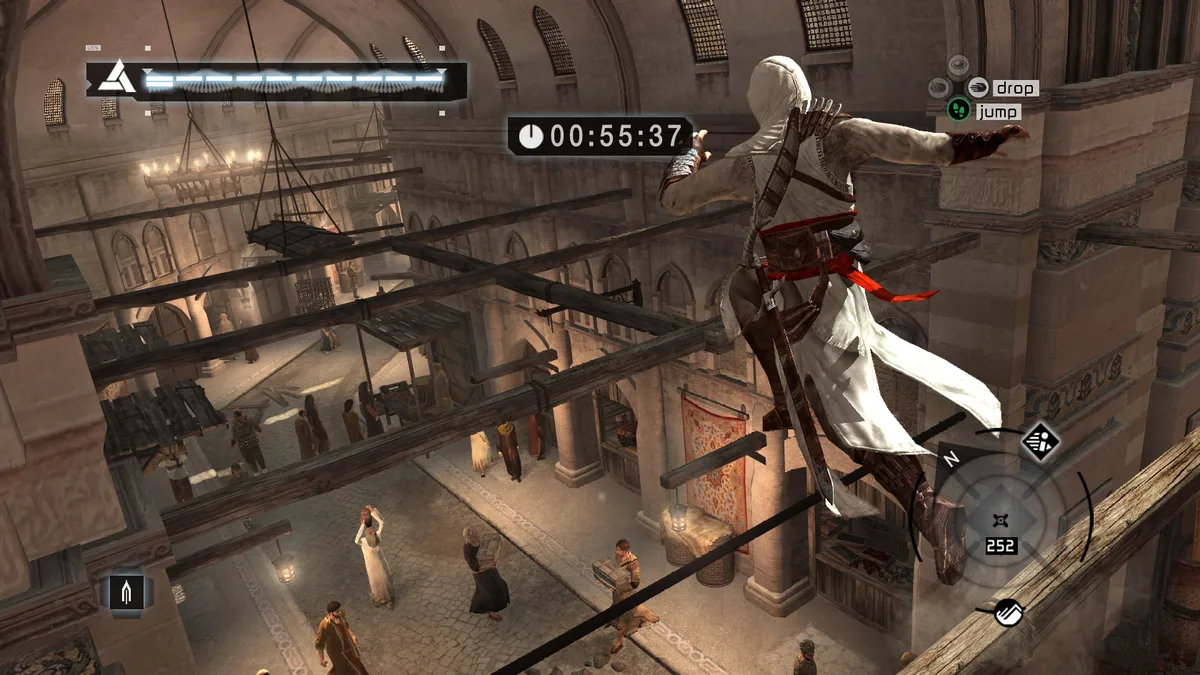
The documented core loop is a hunt. Players eliminate targets wherever, whenever, and however they choose, stalking prey through open-ended environments rather than being pushed along a fixed route. The description repeatedly stresses total freedom in the approach: scaling buildings, mounting horses, and blending into crowds are all listed as parts of reaching an objective. The intended rhythm is reconnaissance and positioning first, then the strike.
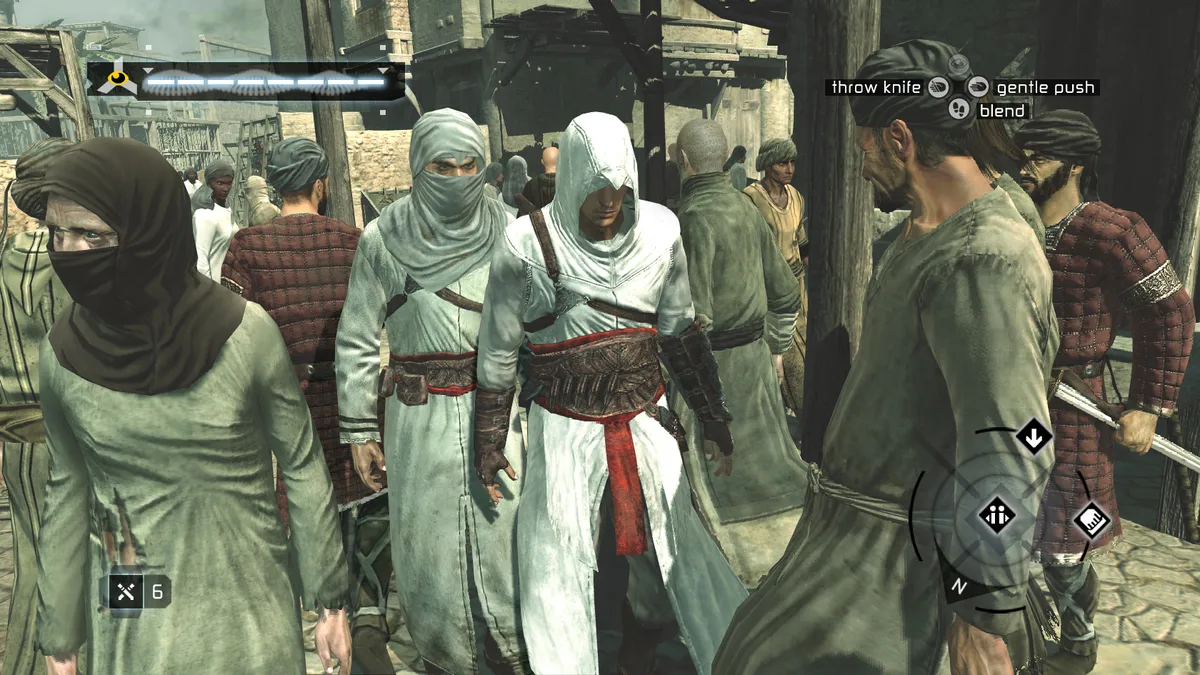
Two movement verbs carry that freedom literally. Scaling structures gives a vertical route through a dense city, and horses extend the player's reach across the wider Holy Land. Crowds serve a different purpose: they are a surface to disappear into, so the same street that exposes a running player can conceal a walking one. The design promise is that this toolkit produces a flexible approach rather than a single scripted path.
 View full image ↗
Stealth, Weapons, and Swordfight Duels
Assassination is described as both stealth work and combat. The store text notes the use of a wide range of medieval weapons and face-to-face swordfight duels, presented as realistic and animated with fluid, precise motion. Stealth and precision are named explicitly as the tools for taking out targets, which suggests the intended split: quiet removal where possible, and a duel when the approach breaks down.
Combat is tied to an intuitive control scheme, and the underlying engine is described as supporting organic, open gameplay with realistic interaction between the player and the environment. In practical terms, that is the connective tissue of the loop: the same systems that let you push through a market crowd also govern how a chase escalates when the crowd turns against you.
A World That Reacts: Crowds and Consequences
Among the systems described, the reactive crowd is the most consequential for how the game is played. Crowds react to the player's moves and will either help or hinder, meaning bystanders are a resource with a cost rather than background decoration. The store description frames the whole environment as living, with every action having a consequence. That framing is what makes free assassination approaches meaningful: if the crowd can turn, then how you move through it is a decision, not a formality.
 View full image ↗
Missions, Skills, and Progression
The game is structured around missions and quests that advance the story, with the primary objective described as assassinating targets using stealth and combat. Progression is tied to completing that mission work; the store text refers to mastering the skills, tactics, and weapons of the Assassin order, phrasing a journey of growing capability rather than a stat sheet.
One common expectation is not confirmed by the available material. A conventional skill-tree or point-spend progression system for developing Altair's abilities is not described anywhere in the supplied source, so this profile does not assert one. What the source does support is mission-driven advancement and skill mastery as a described theme.
What the Director's Cut Edition Adds on PC
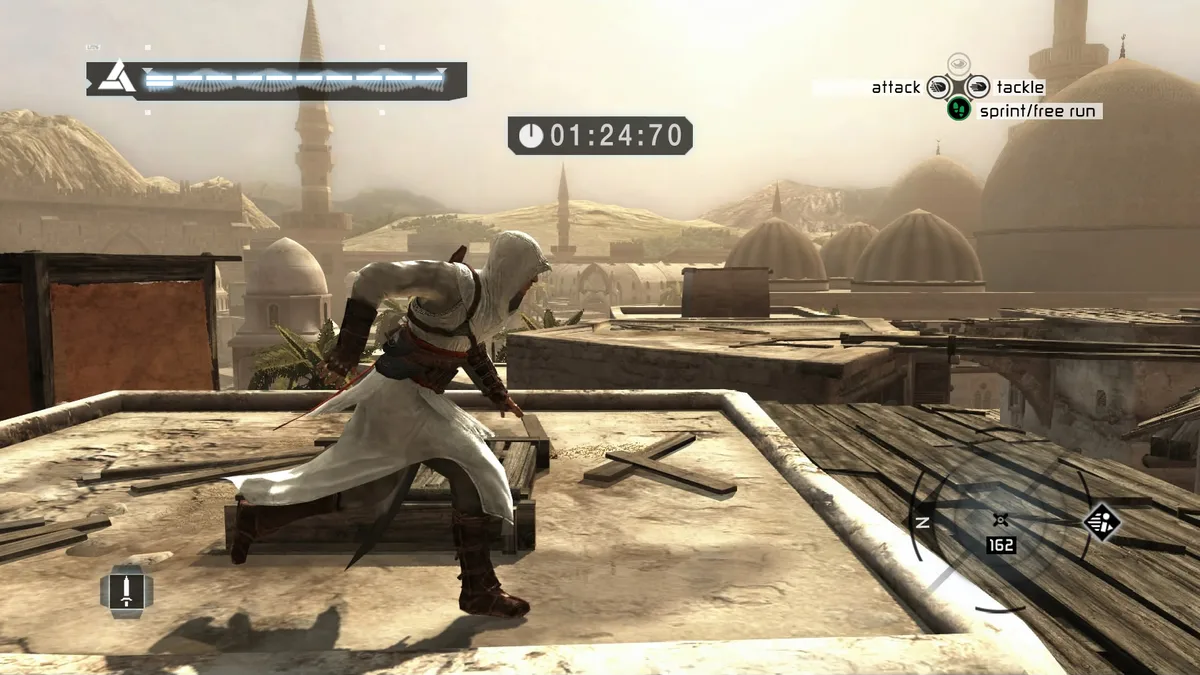
This edition is defined by its PC-exclusive content. The source lists four PC-exclusive investigation missions and names two of them: the Rooftop Race Challenge, described as a race to a specified location, and the Archer Stealth Assassination Challenge, in which the player must assassinate all archers in a given zone to help fellow Assassins. Those additions extend the investigation layer that precedes an assassination, and in the archer case they add an optional stealth objective with a clear clear-the-zone rule.
Scope matters here: this profile concerns the Director's Cut Edition entry, and its 2008 date should be read as the year attributed to this listing rather than a reconstructed release history for every version of the game. The entry lists Windows as the platform, with Ubisoft Montreal as developer and Ubisoft as publisher.
 View full image ↗
How to Approach the Game, Based on What It Documents
The source describes an approach rather than a tutorial route, so guidance here is limited to what the material actually implies. Because targets can be eliminated wherever, whenever, and however, and because crowds either help or hinder, the safest reading is that time spent reading a district before acting pays off. Vertical routes and horse travel are both documented as ways to move, so they are viable starting tools for reaching a target rather than optional flavor.
Stealth and precision are named as the tools for assassination, with weapons and duels as the fallback, so a first attempt at a target is reasonably oriented toward avoidance and positioning rather than open confrontation. The PC-exclusive investigation missions sit before those strikes, which makes them a sensible early focus for players who want the full Director's Cut content rather than only the main path.
Design Character: Why the Systems Fit Together
Read together, the documented features describe a game whose identity is permission rather than prescription. The world is open-ended and historically framed; the player can climb, ride, and disappear into crowds; the crowd itself reacts; and targets can be taken in more than one way. The store text calls this action with a new dimension of total freedom, and the specific verbs support that claim more than the slogan does.
The visual and atmospheric claims point in the same direction: the Holy Land of the 12th century is presented with life-like graphics, ambience, and detailed nuance, and the world is described as living and breathing. Whether those claims hold up decades later is a question for hands-on testing, which this source summary does not provide. What it does establish is the intent behind the design: a setting detailed enough that blending into it feels plausible.
Limits of This Source
This profile rests on a single official store entry. It describes systems, modes, and the edition's added missions, but it does not document exact controls, level routes, difficulty settings, or how the PC-exclusive missions are unlocked and sequenced. Those gaps are noted below so they can be filled by further research rather than invented here.
Scroll sideways to see the full table →
| Field | Value |
|---|---|
| Title | Assassin's Creed: Director's Cut Edition |
| Developer | Ubisoft Montreal |
| Publisher | Ubisoft |
| Year (this listing) | 2008 |
| Platform | Windows |
| Genres | Action, Adventure |
| Documented PC extras | Four PC-exclusive investigation missions, including the Rooftop Race Challenge and the Archer Stealth Assassination Challenge |
Sources & further reading.
- Assassin's Creed™: Director's Cut Edition — official game profile Retrieved Oct 10, 2026
First published .