 THE GAME ARCHIVE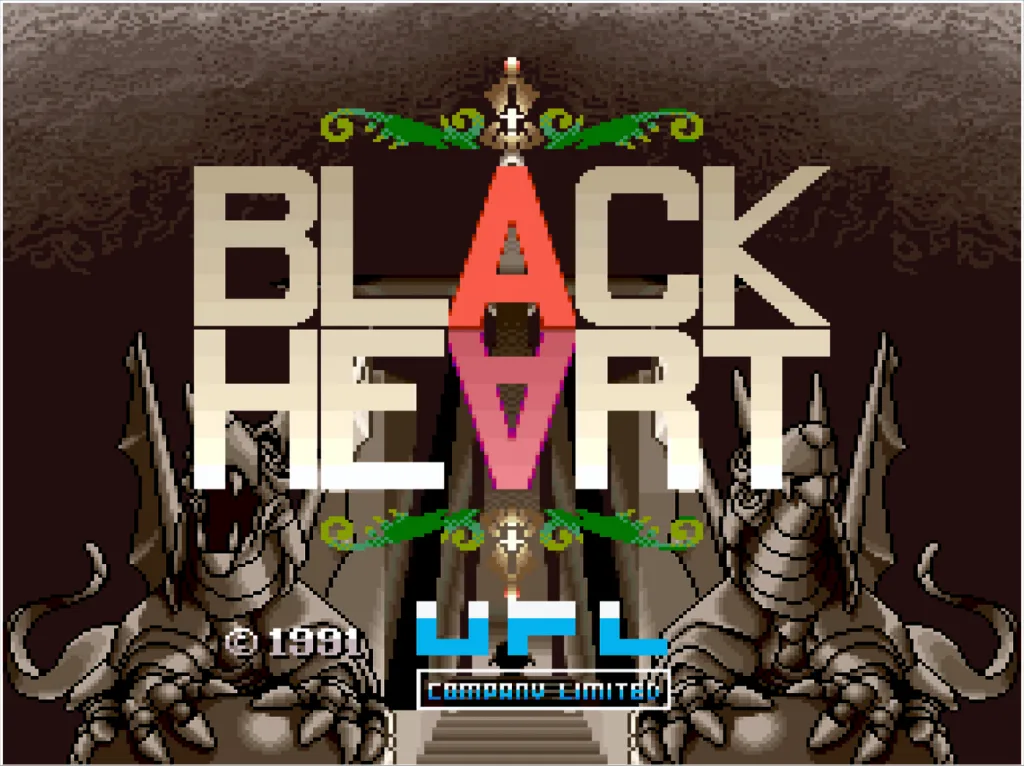
A Rescue Carried on Dragonback
Black Heart is a 1991 arcade shooter released by UPL. Its conflict is set up immediately: Taranith, absolute ruler of the Dark Forces, has kidnapped Jeanne, and Zil must mount his dragon and take to the skies to assault the enemy castle and save her. That premise defines the action. The player is not a grounded hero advancing through corridors but a rider whose dragon carries the fight upward and toward a fortified destination.
What separates Black Heart from a bare rescue premise is the support structure around Zil. Fairies accompany him, and the documented way to defeat enemies is to work together with them. Pixies serve a different function: collecting them is what allows Zil to fire the powerful F・BREATH attacks. The boss rule names both groups, tying fairy cooperation and pixie-enabled F・BREATH to the same encounter. The result is a shooter in which the player's companion and collectible relationships are part of the combat vocabulary, not background lore.
The Core Loop: Flight, Shooting and Gathering
The documented systems establish a side-scrolling shooter built around controlling Zil mounted on his dragon for aerial combat. The movement rule and the shooting rule describe one activity: the dragon that carries Zil toward the enemy castle is the same vehicle used to fight through the air on the way. For the player, this means the rescue is pursued through continuous aerial action rather than through separate exploration or dialogue sequences. Progress and combat are the same forward motion.
Within that loop, pixie collection is a concrete objective layered over the shooting. The source does not simply say Zil has a powerful attack; it says collecting pixies is what allows him to fire F・BREATH. That phrasing makes the collection itself the enabling action. A player who gathers pixies is doing something connected to a specific combat capability, and that capability is named again in the boss rule. The gathering feeds the fighting rather than sitting apart from it.
The fairies occupy the other half of the support structure. The documented rule is collaboration: to defeat enemies, work together with the fairies that accompany you. Their role is therefore attached to combat outcomes. The source does not describe how that cooperation is triggered or controlled, so it should not be expanded into invented button commands or partner AI behavior. What can be said precisely is that the fairies are present during the flight and that working with them is the named means of defeating enemies.
Fairies, Pixies and F・BREATH at the Boss
The boss instruction is the clearest statement of how the systems combine. To defeat the boss, the player must work together with the fairies that accompany Zil and with the pixies that allow the F・BREATH attacks when collected. The two support elements are not alternatives; the rule names them in the same sentence and attaches both to the boss objective. This matters for how the player reads the stage: gathering pixies and staying coordinated with the fairies become preparations for the decisive encounter rather than optional diversions.
Because the source is a publisher description rather than a mechanics manual, some details of that boss collaboration remain out of reach. The documented facts do not specify how many fairies accompany Zil, how pixies are counted or spent, how long F・BREATH remains available, or what visual form the collaboration takes. Those gaps are worth naming honestly, but they do not undercut the clear design logic: the pilot is supported by fairies in the fight and empowered by collected pixies, and the final obstacle is framed around using both.
Stage Progression and the Enemy Castle
The documented progression is sequential: the player moves through stages to reach the final boss. Combined with the rescue objective, this gives the dragon flight a destination and a shape. Each stage of aerial combat carries Zil farther toward the enemy castle that Taranith's forces occupy, and the final boss encounter waits at the end of that chain. The player's route is therefore a march of stages toward a single stronghold rather than an open-ended journey.
The enemies Zil opposes are the forces led by Taranith in the enemy castle, so the opposition and the destination line up. The source does not provide a stage count, stage-by-stage themes, or the order of mid-bosses and end-bosses beyond the final confrontation. What it does support is a clear reading of progression: pressing through successive stages of aerial shooting until the castle and its boss are reached, with the rescue of Jeanne as the reason the advance matters.
Dark Fantasy Presentation
The documented visual identity is a dark fantasy aesthetic with medieval castle environments. That fits the premise closely: the enemy castle is not an abstraction but the kind of stronghold the imagery names, and the Dark Forces led by Taranith give the setting its antagonistic presence. A dragon-mounted hero, accompanying fairies, collectible pixies and a castle stronghold form a coherent fantasy framework around what is, mechanically, a side-scrolling shooter.
Beyond that broad description, the publisher material does not detail sprite designs, color palettes or specific stage scenery. The honest characterization is a dark fantasy frame around castle environments, with the fairies and pixies as the distinctive fantasy elements attached to play. Readers looking for pixel-level visual description or a survey of enemy designs will not find that evidence here.
Original Release and Modern Access
Black Heart's documented original platform is the arcade, with UPL as publisher in 1991. The source also carries modern licensed reissue context, including the ability to adjust difficulty, recreate a CRT-style look depending on the title, and compete for high scores through online rankings. Those are features of the modern licensed release context, not features of the original 1991 arcade game. Keeping the two separate avoids mistaking a contemporary package for the historical cabinet experience.
For a reader wanting to understand the game before playing it, the useful distinction is simple: the 1991 arcade shooter is the object of this profile, and the modern licensed reissue is context for how it can be accessed today. The source does not list a complete catalog of current storefronts or compatibility details, so none should be assumed. What the documentation supports is the original arcade identity and the general shape of the licensed reissue offerings.
Reading the Documented Rules as Player Advice
The source does not offer a walkthrough, but its rules imply a sensible approach. Because pixies enable F・BREATH when collected and the boss rule names both pixies and fairy cooperation, treating pixie collection as a priority during the stage is consistent with the documented design. The same rule makes the fairies something to keep in mind rather than ignore: they accompany Zil, and working with them is the stated means of defeating enemies. The player's attention is thus drawn simultaneously to what can be gathered and to the companions already present.
The stage structure points the same way. Since progression runs through sequential stages to the final boss in the enemy castle, the dragon flight should be read as a stretch of aerial combat with an endpoint, not as a single arena bout. Each stage is a leg of the rescue, and the boss at the castle is where the fairy-and-pixie preparation is called upon. Players who internalize that arc can treat the run as a build-up toward the castle confrontation.
- Quick reference: Title: Black Heart | Publisher: UPL | Year: 1991 | Platforms: Arcade | Genres: Shooting | Premise: Zil rides a dragon to rescue Jeanne from Taranith | Support: Fairies accompany Zil; collected pixies enable F・BREATH
Sources & further reading.
- BLACK HEART — licensed publisher game documentation Retrieved Oct 17, 2026
First published .