 THE GAME ARCHIVE
Building Battlegroups: Force Pool Points, Team Slots and Parent Formations
Building a battlegroup in Close Combat: Last Stand Arnhem involves both purchasing teams and fitting them into the formation’s available slots. Teams come from the Force Pool, with limited points assigned to each battlegroup and its parent formation. Spending points therefore sits alongside a separate organizational limit: the battlegroup’s size determines how many team slots appear on its management screen. Company, battalion and regiment are the named echelons used by this system. The distinction matters when assembling a force: the points govern team purchases, while the echelon governs the number of places available to accommodate teams.
Battlegroup management also extends beyond assembling each group separately. You can stack battlegroups, merge them, or have one lend teams to another. Lending provides a way to transfer teams between groups, whereas merging combines the groups themselves; these are distinct management options rather than additional Force Pool purchases. The game also tracks the parent formation to which a battlegroup belongs. For example, both the 1st Parachute Brigade and 4th Parachute Brigade are assigned to the British 1st Airborne Division. That organizational relationship accompanies a purchasing system with limited point pools at both battlegroup and parent-formation level.
Contesting the Maps: River Crossings, Destructible Bridges and Static Defenders
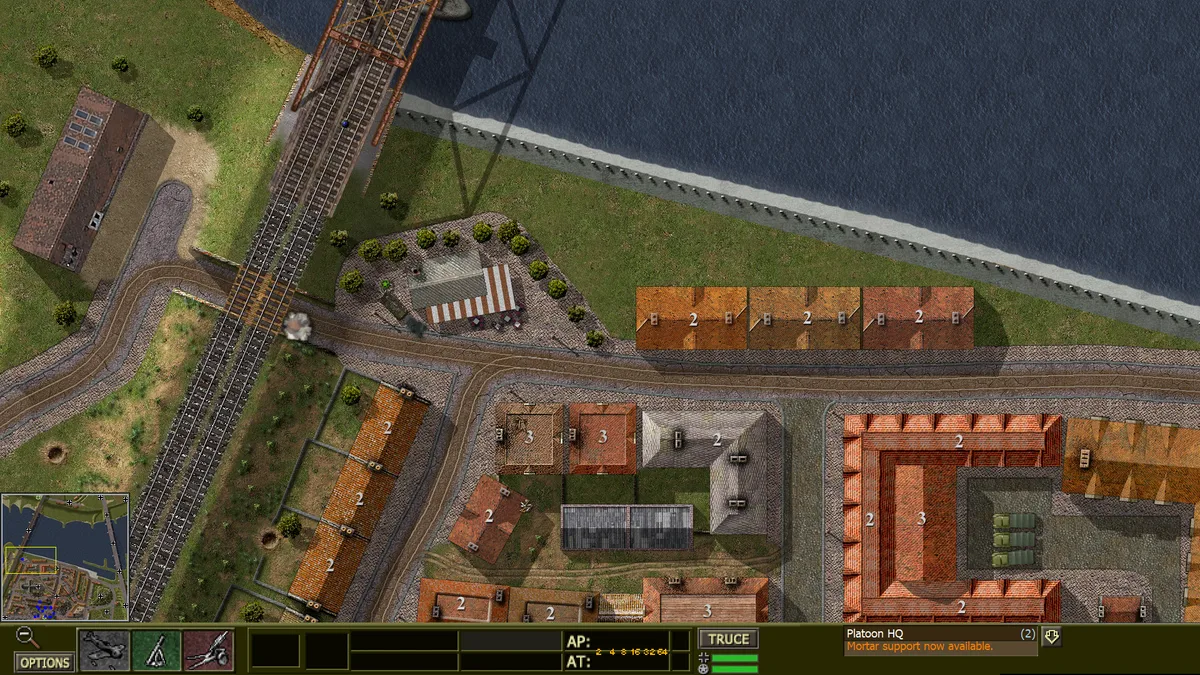
River crossings are part of the struggle for Arnhem Bridge in Close Combat: Last Stand Arnhem. During Operation Market Garden, the Allies seek to cross the Rhine, while German forces try to prevent them from reaching the bridge. The game includes ferry and assault crossings as well as destructible bridges, so its river-crossing features extend beyond bridges alone.
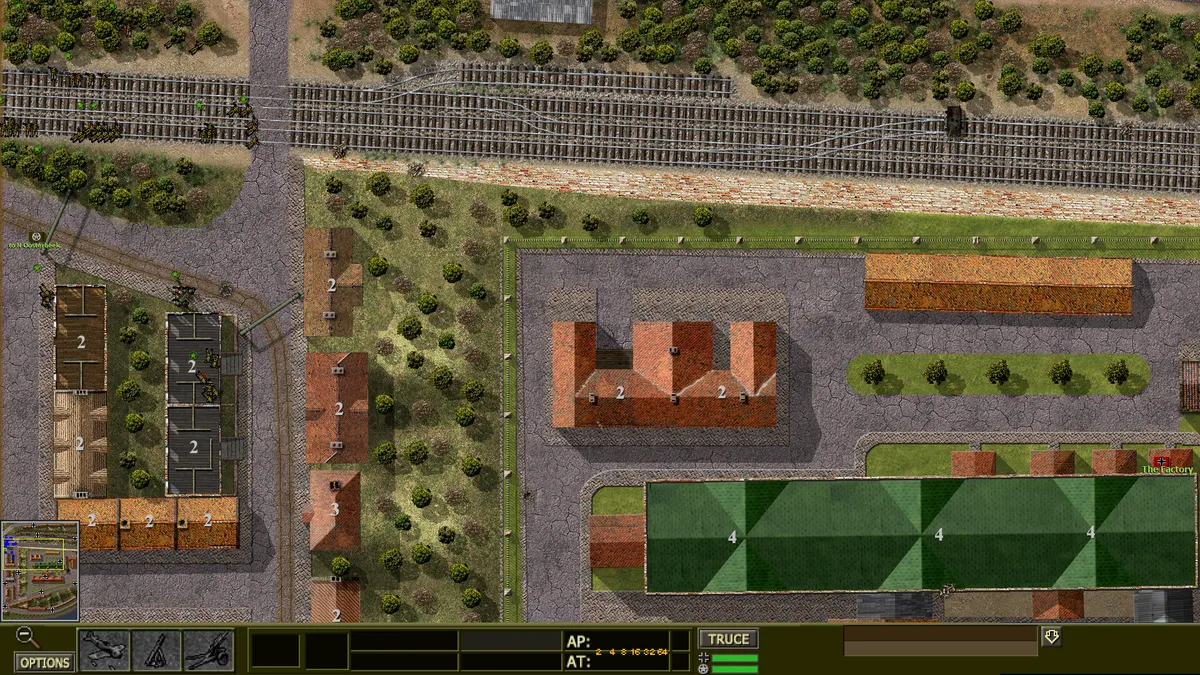
A map without a battlegroup is not necessarily undefended. Static troops consist of a small number of teams attached to a particular map, and those teams defend it even when no battlegroup is present. Their attachment is therefore to the location, rather than dependent on a battlegroup occupying it. This gives the map its own defensive presence alongside the forces managed as battlegroups. At the strategic level, improved graphical presentation communicates connections between maps; those connections describe the wider map network, while static defenders determine whether a location retains troops in a battlegroup’s absence.
Battlefield Conditions: Night Flares, Support Limits and Force Status
Night battles make flare deployment part of visibility: simulated flare effects alter the ability to see enemy troops in the darkness. Illumination is therefore a battlefield condition tied to deployed flares, rather than simply a visual treatment of the map. Off-map support has a separate constraint, with its quantity tied to the difficulty setting. These rules govern different resources during combat: flares affect enemy visibility at night, while difficulty determines the amount of off-board support.
Force status is also visible through displays of battlegroup cohesion and fatigue. These provide two named measures to check during gameplay, alongside the battlefield itself. After a battle, reports show campaign cohesion and victory-location control, giving the campaign record both a cohesion measure and a territorial measure. The distinction is useful when reading the results: the battlegroup display concerns cohesion and fatigue, whereas the post-battle report tracks campaign cohesion together with control of victory locations.
Campaign Structure: Battles, Daily Turns and Scheduled Reinforcements
Close Combat: Last Stand Arnhem includes more than 60 battles, operations and campaigns in total, with an enhanced Grand Campaign among them. Its daily schedule allows a maximum of six turns, providing the time divisions within which operations and campaigns are arranged. The scenario editor lets you specify the starting turn on the starting day for an operation or campaign. That setting establishes where the scenario begins within its opening day, rather than only identifying a starting date. The six-turn daily maximum and selectable opening turn are separate settings: one defines the daily limit, while the other places the beginning within that schedule.
Reinforcement timing has its own scenario-editor setting: you can assign the turn on which reinforcements arrive. When configuring an operation or campaign, this works alongside the selectable starting turn, allowing the opening point and reinforcement arrivals to be specified separately. The concrete editing task is therefore to set when play begins within the starting day and when the additional forces enter the schedule. Campaign customization also extends beyond these timing options. Moddable elements include campaign details, strategic-layer features, support missions and battlegroup recycling, placing the documented scheduling controls within a broader set of editable campaign systems.
Sources & further reading.
- Close Combat: Last Stand Arnhem — official game profileRetrieved Nov 7, 2026
First published .