 THE GAME ARCHIVE
Turn-Based Rule and Eighteen Factions
Conquest of Elysium 3 is built on a turn-based structure, and each turn is a chance to weigh complex decisions against risky ventures. Progress comes through vying for control of the map in order to conquer Elysium. What looks like a simple game with limited options at first glance opens into a wider web of choices as play continues. The strategic decisions extend beyond movement and recruitment: the faction you pick reshapes what your turns are spent on and what you are trying to achieve.
The eighteen factions operate by different mechanics and pursue different goals. A druid, for example, works to build a vast forest and jungle empire, harvesting ingredients to summon woodland creatures, with no practical need to seize mines. A dwarf cares only for mines, producing units at a fixed rate each turn and focusing almost entirely on upgrading those units so they survive, since replacing them is so difficult. Separately, six scenarios help randomize the map, ranging from the early days of an agrarian world to a shining capital that spawns patrols of human guards, and to a fallen empire full of the living dead, scarred by battlefields and tombs. Random events also appear, from merchants to pillage to gates of the underworld opening portals into your realm.
Automatic Combat and Battlefield Ranks
Combat in Conquest of Elysium 3 resolves automatically, but the outcome still depends on the arrangement of the army you bring. Every unit has a desired battlefield location, which sorts the force into three ranks. Front rank units wield hand-to-hand weapons and occupy the leading rows. Middle rank units typically attack with a ranged weapon or spell, or act as commanders who do not lead from the front, and they stand behind the front line. Back rank units are usually pure mages or non-combatant leaders, placed in the rearmost rows. Building an army that shields the powerful archers and spell casters therefore means pairing them with enough front-line strength to hold the enemy back.
Once battle begins, the defender always acts first, and both sides follow the same sequence, with whichever side is currently acting called the active side. Prebattle effects are applied before any other action, and assassination attacks come at the very start of combat, before any other attacks. The fighting continues until only one side remains on the battlefield. Weapons can strike several targets at once, covering three or five targets, an entire row, all targets on one side, or even every target on the field. Spells can additionally target only the caster, two to five random targets, or twelve random targets scattered anywhere on the battlefield regardless of placement.
Weapons, Damage Types and Lingering Poison
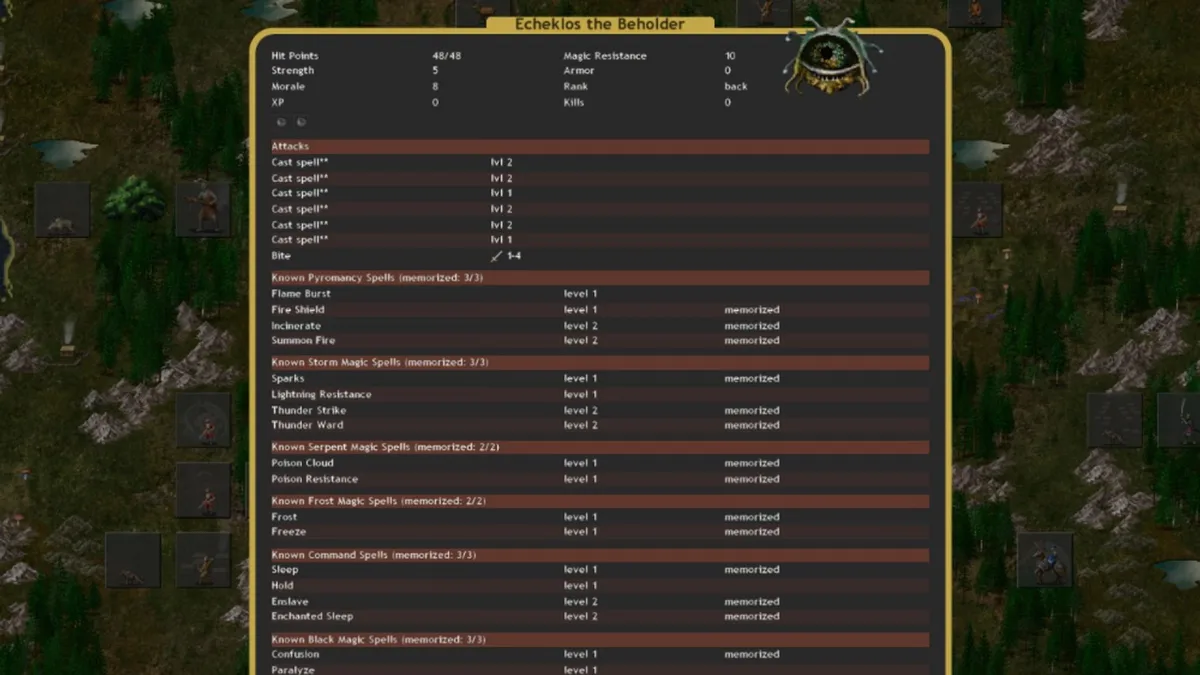
Weapons in this strategy game carry specific type labels that govern how an attack is used. A plain melee weapon is a close-combat attack, while a melee weapon marked with a variant lets that melee strike either be used or be replaced by the following attack, never both in the same round. Ranged weapons fire from the back rows, and further variants let a ranged weapon be used in melee instead of other attacks, or in melee in addition to them. Siege weapons function only against fortified structures such as cities and guard towers. Spell attacks follow the same restrictions as the cast-spell weapon type they belong to.
Every strike deals one of several damage types: blunt, piercing, slashing, fire, cold, shock, poison, or acid, and each type can be normal or magical. Poison behaves unlike the rest. When a unit accumulates a total poison value, it suffers ten percent of that total each round, rounded up, until the entire amount has been applied. Repeated poison attacks add their damage to the existing total, so a poisoned unit can become more poisoned. Poison immunity blocks new poisoning. Special damage that causes lasting effects, such as charm or enslavement, adds a pentagram icon to the unit's row of special abilities.
Unit Abilities: Movement, Stealth and Auras
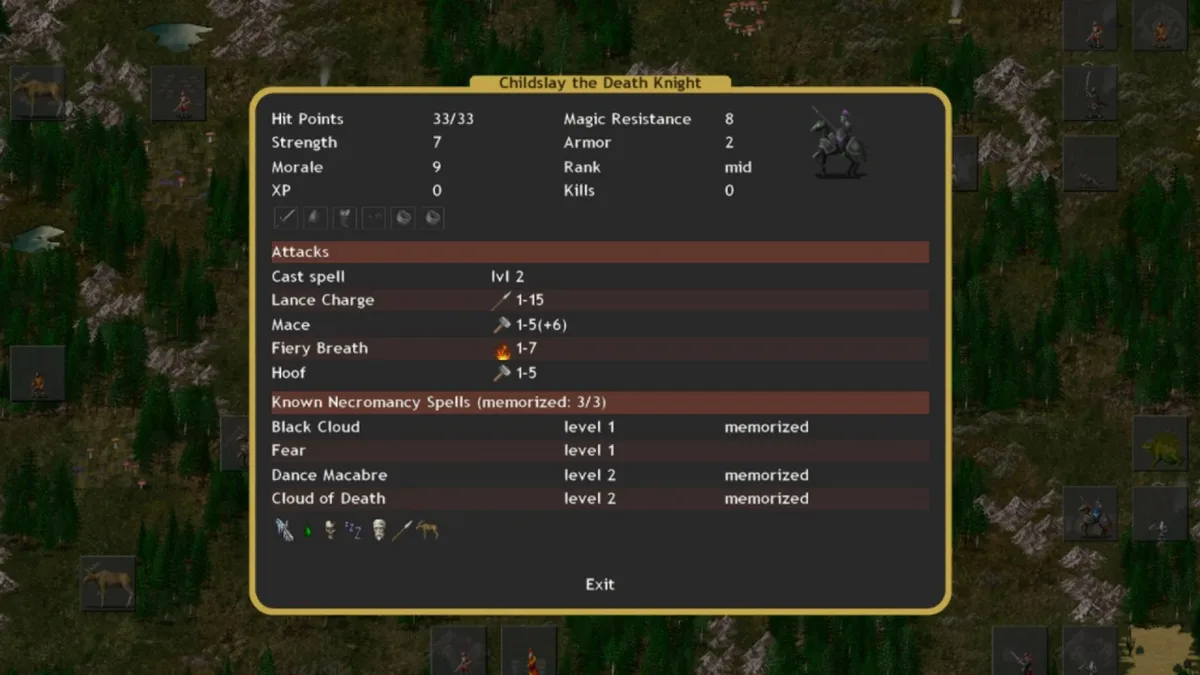
Special abilities are displayed as a row of small icons beneath a unit's attacks, or beneath its spells for spellcasters. Movement abilities set action points and terrain costs on the world map: normal units have 3 action points, slow units 2, and fast units 4, while immobile units cannot move at all. Aquatic units cannot travel on land. Some movement abilities go further and permit entry into squares that other units are denied.
Stealth and invisibility apply only on the world map, not in combat. A stealthy unit is seen only by an enemy with Acute Senses or Spirit Sight, and forest stealth works solely in forest or jungle terrain. Invisibility is detected only by Spirit Sight, which also reveals stealthy units. If an enemy moves onto the same square as such a unit, combat follows. Beyond movement and concealment, abilities include damage reduction and immunities, plus auras that affect other units for better or worse; final strikes trigger when the unit dies, usually harming nearby enemies. Leadership grants a morale bonus to assigned units, while local leadership boosts morale for all other units sharing its row.
Experience, Afflictions and Spellcasting Paths
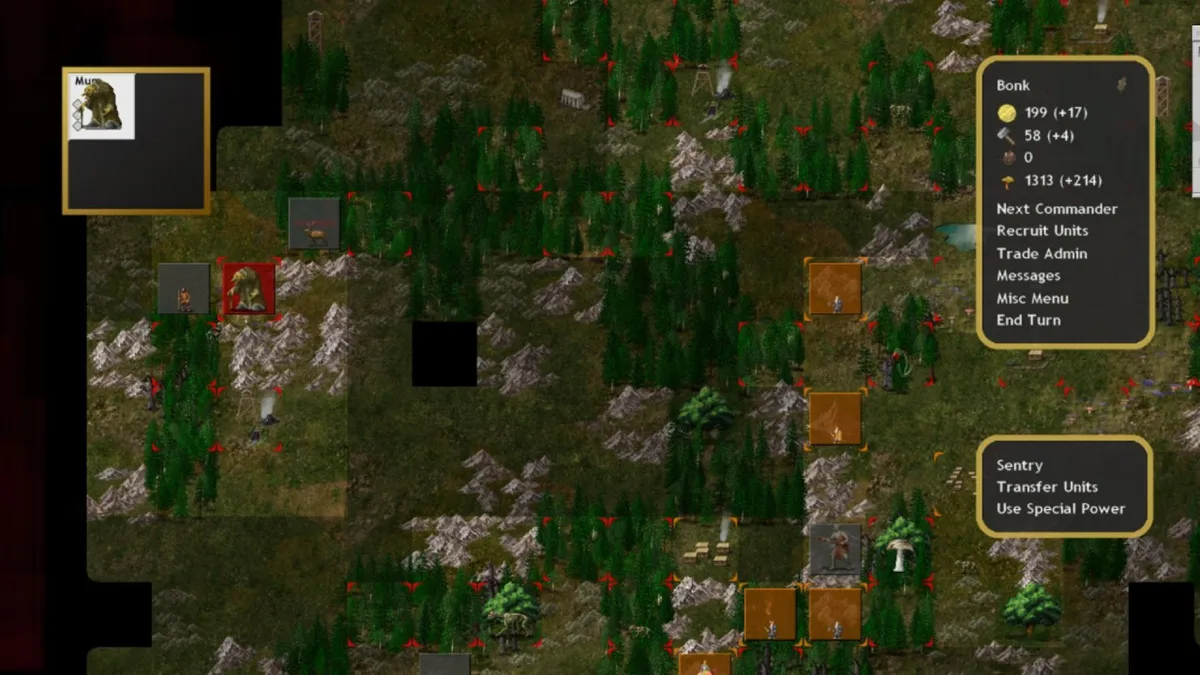
Troops gain experience as they spend time traveling and fighting battles. Experience points appear in a unit's primary statistics and accumulate at 1 XP per turn plus 1 XP per battle; a commander with the Army Trainer special ability is the only other source. Mindless units gain no experience at all. When a unit accumulates enough experience, it becomes experienced and receives bonuses, which are marked by star icons on its row of special abilities. Commands and normal units alike may also possess spellcasting skills in a path of magic, with 45 different disciplines in total. Magic skills are listed by discipline below the weapons, with initial spells ordered by level and later-learned spells listed in the order acquired. Spells act like weapons in combat, and their effects last for the battle unless they cause permanent effects such as disease.
Battle afflictions are permanent injuries and disabilities a unit suffers from being wounded in combat. They impose penalties on primary statistics or otherwise hinder performance. Unlike regular wounds, afflictions do not heal over time unless the unit has a special ability that also heals afflictions, such as Fast Heal, Regeneration or Immortal; no spells or rituals heal battle afflictions. Alongside these penalties, units may carry spellcasting skills in multiple disciplines, with each school's spells presented by level and acquisition order beneath the weapons, so a unit's attack entries and magic entries sit together in its statistics.
Magic Items, Scrolls and Summoning Trinkets
Magic items in Elysium come in six types: weapons, helmets, body armor, gauntlets, boots, and miscellaneous items. These types correspond to the item slots units possess, and a unit must have the matching slot to use a given item. As a rule, items can be used by any unit with the correct slots, not only commanders. Magic weapons replace the bearer's normal weapon with a different, magical one and may also provide benefits such as stat increases or special abilities. Other item types grant stat increases and abilities tied to their slot, including armor bonuses and resistances for armor, movement abilities for boots, and nearly anything for miscellaneous items.
Items are transferred from unit to unit by clicking the item slot where the item is located; this opens the Army Screen, and clicking the target unit moves the item there. If the target lacks the appropriate slot or its applicable slots are full, the item stays with its current owner. Summoning items bring creatures to aid the bearer in combat, occurring either at the beginning of battle when the bearer first acts or every round. Spell scrolls are miscellaneous items with an activated power that disappear after use; each permanently adds a new spell of the scroll's level to the user's spellbook, and high-level scrolls may add lower-level spells as well.
Sources & further reading.
- Conquest of Elysium 3 — official game profileRetrieved Oct 27, 2026
- Conquest of Elysium 3 — official game profile — publisher-supplied gameplay manualRetrieved Oct 27, 2026
First published .