 THE GAME ARCHIVE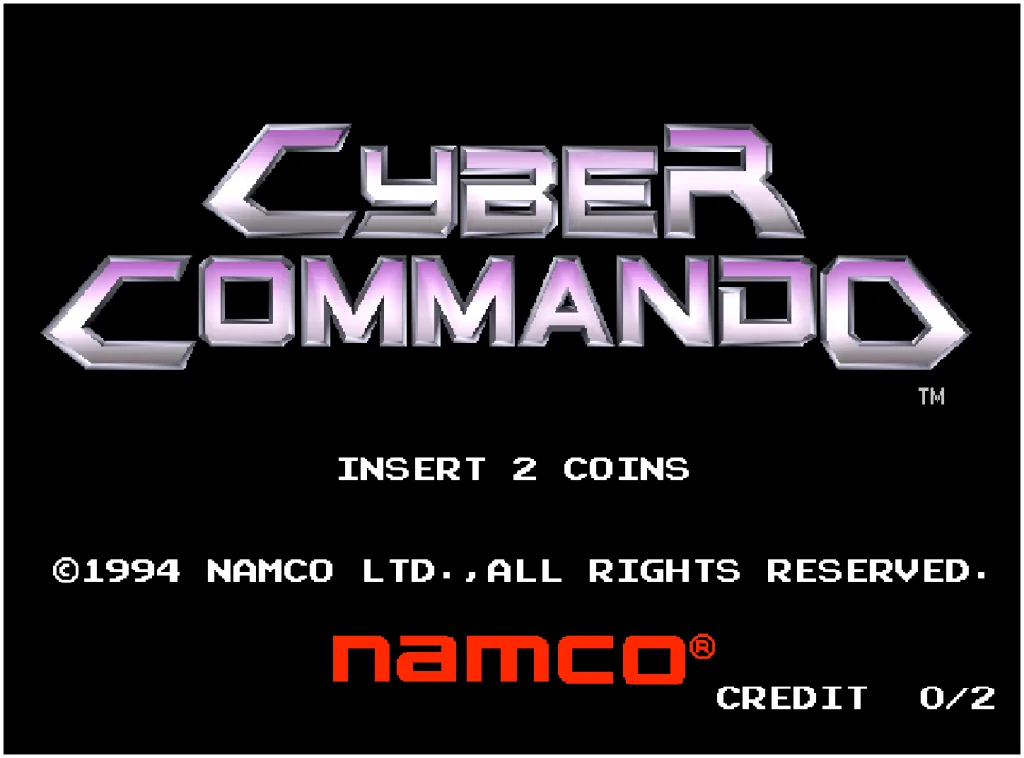
A Vehicle, a Malfunction, a Split-Second Window
CYBER COMMANDO is an action game released by Namco in 1994 for the arcade. Its premise is compact and concrete: a security computer malfunction has broken out in a space colony, and the player boards a vehicle and fights to stop it. From there the publisher's description leans on a single image — the thrill of locking on and slamming missiles into a split-second opening — combined with diverse strategies unique to each vehicle, all of which is said to accelerate an ultimate one-on-one battle. That short description is the documented core of the game, and it is enough to sketch what a player is doing at the cabinet.
What distinguishes the game within its catalogue entry is the combination rather than any one element. It is an arcade action title, but its documented action is missile combat built on a lock-on step and a narrow window for release, fought from a vehicle against a single opponent. The vehicle is not cosmetic: each one brings its own strategies. Read together, those supported pieces describe a game about committing to a craft, finding the instant the shot is available, and converting that instant before it passes.
The Premise: A Colony and a Runaway Security System
The documented setting is a space colony, and the documented task is to stop a security computer malfunction that has broken out there. Those two facts do the narrative work: the colony is where the conflict happens, and the malfunctioning security system is what the player is fighting. The description does not spell out story beats, characters or cutscenes, so the premise reads as a direct launch into the action — board the vehicle, enter the colony's crisis, and end it.
The vehicle is part of the premise, not just the controls. The player is told to board a vehicle and fight, which places the machine between the player and the malfunction. Everything else the source describes — locking on, missile launch, the split-second opening, vehicle-specific strategies — happens through that vehicle. Cyber Commando can therefore be understood as a game in which the craft is the protagonist's instrument and the battle is fought machine against machine.
The Core Loop: Lock On, Find the Opening, Slam Missiles
The documented combat sequence is short and specific. The player locks onto the target, and the payoff is slamming missiles into a split-second opening. The word choice matters: the opening is a moment, not a state, and the shot is something delivered into it. Structuring play around that single beat gives the game its rhythm — acquire the lock, wait out the moment before the opening presents itself, and release the missiles before the window shuts.
The phrase "the thrill of locking on and slamming missiles into a split-second opening" is the publisher's own framing, and it points to where the game places its emphasis: the release, not the approach. A player who fires without the lock, or who is slow once the opening appears, is not described as getting the same result. The split-second window is what turns the missile exchange into a timing decision rather than a simple button press.
Because the source describes this lock-and-launch pattern as the central thrill, the exchange can be read as the game's recurring unit of play: each moment of missile combat runs through the same arc. What changes from encounter to encounter is the vehicle providing the strategies around that arc. That is the documented structure the rest of this feature builds on.
Vehicle Choice: Why the Craft Matters
The publisher description credits each vehicle with diverse strategies unique to it. This is the clearest documented sign that the game is not a single uniform experience across machines: the strategies available depend on the vehicle, so the craft a player boards shapes the tactical options brought to the duel. The lock-on and missile launch remain the documented way a strike happens, while the surrounding strategy set is what the vehicle contributes.
The practical decision this creates is a choice of instrument before a choice of action. Picking a vehicle means picking the strategic vocabulary for the fight; the missile exchange is then played out using that vocabulary. The description does not itemize what those strategies are, so the analysis should stop at the supported point: vehicles differ in strategy, and that difference is presented as a feature of the combat rather than a cosmetic variation.
This also explains why the vehicle and the lock-on mechanic are intertwined in the source's own sentence. It does not describe lock-on in isolation and then vehicle strategies in isolation; it joins them, saying the thrill of locking on and slamming missiles into a split-second opening — combined with diverse strategies unique to each vehicle — accelerates the battle. The machine and the missile moment are presented as one combined driver of play.
The One-on-One Battle
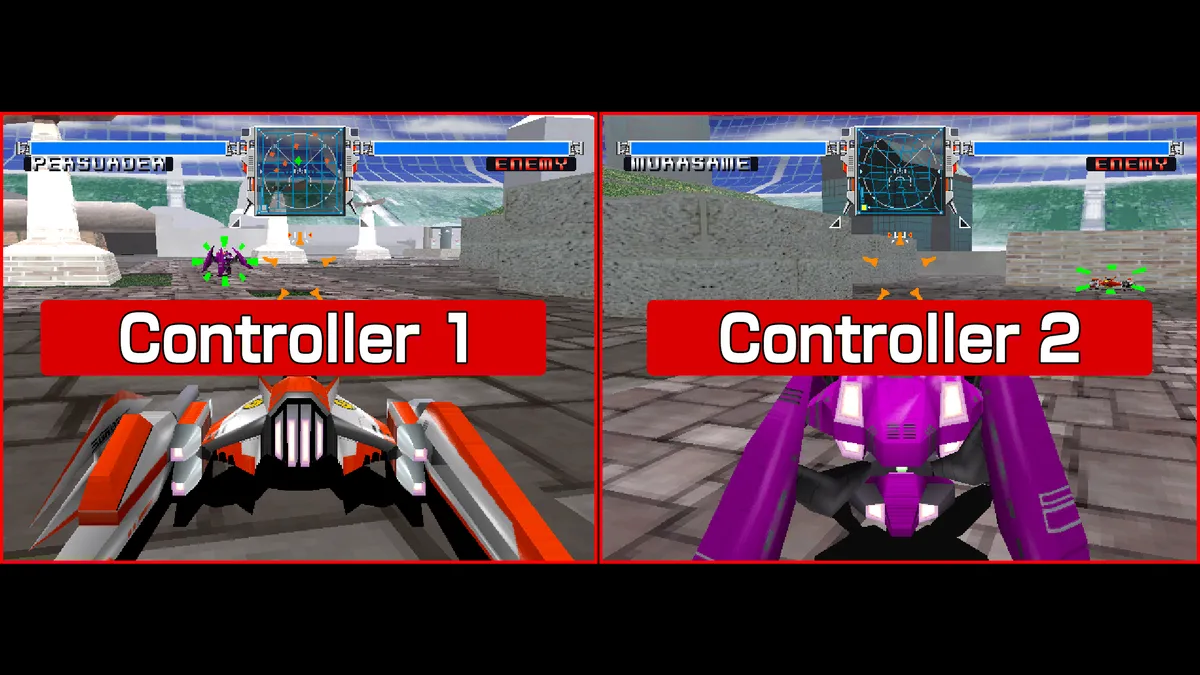
The publisher calls what these elements accelerate an "ultimate one-on-one battle." That framing establishes the format of the confrontation as a duel: the player's vehicle against an opposing side, in a head-to-head structure. The lock-on and missile exchange is aimed at that duel, and the vehicle-specific strategies are brought into it. The description presents that pairing of duel format and missile timing as the game's defining combination.
Read alongside the objective, the one-on-one battle is how the fight against the malfunction is conducted. The player boards the vehicle to stop the security computer malfunction, and the documented style of that fight is the one-on-one clash in which lock-on missiles find their split-second mark. The source does not describe crowds of minor enemies, battlefield maneuvering or large-scale stages; the supported picture is a focused confrontation built around the missile exchange.
Reading the Missile Exchange: What the Description Teaches
The description supports a few starting expectations even without a manual. First, the split-second opening means patience before the release: the shot is described as being slammed into an opening, so recognizing when it appears is part of the documented skill. Second, the lock-on step precedes the strike. Third, the vehicle's strategies are a genuine variable, so the machine is worth thinking about as the toolset for the duel rather than a fixed default.
These are cautious inferences drawn strictly from the documented rules; the source does not supply command lists, stage routes or difficulty tuning. What it does communicate is the priority order of play: establish the lock, seize the brief moment, deliver the missiles, and lean on what the chosen vehicle uniquely offers. That is the supported basis for approaching the arcade game.
The 1994 Arcade Original
CYBER COMMANDO was released by Namco in 1994 as an arcade title. That original cabinet run is a distinct thing from any later appearance, and the publisher documentation distinguishes the original game from the Arcade Archives reissue context. When discussing the game's design — the space colony, the malfunction objective, the vehicle, the lock-on missiles, the split-second opening, the per-vehicle strategies and the one-on-one battle — those are contents of the 1994 original as described by its publisher.
The vehicle and duel framing also situate the game within its genre entry: it is catalogued as an action game, and the documented action is the missile duel conducted from a machine. The publisher description is brief, but it is consistent — premise, vehicle, missile timing and duel format all point at the same kind of play. That coherence is worth noting when placing Cyber Commando among 1994 arcade action titles.
Modern Access: Arcade Archives Modes and Conveniences
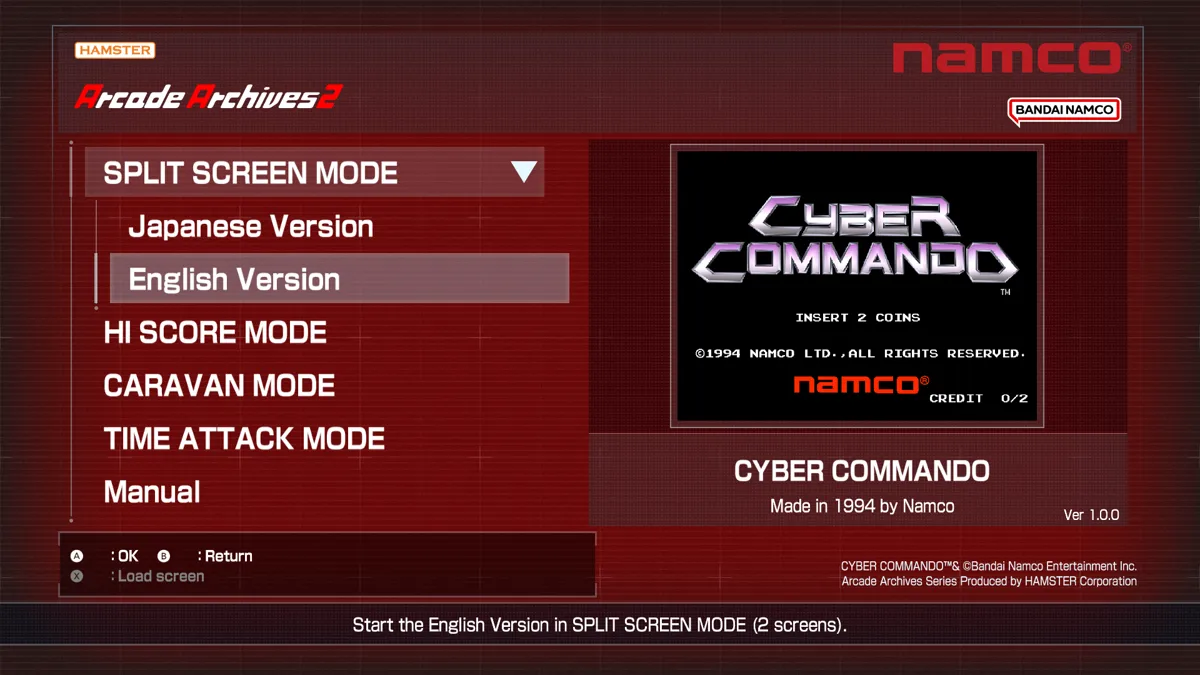
The modern licensed reissue places Cyber Commando under the Arcade Archives banner, a series described as being developed to faithfully reproduce classic arcade games while staying true to the originals. In ORIGINAL MODE, the reissue gathers convenience features: difficulty and display settings, button remapping, rapid-fire options, the ability to create multiple save files at any time, and a rewind function to undo your last move. Some titles also offer special settings that recreate the nostalgic atmosphere of CRT televisions.
Scoring competition is handled through dedicated modes. In HI SCORE MODE and CARAVAN MODE, players compete for the best scores with others around the world through Online Rankings. The Arcade Archives 2 series introduces a brand-new TIME ATTACK MODE in addition to ORIGINAL MODE, HI SCORE MODE and CARAVAN MODE; TIME ATTACK MODE focuses on how quickly you can complete the game, regardless of the score you achieve. The documentation also notes VRR (Variable Refresh Rate) support, framed as reproducing gameplay more accurately and closer to the original arcade experience. These are reissue features, not contents of the 1994 original.
For the missile duel specifically, the save-file and rewind tools change the stakes of the split-second window in an interesting way: a mistimed release need not end the attempt, because the player can step back to before the opening closed. Difficulty and display settings and button remapping sit alongside that, adjusting how the classic arcade experience is presented rather than altering the documented core of lock-on and missile combat.
Sources & further reading.
- CYBER COMMANDO — licensed publisher game documentation Retrieved Oct 17, 2026
First published .