 THE GAME ARCHIVE
Dark Messiah of Might & Magic, developed by Arkane Studios and published by Ubisoft for Windows, is an Action-RPG set in the Might & Magic universe. Its combat documentation describes a game about deciding how to spend a moment: charging a strike, timing a parry, choosing a spell, and shaping the battlefield before a fight begins.
Charging the Adrenaline Bar and Unleashing Finishers
The adrenaline bar sits among the heads-up display elements alongside the equipped weapon, mana bar, stealth bar, selected spell, and crosshairs. Striking enemies with weapons and spells fills it. A charged power strike forms the core offensive loop: holding the left mouse button adopts an offensive stance, and releasing delivers a powerful blow. The manual lists five different attacks depending on which button is held while charging the strike, so the release itself becomes the decision point.
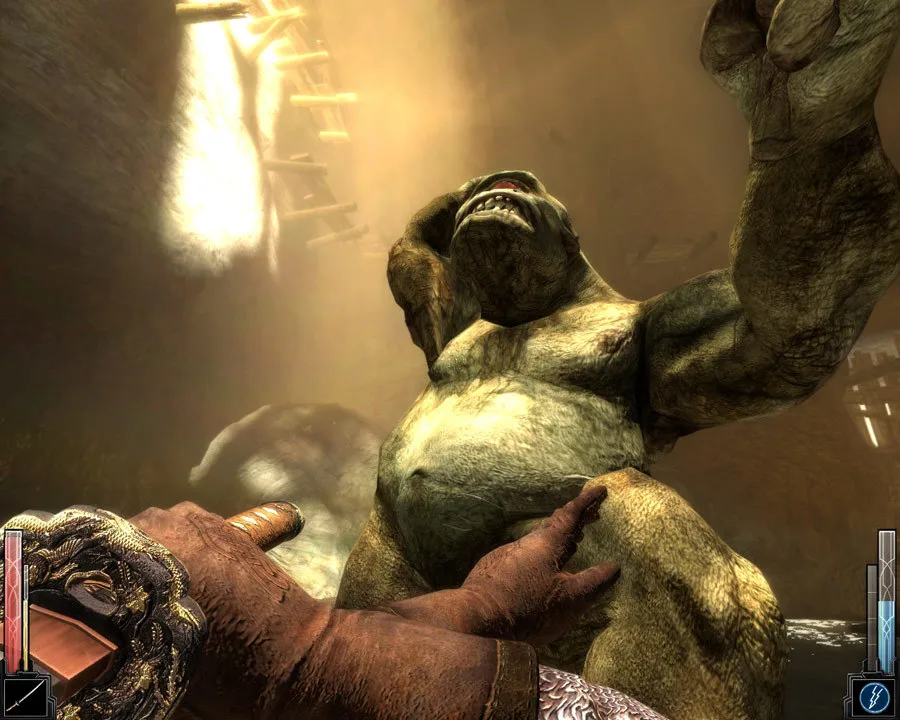
With a full adrenaline bar, a power strike becomes a fatality that slays the enemy, and the move changes based on what the player aims at; aiming at the head beheads the target. A full bar also upgrades equipped spells. Fireball's adrenaline effect destroys the opponent, Freeze permanently freezes a creature, and Lightning Bolt gains an enhanced version. Telekinesis can grab living creatures and massive objects instead of only distant props.
Skill Points and the Three-Branch Skill Tree
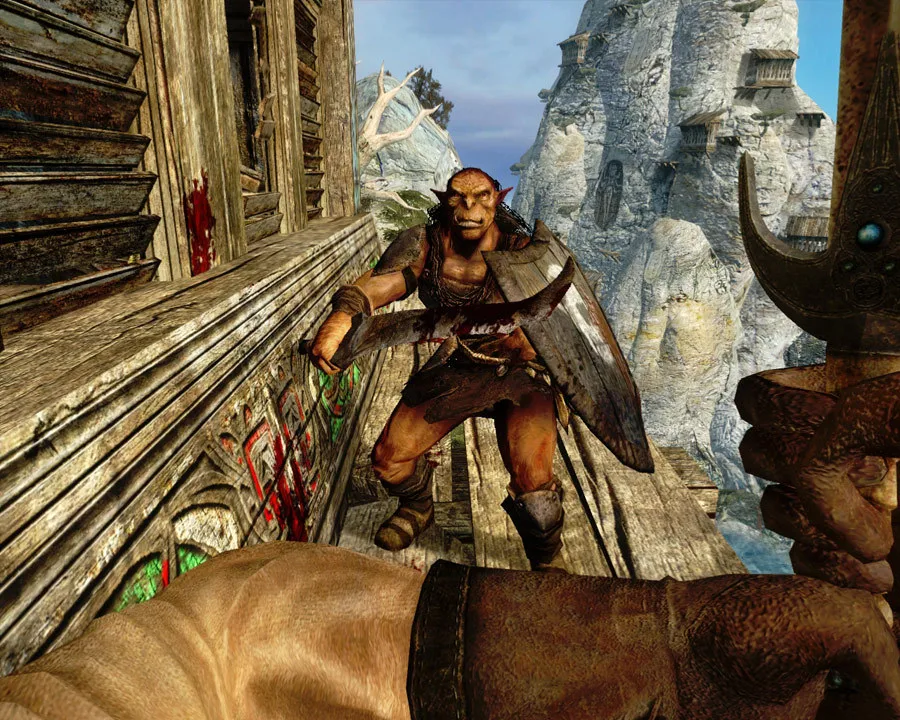
Skill points in Dark Messiah do not come from the bodies you leave behind. Defeating enemies grants nothing toward progression; points are awarded only after you complete a mission objective. The manual stresses that many mission types exist, some of them secret, and that finding the right pathway is the player's job if maximum points are the goal. Because kills are decoupled from advancement, a stealthy run that slips past guards and finishes the objective pays the same as a loud slaughter, shifting the incentive toward route-finding and objective play rather than clearing rooms.
Accumulated points are spent through an interactive skill tree opened from an icon in the interface; clicking a skill-type icon displays the corresponding tree. Selecting a node brings up a window with a short description and its cost, and a double-click purchases the skill. The trees divide into weapon, spell, and miscellaneous abilities, and the same screen hosts the Vitality passive that raises the rate of health regeneration. Since points arrive in fixed amounts tied to objectives, each purchase is a real allocation decision across the three branches rather than a reward for grinding.
Swords, Daggers, Staves, and Bows
The manual sorts weapons into four classes, each with a distinct combat role. Swords are described as powerful and very effective in melee, while daggers suit sneaking behind an enemy to deliver deadly blows. Staves deal less damage than swords or daggers but work against large groups because they more easily stun and knock enemies down. Bows cover ranged fighting, supported by archery skills for zooming in, steadying aim, and reloading faster. Daggers and other close-combat weapons need skill upgrades before they reach full effectiveness.
The mouse controls split attack, defense, and utility. Left-click attacks or casts a spell, right-click is held to parry, and the mouse wheel displays and selects belt items. Parrying cannot be performed while armed with a bow, so the bow user forgoes that defensive option. Parrying right before an enemy strikes destabilizes the attacker and opens a counter-attack. Because the manual separates these inputs, the right-click parry and the timed counter form the close-combat defensive layer, while the wheel keeps belt items reachable in the middle of a fight.
Spells, Stealth, and Environmental Kills
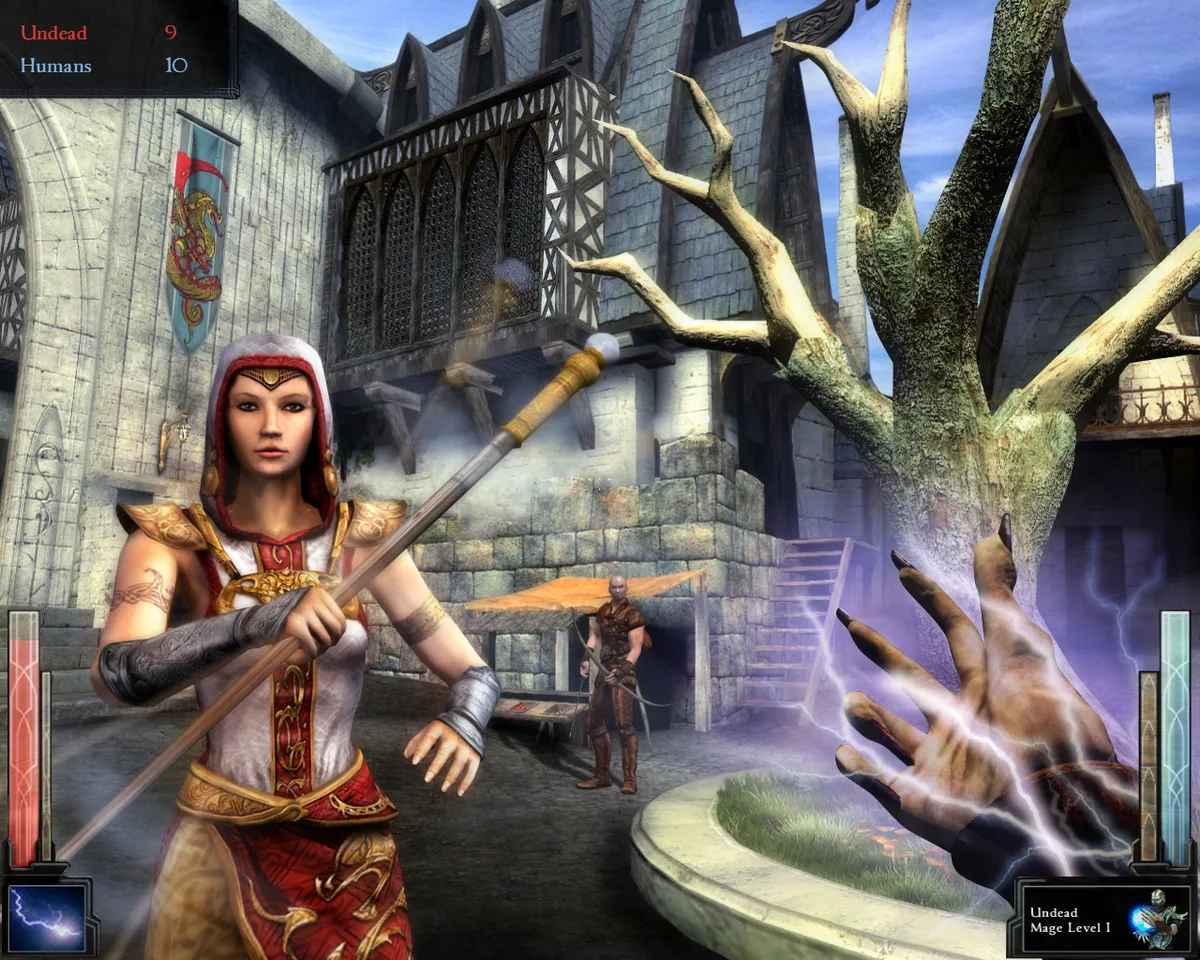
Fire and lightning form two spell specializations, with Fireball launching a large exploding projectile that hits multiple enemies and can be steered by holding the cast, while Lightning Bolt electrocutes targets and bounces off walls. Casting Lightning Bolt onto water electrifies enemies standing in it, and Freeze throws a non-lethal ice projectile that holds a foe for a couple of seconds and leaves a slippery patch where it strikes the ground. A Fire Trap sets an invisible magical trap that detonates for fire damage when an enemy comes near, and Flame Arrow fires a guided fire projectile that splits into several projectiles under adrenaline.
The stealth branch lowers footstep noise at level one, unlocks dagger backstabs against an enemy who has not spotted you at level two, and at level three lets you hide in shadows while walking and pickpocket unaware enemies to steal a key. Animals tracking by smell see through the shadow hiding. The Burglar knowledge covers picking door locks and detecting traps by targeting a lock and using tools on it. Environment kills round out the toolkit: topple pillars onto crates and barrels, kick enemies beside spiked walls to impale them, and ignite oil-filled jars or barrels to burn them.
Multiplayer: Factions, Classes, and the Crusade Campaign
Multiplayer expands the combat into four modes: Deathmatch, Team Deathmatch, Capture the Flag, and Crusade. Deathmatch is a free-for-all in which you minimize your own deaths while maximizing your opponent's within a time limit, and Team Deathmatch applies the same logic across two teams. Capture the Flag asks you to seize the opposing team's flag and carry it to your home flagpole to score, but only while your own flag is on its pole; a dropped enemy flag can be picked up by another teammate running over it, and if an enemy touches their fallen flag it returns to its initial position.
Crusade is a single unified mode in which two teams battle through evolving objectives across one map at a time; the winning team advances to the next map. The campaign spans five maps split between Human and Undead, with each faction's stronghold as the target at both ends, and ultimate victory comes from destroying the opponent's stronghold. Play begins on the middle map, where the teams fight for the balance of power. Multiplayer also removes weapon pickups: experience points earned by capturing a flag or killing an enemy instead buy new skills, with five classes available, an Archer built for single-target damage, a Mage for area-effect spells, and a Priestess for curing or cursing and resurrection.
Scroll sideways to see the full table →
| Detail | Value |
|---|---|
| Title | Dark Messiah of Might & Magic |
| Developer | Arkane Studios |
| Publisher | Ubisoft |
| Platform | Windows |
| Genres | Action, RPG |
Sources & further reading.
- Dark Messiah of Might & Magic — official game profile Retrieved Oct 20, 2026
- Dark Messiah of Might & Magic — official game profile — publisher-supplied gameplay manual Retrieved Oct 20, 2026
First published .