 THE GAME ARCHIVE
Hunting Clues in DinerTown Crime Scenes
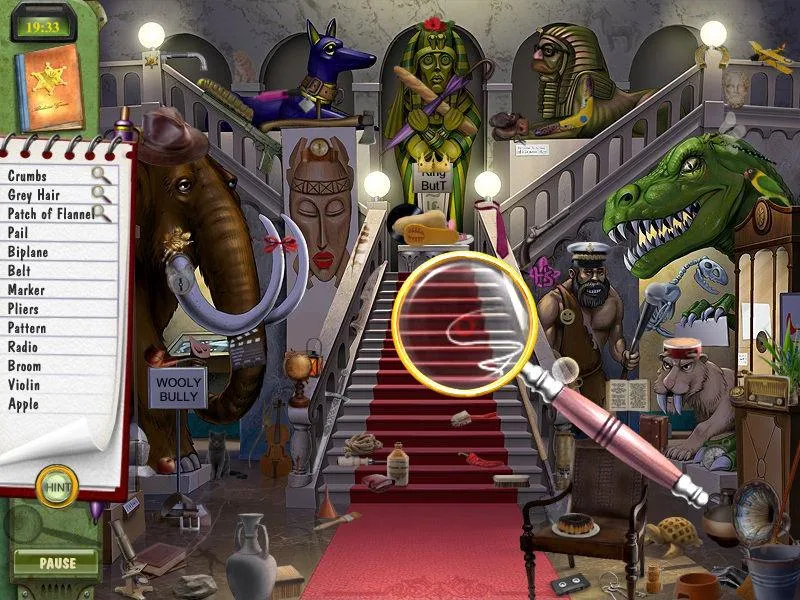
In DinerTown Detective Agency, the hidden-object hunting is framed as detective work. Players help Bernie the Bookworm pursue the title of a real detective by searching crime scenes for vital clues. The settings are DinerTown mysteries rather than abstract rooms, and the case subjects lean comic: someone has put a finger into every jelly donut, and zoo animals have been partying like rock stars. Within each scene, the task is to locate the hidden items that count as clues. Searching a location and collecting found items are the two halves of the same activity, with the items serving as the raw material for the investigation.
The documented rules connect found objects to suspect deduction. Items picked up in a crime scene are used to narrow the list of suspects and identify the culprits, so collecting clues and analyzing them are linked steps rather than separate diversions. The game presents this as a lighthearted parody of traditional hidden-object games, with the searching wrapped in case-solving. A broader thread runs alongside the individual cases: while working through the head-scratchers, players may uncover a real mystery that affects everyone in DinerTown. The crime-scene hunt therefore feeds both the immediate case and that larger town-wide thread.
From Found Items to Named Suspects
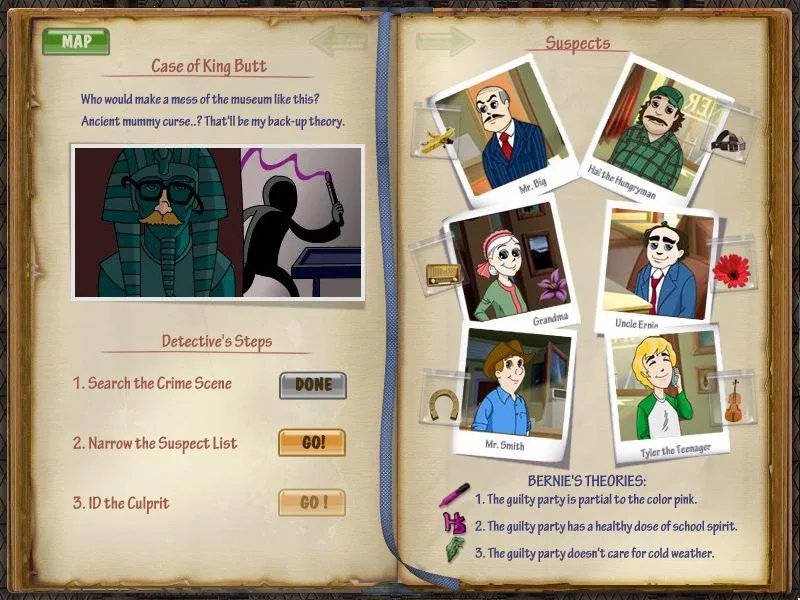
Once a crime scene has been searched, the items gathered there become the working evidence for the case. The documented rule is direct: found items are used to narrow the list of suspects and to identify the culprits. That makes the analysis phase a matter of elimination, where each recovered object trims the field of possible offenders until only the responsible party remains. The collecting and the deducing are therefore joined into one loop, since nothing narrowed without something found first.
The suspects come from the town's cast of DinerToons characters, and the game invites investigation of all the familiar faces because any one of them might be a suspect. The player, working as Bernie the Bookworm's helper, is the one who identifies the culprit using the clues found as evidence. Alongside the individual cases, there is a second thread: while working through the head-scratchers, the player may uncover a real mystery that affects everyone in DinerTown.
Twenty-Five Cases and Their Built-In Puzzles
The game is built around twenty-five unique cases, each handled as its own investigation rather than as a single continuous hunt. Progression follows a case-based structure: completing a case moves the player forward to the next one, so the twenty-five mysteries form the backbone of the campaign. Each individual case is not limited to a single search, either. Every case holds multiple puzzles, and puzzle-solving elements are part of the wider design, giving each crime scene a set of built-in tasks beyond simply spotting the clues. Within a case, the hidden-object searches and the puzzles work as connected stages of the same investigation. Found items become the material used to narrow the suspect list, and the multiple puzzles that fill out each case extend that work until the case is resolved. Because completion of one case is what advances the progression, the suspect-deduction step is the natural close of each case's puzzle chain before the next of the twenty-five begins.
Each of the twenty-five cases is self-contained enough to carry its own series of puzzles, with the puzzles functioning as a documented element of play alongside the clue hunting. Solving a case is the trigger for moving on: once the clues have been used to narrow the suspects and identify the culprit, that case is complete and the next mystery can be taken up. This keeps the forward motion tied to resolving cases rather than to any separate unlock condition. The combination gives each case a two-part rhythm. The player first searches a crime scene and gathers the hidden items, then applies the multiple puzzles within that same case until the culprit is named. Across the set of twenty-five, every case repeats this pattern of search, puzzle, and deduction, so the case-based structure and the per-case puzzle load reinforce one another.
Twenty Locations and Four Mini-Games
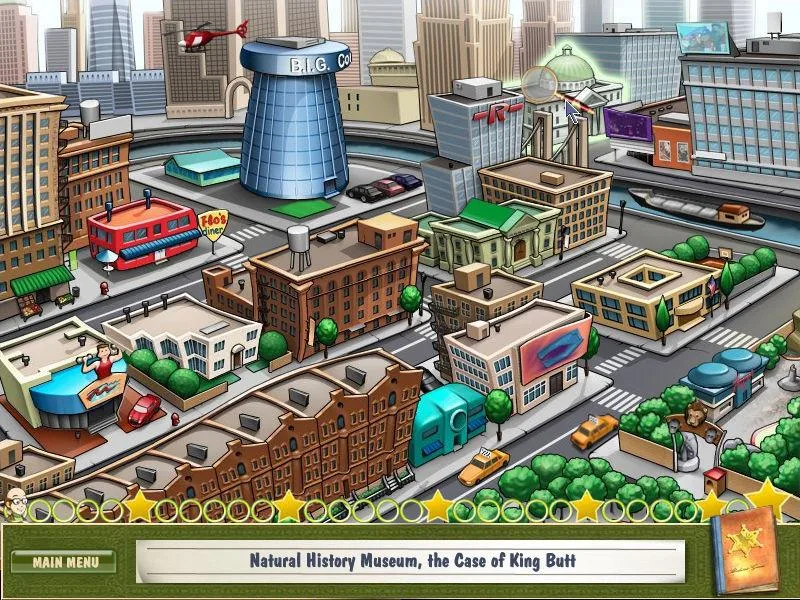
Across the investigation, searches take place in twenty locations spread throughout DinerTown, so the clue hunting is distributed across the town rather than confined to one set of rooms. Each stop is a place where hidden items count as evidence, and the found objects feed the suspect-narrowing step once the search is done. The lighthearted spoof framing carries into these locations as well, since the crimes themselves stay comic: a finger in every jelly donut, zoo animals partying like rock stars.
Four mini-games sit alongside the clue hunting as documented tools for solving the cases. They are distinct from the hidden-object searching itself, giving each case another kind of task to work through before the culprit is named. The multiple puzzles attached to every one of the twenty-five cases and these four mini-games are listed as separate features, so the case work combines location searches, per-case puzzles, and the mini-games rather than relying on spotting alone.
Sources & further reading.
- DinerTown Detective Agency™ — official game profile Retrieved Oct 18, 2026
First published .