 THE GAME ARCHIVE
Voice in Command: Radio-Style Orders and the Third-Person Battlefield
Issuing orders in EndWar works as a two-way radio exchange rather than a simple click. Holding down the Voice Command Key, bound to the Space Bar by default, transmits to your units, and while the key stays pressed a menu of military order codes appears on screen. You read the keywords one after another to command individual units or task groups, directing them to move, attack, call in off-map mission support, or deploy reinforcements. Alongside voice, units are selectable by mouse cursor or keyboard shortcuts, and one voice phrase sets the camera on a chosen unit.
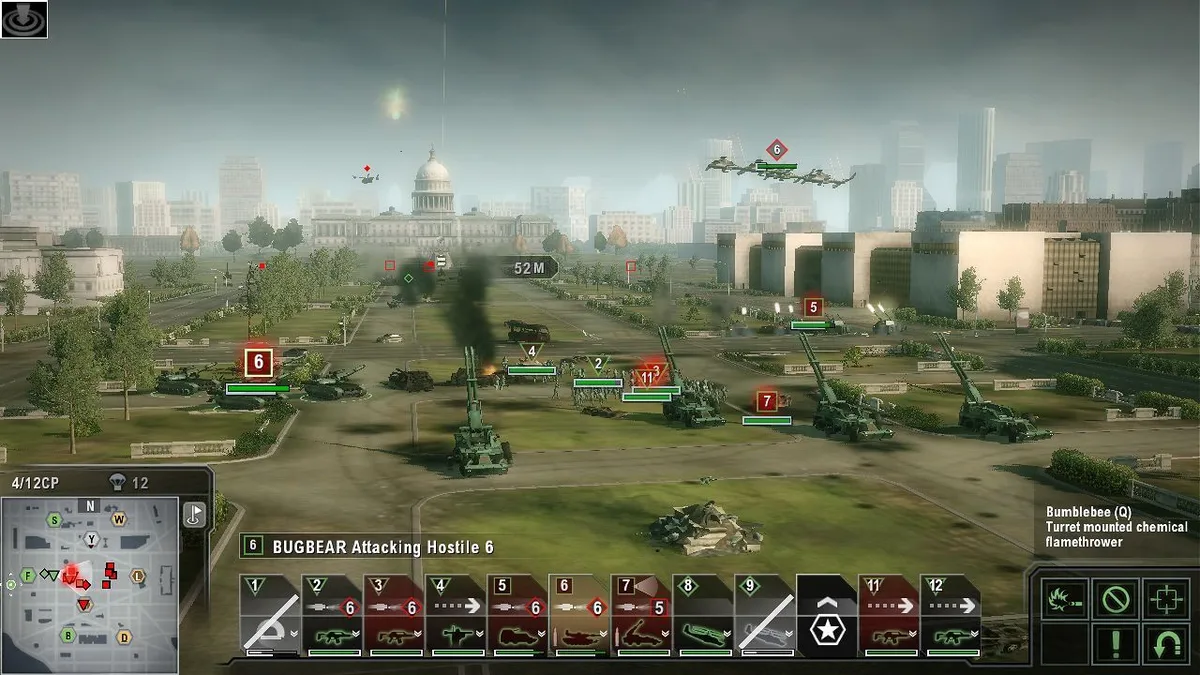
The view is a third-person camera instead of the usual top-down perspective, placing the player inside the battle and making terrain and cover critical to victory. The camera belongs to a Point of View unit: you always see the battlefield through one of your own units, and its Unit Card in the Unit Dashboard shows a camera cone marking that view. Swapping is immediate — select a unit in the Unit Dashboard, or point at a unit with the cursor and double-click, or use a voice command to reassign the camera. Zooming in and out is done at will while hundreds of units engage.
The Seven Unit Types and Their Battlefield Roles
EndWar fields seven playable unit types: Riflemen, Engineers, Transports, Tanks, Gunships, Artillery, and Command Vehicles. Riflemen are elite soldiers who form the mainstay of the forces, able to take cover, garrison buildings, and secure and upgrade uplinks; they can also receive stealth and sniper upgrades. When caught out of cover they are vulnerable to vehicle units, and their effectiveness climbs while in cover or garrisoned. Engineers are heavy infantry that bring battlefield computers, explosives, and anti-armor weapons, and like Riflemen they can use cover and garrison buildings to survive hostile combat.
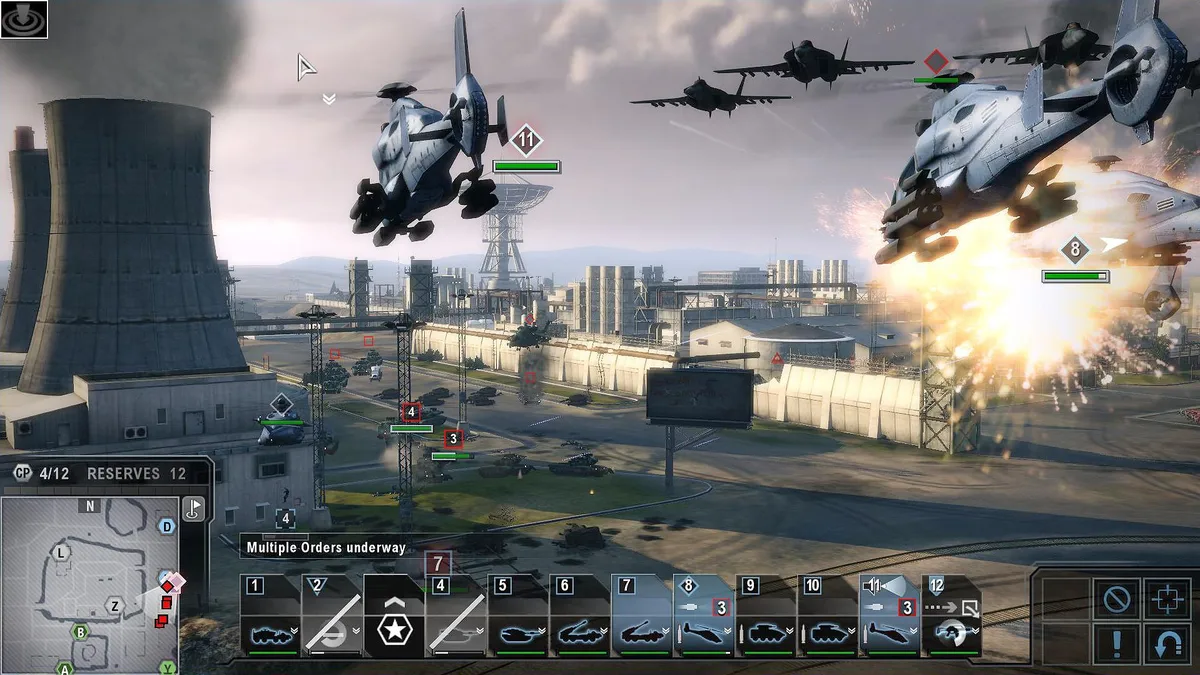
Cover and garrisoning are treated as critical for infantry, granting defensive bonuses plus rate-of-fire and range benefits. Transports and Engineers in cover threaten Gunships, while Gunships in turn are effective against Tanks and Artillery. Artillery delivers long-range, non-line-of-sight fire support and area bombardment with high-powered cannons, but is ineffective and vulnerable at close range. Command Vehicles act as mobile field bases, supplying intel, the SITREP command overview, and long-range combat support; they can be upgraded with sentry drones and unmanned aerial vehicles, yet are vulnerable in direct combat.
Uplinks, Command Points, and the DEFCON 1 Endgame
Uplinks are the central strategic objectives in battle. Only infantry units can capture or upgrade them, so a selected infantry unit targets a neutral uplink with the reticle and right-clicks, or issues a radio order such as securing a named uplink with a numbered unit. The unit moves to the site and begins securing it, with an icon and gauge on its Unit Card tracking progress. Once secured, an uplink provides Command Points, and upgrading it grants access to powerful off-map mission supports. Upgrades can be interrupted and resumed, but an upgraded uplink that is destroyed loses its upgrade.
Command Points serve as the battle currency: more of them let Central Command offer additional units or extra support. They accumulate simply by surviving, and securing uplinks increases the gain. They are spent deploying extra units onto the battlefield or requesting mission supports such as Air Strikes. Three off-map support types can be unlocked by upgrading uplinks — Air Support, Force Recon, and Electronic Warfare — each with three levels gained by upgrading multiple uplinks of the same type, and each support may have a recharge time. When victory or defeat grows close, DEFCON 1 unlocks powerful supports to secure a win or turn the tide.
Mission Types: Conquest, Assault, Raid, and Siege
The mission structure offers four distinct modes with their own win conditions. In Conquest, the aim is to secure more than half of the uplinks on the battlefield and hold them until the victory timer runs out; crucially, that timer pauses if the side that had been winning loses control of the majority of uplinks, so losing the uplink lead stalls the countdown back toward defeat. Assault instead asks you to seek and destroy every enemy unit on the field, while Raid puts you either as attacker destroying over half the map's critical targets before the countdown ends, or as defender keeping over half of those targets intact. Artillery units cannot be deployed during Raid missions.
Siege splits the roles cleanly: the attacker must capture the critical uplink and hold it until the timer countdown finishes, whereas the defender must eliminate all enemy units. The defender in a Siege is cut off from all support as the mission begins; until the reinforcement timer ends, that side cannot deploy reinforcements or call off-map supports. These objectives tie into deployment rules, since certain mission types impose limits, barring a given unit type or capping how many of a specific type can be fielded according to the mission.
Ranks, Upgrades, and the Persistent Battalion
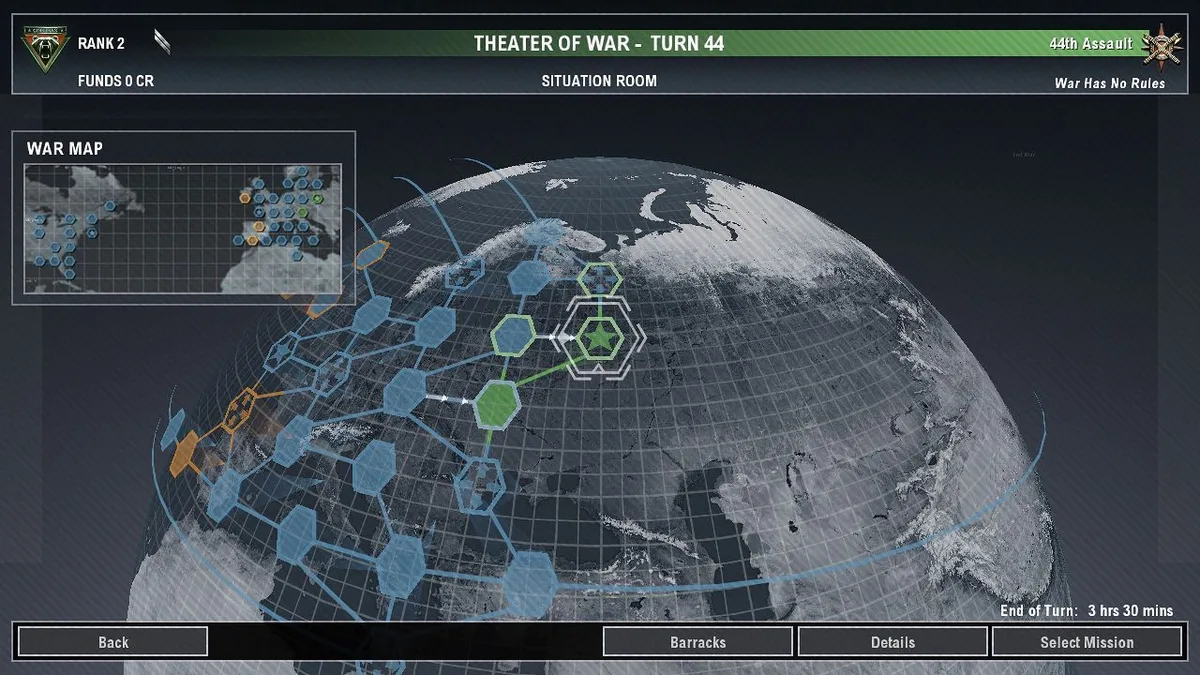
In the World War III and Theater of War online campaigns, you build a personal army, and surviving units gain experience from battle and climb through ranks. Promotions are awarded only after battles, so a unit's rank carries forward between fights. Six rank levels exist in total, and rank shows on the Unit Card in the Unit Dashboard. Veteran units hold higher morale and combat capabilities than new recruits and can access more advanced upgrades and weapons than fresh units can.
Between battles, the main campaign screen opens the Barracks, where credits buy upgrades. Purchases apply to an entire unit type rather than a single unit, split into four categories: Attack, Defense, Mobility, and Ability. Each upgrade has a credit cost, and you need sufficient funds to buy it. Some upgrades also carry rank requirements, working only for units at or above that rank. The battalion is further customized through advanced weapons, special-ability upgrades, and a selectable camouflage pattern.
Factions and Online Matches
Players pick a side from three factions: the United States Joint Strike Force, the European Enforcer Corps, or the Russian Spetsnaz Guard Brigade. Each brings a distinct doctrine to the field. The Joint Strike Force descends from the Marine Expeditionary Force and leans on air and ground combat, precision fire, fast deployment, plus stealth and robotics technology. The Enforcer Corps draws troops from across Europe, excels in urban conflicts and electronic warfare, and fights with energy weapons. Spetsnaz units handle Russian operations, and whichever faction you choose governs the units and tools available in matches.
Online play supports up to four players in multiplayer matches, played against other people for world domination across a variety of modes and options on the internet. Getting online requires an Online Keycode, found on the back cover of the manual, and a valid Ubi.com user account. Skirmish pairs you against the AI or other players over the Internet or a local network, opening a Game List page that shows the fastest games you can reach, with a Filter Games option to narrow the listed matches.
Sources & further reading.
- Tom Clancy's EndWar™ — official game profile Retrieved Oct 13, 2026
- Tom Clancy's EndWar™ — official game profile — publisher-supplied gameplay manual Retrieved Oct 18, 2026
First published .