 THE GAME ARCHIVE

V.A.T.S.: Pausing the Wasteland to Queue Your Shots
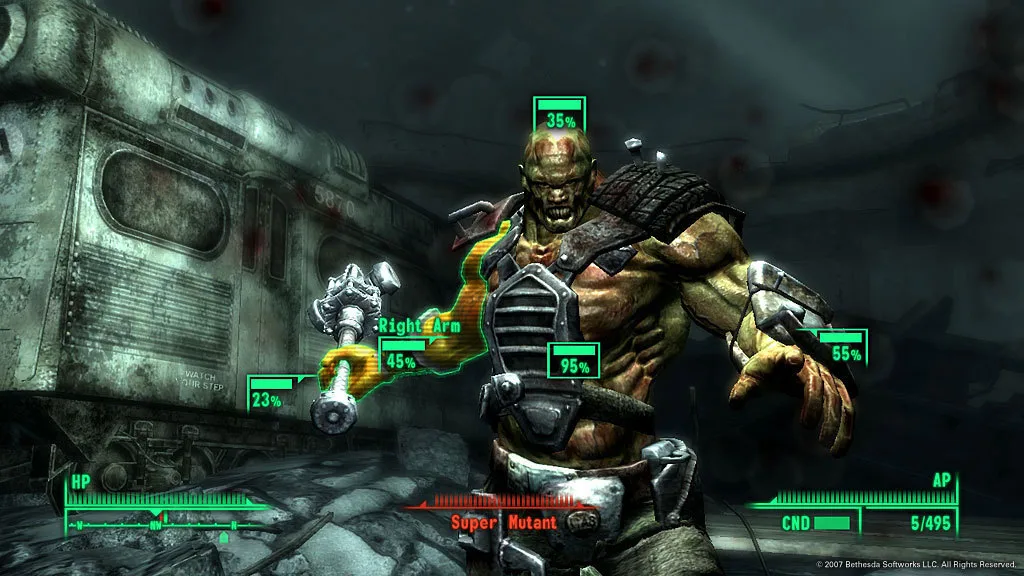
Holding the V.A.T.S. key pauses the game and scans the surrounding area for targets. Selecting an enemy and releasing the key zooms in, letting you pick a specific body part before committing an attack. Each queued strike draws from an Action Points bar, which drains as you stack up shots; the flashing portion of that bar shows the cost of your next attack, and holding the left mouse button reveals what another shot would require when AP runs low. Two more indicators sit alongside it: enemy health, where the flashing segment previews the damage a successful hit would deal, and limb condition, which disappears to show a crippled body part.
The system also tracks how many targets you can juggle. As long as Action Points remain, you can switch among available targets and attack each one, so a single paused round can cover several enemies. Weapon type changes the rules: melee weapons and unarmed combat require close proximity, while both melee and grenades count as full-body attacks that cannot be aimed at a specific limb. Smaller weapons generally consume fewer Action Points per shot. Body-part targeting pays off in other ways too, since different limbs often yield different damage, and crippling effects follow from those choices.
Building a Survivor: S.P.E.C.I.A.L., Skills and Leveling
Character building starts with seven S.P.E.C.I.A.L. attributes: Strength, Perception, Endurance, Charisma, Intelligence, Agility and Luck. Each one shapes concrete outcomes rather than serving as flavor. Strength sets raw physical power, affecting how much you can carry and how effective all melee attacks are. Perception grants bonuses to the Explosives, Lockpick and Energy Weapons skills and governs when red compass markings appear to signal threats. Endurance measures overall physical fitness and feeds into bonuses, so the numbers you set at the start ripple through combat and skill checks alike.
Experience Points drive leveling: once you hit the required total, you level up automatically, provided you are not in combat. Each level raises your Health, grants Skill Points you assign to your skills, and lets you pick a new Perk. Those Skill Points feed specialized abilities such as Barter, which lowers prices on purchased items and depends on Charisma, or Big Guns, which covers oversized weapons like the Fat Man, Missile Launcher, Flamer, Minigun and Gatling Laser and depends on Endurance. Your Karma status, tracked as Evil, Good or Neutral with a rank inside it, also appears in your records.
Perks That Change the Fight
The Black Widow and Lady Killer perk sits at level 2 with a single rank and no requirements, and it splits by sex: in combat you deal 10% more damage against male opponents as Black Widow or female opponents as Lady Killer. Outside of combat, dealing with the opposite sex sometimes opens unique dialogue options, so the same perk changes both the damage of an exchange and the conversation preceding one. Because it needs no attribute or skill threshold, it can be selected as soon as a character reaches the appropriate level and picks a perk.
The Ninja perk has one rank and requires a Sneak skill of 80% and a Melee Weapons skill of 80%. Attacks made with Melee or Unarmed weapons gain a 15% critical chance on every strike, and sneak attack criticals deal 25% more damage than normal. The perk therefore stacks a steady critical boost with a bonus on stealth-opened critical hits, tying two skills a character must raise before the perk becomes available to the close-range fighting styles it rewards. Ranged attacks receive neither part of the effect.
Guns, Grenades and Gear That Wears Out
Ranged combat in Fallout 3 runs through three weapon skills: Big Guns, Energy Weapons and Small Guns. Accuracy and damage both trace back to your skill level with the relevant category, then pass through weapon condition and the target's Damage Resistance. Firing is a crosshair affair, with left click attacking; holding the button on an automatic weapon keeps it firing as fast as it can. Empty a magazine and your character reloads automatically as long as spare ammunition is available, while tapping R forces a reload at any moment.
Grenades and mines belong to the Explosives skill, which sets the power of any mines you place, how easily hostile mines can be disarmed, and how effective thrown grenades are; the skill is tied to Perception. Armor works as Damage Resistance, the percentage of incoming damage absorbed, and the rating is the combined total of every piece worn, with some pieces contributing more than others. Apparel may trade protection for stat or skill boosts such as Charisma or Repair. As armor takes damage its condition drops, reducing the protection it gives; weapons of lower condition likewise deal less damage and jam more often. In the Pip-Boy, selecting Repair on an item lets you fix it only if you have similar items to scrap as parts, and the outcome depends on your Repair skill.
Sneaking, Rads and Patching Yourself Up
Crouching, done with the left Control key, puts the character into a stealth state shown by four markers. HIDDEN means nobody detects you, DETECTED means someone sees you without being an enemy, CAUTION means someone is searching, and DANGER means an enemy has spotted you. How well you stay unseen depends on the Sneak skill, which only functions while crouching and also makes it easier to steal items or pick pockets, along with each enemy's Perception, line of sight, lighting, movement and the weight of worn apparel.
The Pip-Boy screen presents a RAD readout that lists current radiation resistance and the total rads your character has absorbed. Exposure comes directly from the environment or from eating irradiated food and drinking irradiated water. If RadAway sits in the inventory, pressing A flushes accumulated rads from the system; with Rad-X, pressing X raises radiation resistance for a period of time. Healing a crippled limb offers three choices: sleep in a bed, visit a doctor, or use a Stimpak. General Stimpak healing also slightly repairs crippling, while highlighting a body part and applying the Stimpak restores that part's condition directly.
Your Own Path Through the Capital Wasteland
The character's starting situation is Vault 101, a Vault-Tec facility the protagonist has lived in for nineteen years. That routine ends when the father leaves the vault without warning, and the player follows him into the Capital Wasteland. Once outside, the objective of pursuing him is open rather than forced: the survivor can track the father down, disregard him, or head straight into the ramshackle town of Megaton and meet its inhabitants. An alternative to talking with the locals is to shoot first and exchange pleasantries later, so the same arrival can play out as a conversation or a firefight.
Beyond the town and the pursuit, the manual describes a wasteland seeded with hidden traps disguised as harmless objects, including a common toilet, a box of ammunition and even a baby carriage. These contraptions are meant to kill and should be avoided once spotted; the same discoveries can then be used against the enemies who set them. The manual's stated principle is that each challenge has multiple ways of solving it and multiple outcomes, with no single right way to play. It points to dialogue options and combat approaches as examples of those different paths to success.
Sources & further reading.
- Fallout 3 — official game profile Retrieved Oct 18, 2026
- Fallout 3 — official game profile — publisher-supplied gameplay manual Retrieved Oct 18, 2026
First published .