 THE GAME ARCHIVE

Twelve Regions, Two Centuries: The Shape of the Campaign
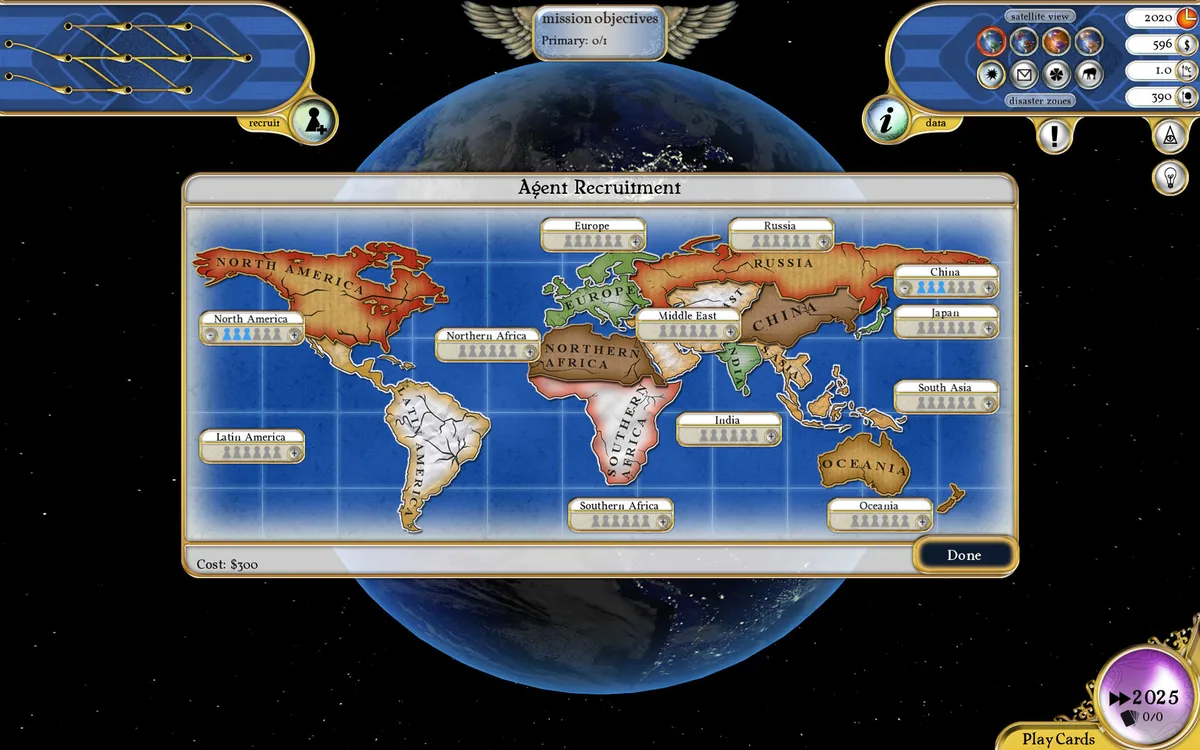
The campaign spans two centuries, running from 2020 to 2200, and is built from a dramatic set of global scenarios grounded in the latest science. Within that frame the world is divided into twelve regions: China, Europe, India, Japan, Latin America, the Middle East, North America, Northern Africa, Oceania, Russia, South Asia, and Southern Africa. Managing those regions is the recurring unit of play, and the two-century horizon means decisions made early are carried forward across the whole span rather than resolved in a single sitting.
The central balance is between protecting the Earth's resources and climate and meeting the demands of an ever-growing world population for more food, power, and living space. The stated objective is to shape the future of the planet, and the game explicitly asks whether you will help the whole planet or act as an agent of destruction. That framing matters because the same regional management and policy tools can be pushed in opposite directions over the full 2020-to-2200 stretch.
The Policy Deck: Over 100 Levers for Climate and Population
The policy set holds more than 100 major policies, organized into broad areas: geoengineering, technological research, international aid, diplomacy, economics, emergency defences, species protection, forestry, health, energy choices, population, politics, and clandestine operations. Each area is a different kind of lever. Technological research and energy choices shape how the world produces power; forestry and species protection govern land and wildlife; international aid and diplomacy work across regions; economics and emergency defences address costs and crises; population and politics handle the human side; and clandestine operations add a covert tool to the mix.
Policies affect both climate and population, which is why the deck is where the central balancing act is actually managed. A choice aimed at the resource and climate side may ease or tighten population pressure, and the two-century projection lets those trade-offs accumulate over time. The same range of levers also supports the game's opposite trajectories, helping the whole planet or acting as an agent of destruction, so the deck is a shared instrument for either path rather than a fixed set of safe options.
Forty Technologies, Fifty Species: The Research and Conservation Tracks
Two long tracks run alongside regional management and policy work. The first is a technology program covering 40 specific future technologies to develop, with examples including nuclear fusion, biofuels, nanotech, robots, AI, smart grids, advanced medicine, synthetic food, and space exploration. These fit within the technological research area of the policy deck, so progress on a given technology is a concrete project within that track rather than a one-off policy switch.
The second track is conservation: 50 signature animal species to save against the backdrop of enormous biodiversity loss. The objective is stated plainly as saving those 50 species, which connects to the species protection and forestry areas of the policy deck. The species list gives the conservation side a fixed roster of targets across the 2020-to-2200 horizon, while extinctions appear among the game's documented impacts, so conservation failures register as concrete outcomes rather than abstractions.
Over 1,000 Impacts and Six Tipping Points
The world responds to play through more than 1,000 impacts: storms, floods, heatwaves, flash fires, desertification, glacial melt, sea level rise, resource wars, drought, famine, dissidence, extinctions, epidemics, technological breakthroughs, energy shortages, and political backlash. These are the documented ways conditions register, spanning environmental shocks, economic strain, social unrest, and scientific advances within one running catalogue of outcomes. In practice the list is what makes the two-century projection legible: the player is reading a stream of consequences rather than a single score.
Six tipping points sit at the dramatic end of that scale. They are described as world-changing events, and the Amazon collapse and the Antarctic ice shelf collapse are named among them. They represent the large, headline shifts that can punctuate a campaign distinguished otherwise by the accumulating impacts listed above.
Reading the Planet: The 3D Globe and Earth Overlays
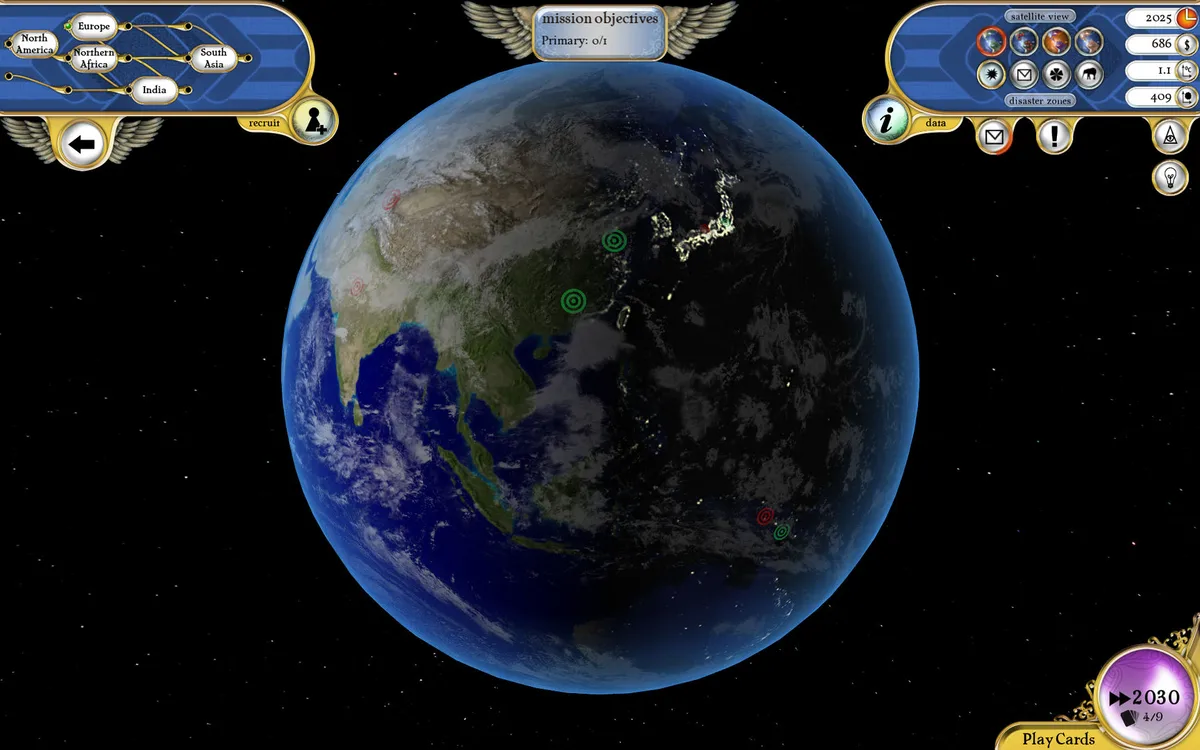
The visual center of the campaign is a 3D Earth globe that shows climate-related changes, accompanied by Earth telemetry that visually graphs past and future change. The globe therefore functions as a moving record of the two-century projection, giving the player a changing picture of conditions alongside the underlying numbers.
Earth overlays sit on top of the globe and reveal three specific local readings: temperature change, devastation, and population. These overlays are the layer where regional detail surfaces, and the underlying simulation is built on a scientific model by Dr. Myles Allen of Oxford University together with detailed real-world data gathered over years of research. The overlay readings are therefore grounded in that model rather than invented on the fly.
How a Campaign Plays Out
Putting the systems together, a campaign is essentially a long, structured argument between policy and consequence. You enter a dramatic scenario grounded in the latest science, manage twelve regions over two centuries, and choose from over 100 major policies that affect climate and population. Research into 40 future technologies and protection of 50 signature species run as parallel projects, while the model returns over 1,000 impacts and, at the extremes, 6 world-changing tipping points. Each decision propagates into the next stretch of the timeline rather than being resolved on its own.
The documented rules suggest a practical stance for a first campaign: treat the policy deck as the primary control surface, because climate and population outcomes respond to it directly, and think of the long technology projects and the species roster as commitments that need sustained attention rather than one-off clicks. Watch the impact feed and the globe overlays together, since the impacts summarize what the model is producing while the overlays reveal where temperature change, devastation, and population stand. The game does not document specific optimal builds, so these are habits implied by the stated mechanics rather than a prescribed strategy.
Scroll sideways to see the full table →
| Feature | Documented value |
|---|---|
| Time span | 2020 to 2200 |
| Regions | 12, including China, Europe, India, Japan, Latin America, Middle East, North America, Northern Africa, Oceania, Russia, South Asia, Southern Africa |
| Major policies | Over 100 |
| Future technologies | 40 |
| Signature species to save | 50 |
| Impacts | More than 1,000 |
| Tipping points | 6 |
| Scientific model | Dr. Myles Allen, University of Oxford |
Sources & further reading.
- Fate of the World — official game profile Retrieved Oct 21, 2026
First published .