 THE GAME ARCHIVE
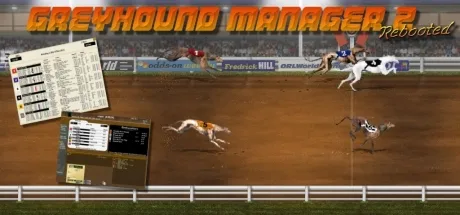
Greyhound Manager 2 Rebooted connects kennel preparation with race-day judgement. You train dogs, plan entries, examine form and place bets, then watch whether those preparations produce a result. Its central management problem is that winning races and building funds are related but different objectives: the trainer must accumulate money while climbing the Trainers Championship table. Decisions about readiness therefore sit alongside decisions about which races to enter and how to interpret the field.
A Kennel Campaign or a Betting Contest
The standard trainer game begins with £15,000 and three dogs. The goal is a successful kennel and a place at the top of the Trainers Championship, not simply one lucrative victory. An ordinary win generally returns less than £100. Feature races pay more—the Wimbledon Derby offers £100,000 to its winner—but are highly competitive. That contrast makes financial planning part of the campaign rather than something automatically solved by collecting routine race wins.
Punter Match removes player-owned and trained dogs. After selecting players and entering their names, each takes a turn examining forthcoming meetings, opening race details and placing bets. Once the last player finishes, the race can be watched or skipped before payouts. The first player to win a million wins the game. Both this mode and Standard Training support single-player and multiplayer play, offering a choice between managing the runners and concentrating on betting.
Readiness Is More Than Fitness
Check both Fitness and Condition on a dog's data screen: peak performance requires high values in each. Light training rebuilds fitness that has fallen very low, such as after injury or a long rest. Red Intensive training brings fitness to 100% and race readiness, but leaving it selected throughout the season makes a dog become jaded sooner than occasional rest would. The useful decision is when to prepare for a target race, rather than whether to keep intensive work permanently enabled.
Training emphasis operates over the longer term. Flat mixes speed and stamina normally; Uphill slightly favours stamina, while Downhill slightly favours speed. Specialist work concentrates on trapping, railing or jumping. Railing means negotiating bends without running wide. These specialisms compromise regular training and switch intensity to amber Light, making high fitness difficult to maintain. Clear the special-training icon before returning to intensive work. Earlier specialist progress survives a break, but improvement can take many days, and some dogs cannot improve in the selected area.
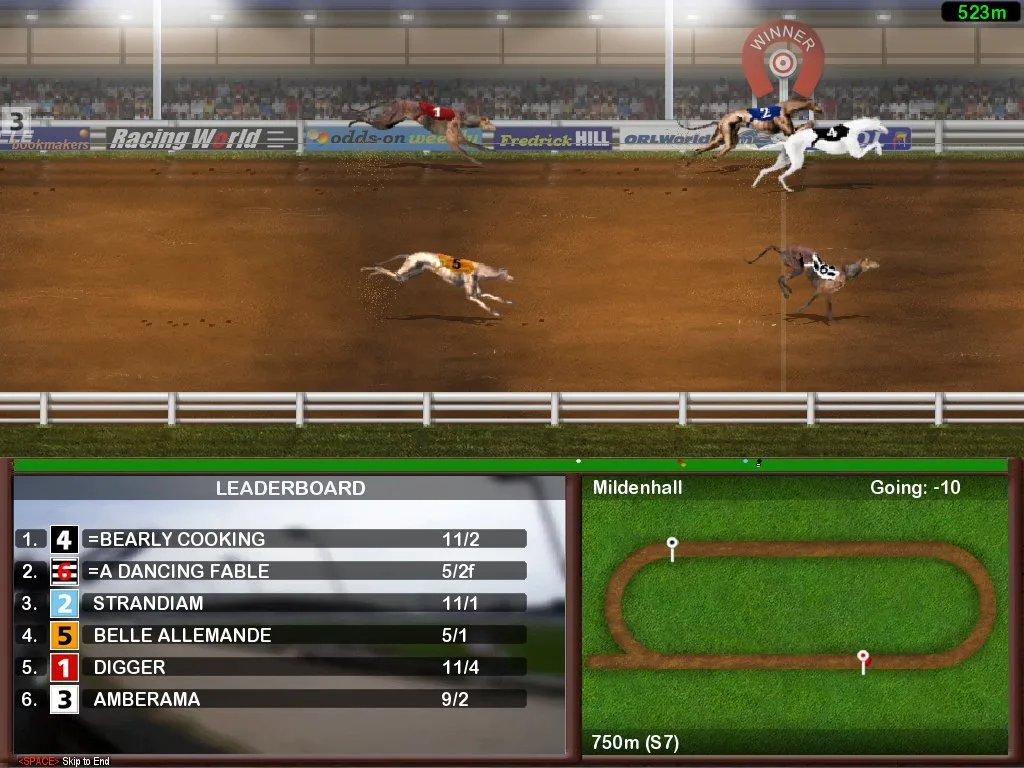
Training trials let your dogs run against one another, showing how they compare over different distances without racing them. They also boost fitness, and the manual recommends trialling close to a race. This gives preparation an observational purpose as well as a conditioning benefit: you can compare runners instead of choosing only from their displayed statistics. For players who prefer to leave training to the game, Simple Mode under Game Settings handles it automatically.
Grades, Draws and Reading the Race
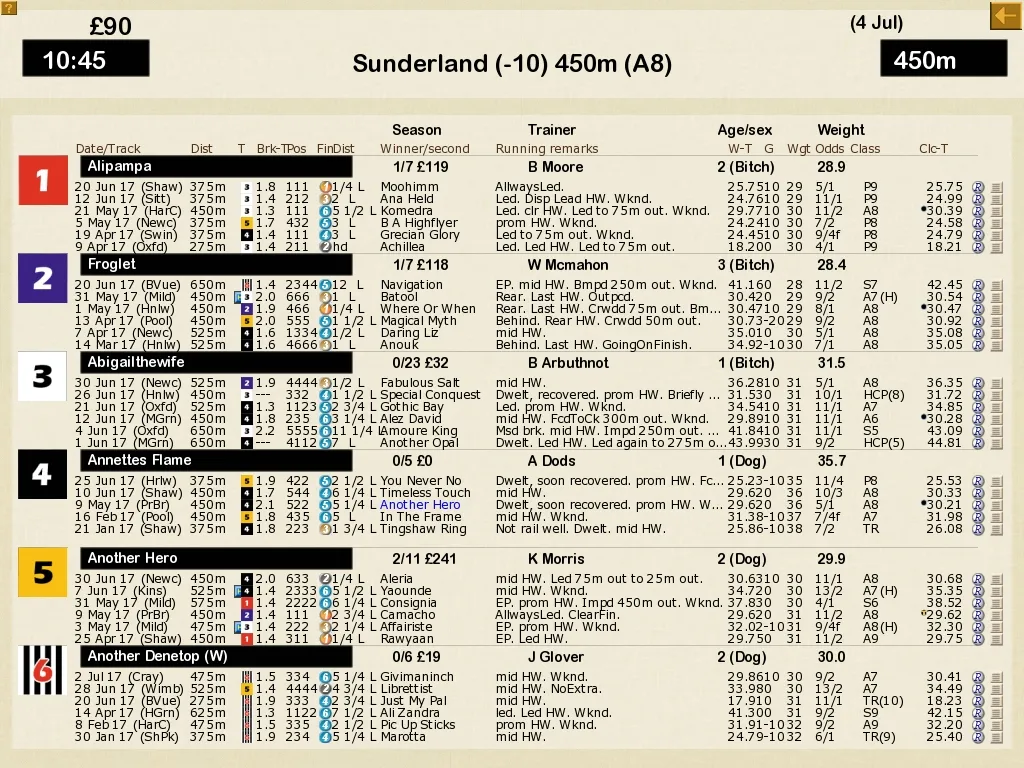
Following a trial race, the grader assigns a grade between 1 and 10, with 1 the best. A graded dog can enter its matching graded race—A7 takes grade-seven dogs—or a handicap, open race or further trial. The grader may reassess after every race and tends to judge finishing position rather than finishing time. Progression is therefore not a permanent unlock ladder: a dog's classification can change with subsequent results, altering its matching graded-race entry.
Draws are normally random, but known wide runners receive outside positions to reduce interference. Handicaps are the exception: the lowest-graded dog, such as a grade-ten runner, starts from the lowest trap number and receives the greatest staggered-start advantage. Form commentary adds another layer to analysis. Its abbreviations include “Qaw” for “quickly away,” providing information about the run beyond the finishing result. Read the draw and commentary alongside the placing rather than treating that placing as the whole account.
Planning at Home, Judging at the Track
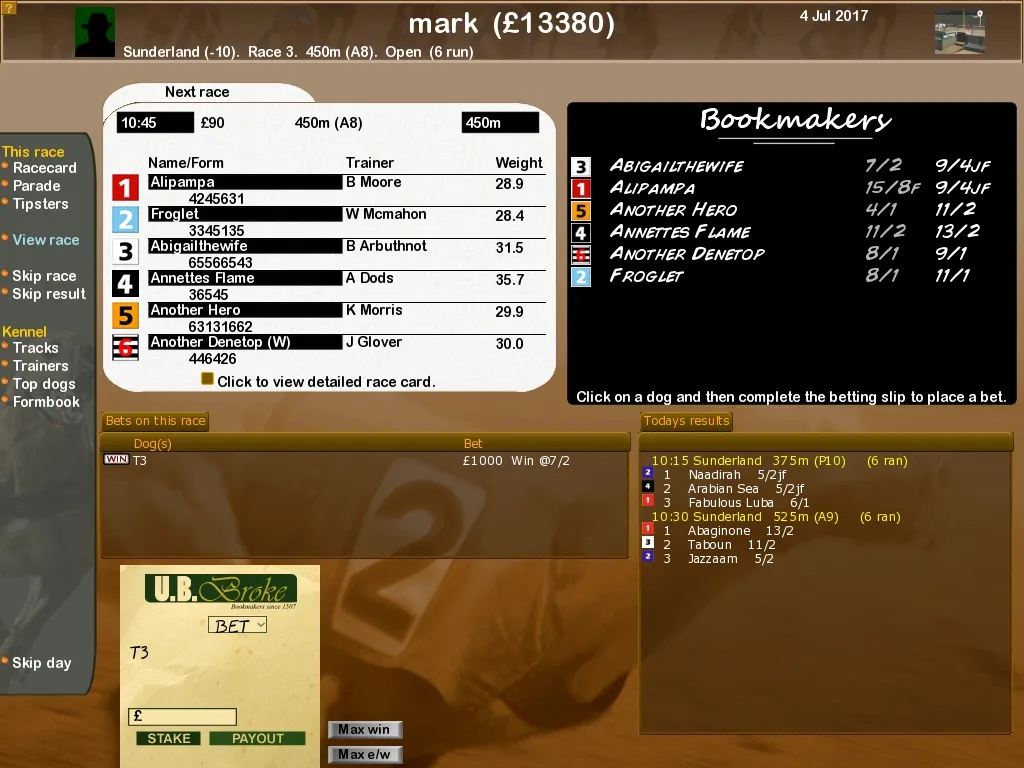
The interface separates preparation from race day. Kennel/Home contains training, finances, race planning, entries and form analysis. At the Track, you inspect current entries, statistics and form before betting and watching. Auto Days can provide previous form by simulating races before play begins, but there is a cost in trainer mode: weekly kennel deductions still apply during those days, reducing starting funds. Choosing it trades some opening money for an existing record of performances to examine.
Facilities, Health and the Next Generation
Kennel purchases have specific roles. Training Hurdles permit home hurdle trials and may improve jumping, although trialling requires the Training Circuit. Training Traps may improve trapping, while a capacity upgrade adds space for one dog in the main kennel. Health has a separate decision: judge symptoms yourself or purchase a vet visit through Finance. A successful diagnosis replaces the Symptoms icon on Home with an Injury icon and displays an estimated recovery time in weeks.
Dogs can race from age one and are likely to improve during their first year or so, but usually deteriorate badly around four or five. With Breeding Facilities purchased, retirement can move a dog into the breeding kennel instead of removing it from the game. When a breeding session ends, the Breeding button flashes so you can check success. Successful females give birth after the season ends; an unnamed one-year-old puppy appears at the next season's start and is cared for automatically by kennel staff and vets.
Sources & further reading.
- Greyhound Manager 2 Rebooted — official game profileRetrieved Nov 11, 2026
- Greyhound Manager 2 Rebooted — official game profile — publisher-supplied gameplay manualRetrieved Nov 11, 2026
First published .