 THE GAME ARCHIVE

Stand, Stalking and the Climb Through Challenge Tiers
Hunting Unlimited 2011 names its two game modes Stand and Stalking, while its challenge progression is organized into tiers of increasing difficulty. Within that structure, you choose a weapon to suit the mission or your own preference rather than receiving a single prescribed choice. Accumulating points unlocks upgraded weapons and new hunting areas, so progression expands both the equipment you can select and the places you can hunt. The climb through the tiers therefore has two concrete rewards: access to additional locations and a broader weapon selection for tackling the challenges.
Mission-specific bonus modifiers award extra points, connecting each challenge’s scoring opportunities to the points used for unlocks. Alongside that progression, the game lets you review records by hunting location: highlight an area on the map to see its highest scores. Wall trophies provide a separate view of achievement, displaying the top trophy score in each category. These records track different things rather than presenting only one overall result. The map organizes high scores around where you hunted, while the trophy display organizes best scores by category; bonus modifiers belong to the individual missions.
Cabin Loadouts: Shotguns, Compound Bows and Rifles
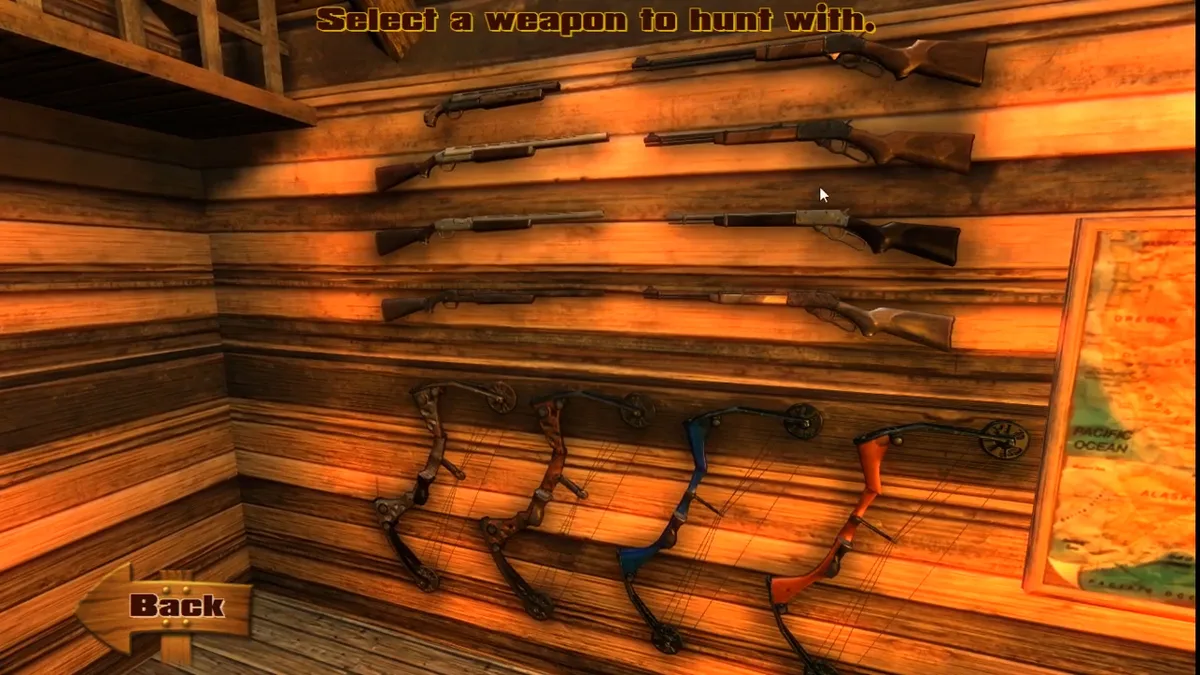
The cabin is where you set your weapon before a mission begins, choosing from the equipment you have unlocked. That timing is a firm restriction: you cannot change weapons once the mission is underway. The full twelve-weapon roster includes four shotguns—the Rusty Shotgun, Shotgun, Double Barrel Shotgun and Sawed-off Shotgun—alongside four bows and four rifles. The rifle selection consists of the 3030 regular rifle, 3030 rusted rifle, 3030 snub nose rifle and 45 caliber rifle. These are separate entries in the arsenal, with the cabin limiting your selection to those already unlocked.
The bow portion of that roster comprises two compound bows and two sport compound bows. Once out hunting, bow use follows a hold-and-release sequence: hold the left mouse button, or your mapped replacement, to draw back the string and bring up the targeting reticle. Releasing that input fires the arrow, so drawing and shooting are successive parts of the same action rather than separate button presses. Shotgun aiming uses the mouse to point the weapon at the target. Your selected weapon remains visible in your avatar’s hands during the hunt.
Steadying the Shot: Scope Zoom, Breath and Heartbeat
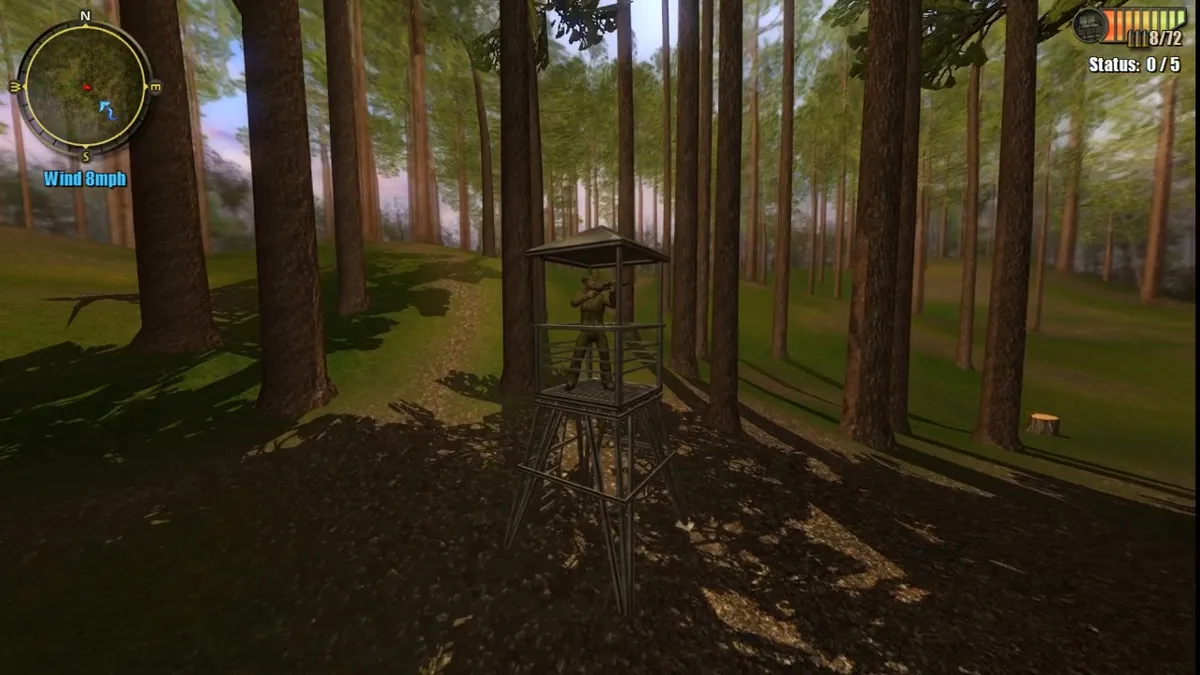
Rifle aiming starts with Tab, or the replacement key assigned through the Controls menu, to bring up the scope. Once you are using it, roll the mouse wheel to zoom in or out; the keyboard’s plus and minus keys provide another way to adjust the view. Scope access and magnification are separate inputs, with a dedicated breath-holding key handling steadiness before the shot. Press that key just before shooting to steady your aim: zoom adjusts the scoped view, while holding your breath addresses the stability of the aim itself.
Running after quarry introduces another consideration before firing: the exertion raises your heartbeat and affects your aim. To recover, switch to walking or stand still for a few seconds; either action helps restore steadiness after the chase. That gives the approach to a shot two documented parts: recovering from running, then using the breath-holding input immediately before firing. Walking is an option here, not just stopping altogether. The distinction matters when preparing your aim: breath holding is the dedicated steadying action, while slowing down or remaining still provides recovery from exertion.
Closing on Quarry: Wind, Cover Scent and Animal Danger
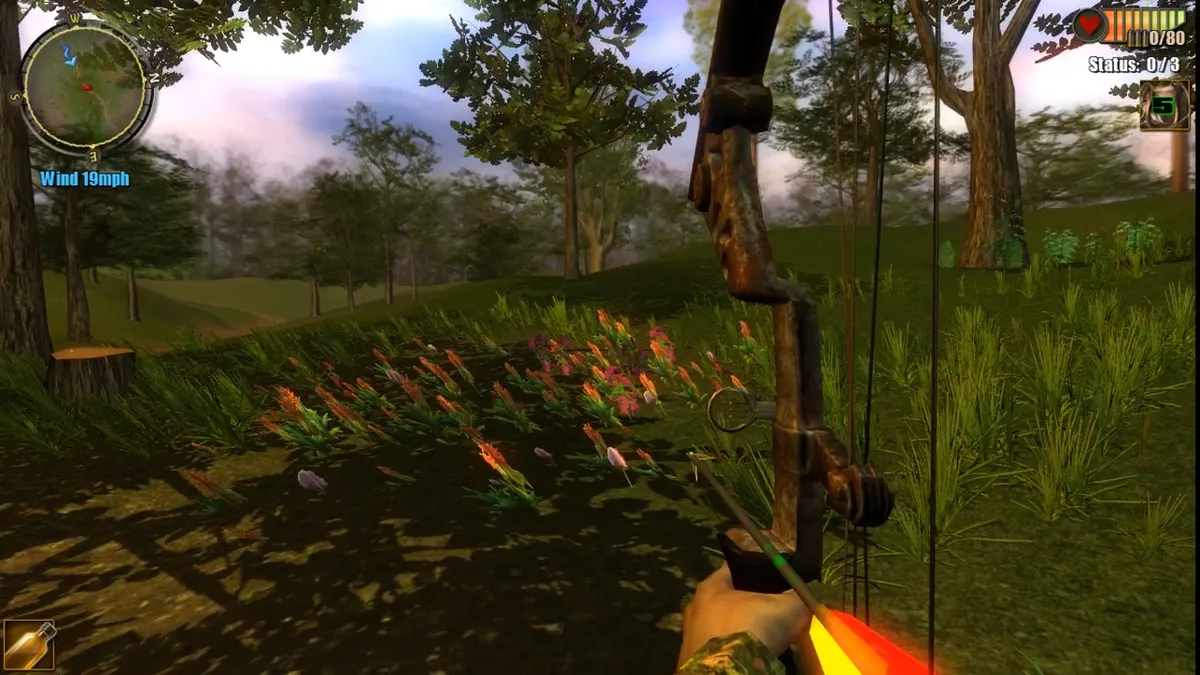
While stalking, use the compass in the upper-left corner to track both your quarry and the wind. Your position is marked by a central triangle, and the top of the compass follows the direction you face. A green arrow points toward the animal, becoming a green circle as you draw near; a blue wavy line indicates wind direction. Follow the quarry indicator while adjusting your approach to stay downwind, rather than treating its bearing as the only information you need. Remaining downwind lets you close the distance without being detected as readily.
Cover scent provides another way to shorten the gap: apply the spray to mask your scent and get closer still. It complements the downwind approach, with both measures helping you approach undetected. The animals you hunt include whitetail deer, mule deer, elk, moose and bighorn sheep, but wildlife also presents danger rather than serving only as quarry. Keep track of the health icon in the upper-right corner during the hunt. Exhausting that health ends the round, so reaching the animal is not the only concern while you are out in the field.
Sources & further reading.
- Hunting Unlimited 2011 — official game profileRetrieved Nov 11, 2026
- Hunting Unlimited 2011 — official game profile — publisher-supplied gameplay manualRetrieved Nov 11, 2026
First published .