 THE GAME ARCHIVE
A Card-and-Board Strategy Game in the Sky
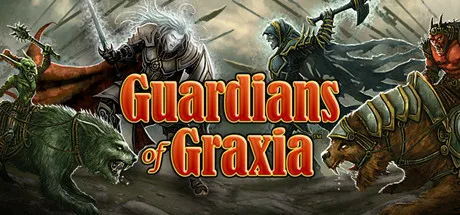
Guardians of Graxia is a Windows strategy title listed on Steam with a 2010 product date. The official store description frames it as a card-based board game set among floating islands high in the sky of the Graxia world, where Guardians lead armies into battle. In practice, the game asks the player to answer a board-game question every turn: which units should move where, which terrain is worth holding, and which cards can be spent now versus saved for a fight that matters. This feature explains the rules documented in the cited publisher material. It has not been hands-on tested.
Moving Units Tile by Tile in the Command Phase
In the Command Phase a unit moves by stepping onto an adjacent map tile, and the base allowance is a single tile per turn. Terrain modifiers can block that step, and a unit cannot enter a tile that is already occupied unless a specific ability allows it. Some units break the default: certain cards are permitted to move two tiles, while others can fly over intervening tiles entirely. Movement is therefore a per-tile decision rather than free repositioning, and each destination has to be checked against terrain and occupancy before the unit is placed.
Extra mobility is capped across a whole Round. A unit cannot enact more than one additional Move ability per Round through any combination of unit abilities and spell cards, so two relocation effects cannot be stacked on the same unit; the manual's examples are a unit that could not use the same charge ability twice and a unit that could not combine two different movement effects in one Round. A Move ability is anything that shifts a unit from one tile to another. Within the Command Phase, a unit can also attack an adjacent enemy, raise its shield, play Command Spell Cards and summon new units, while Command Activated abilities with a mana cost are used during this phase and Command Passive abilities trigger automatically.
Terrain Tiles: Class Bonuses, Defenses and Mana Income
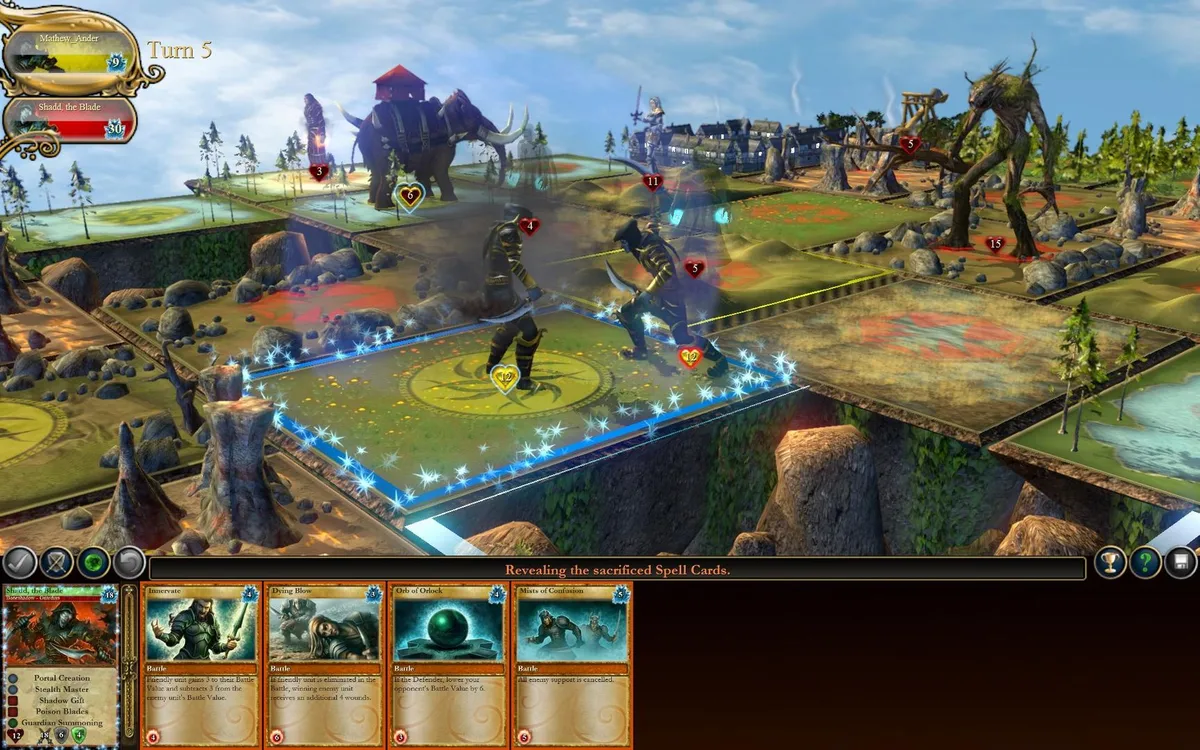
The map is built from thirteen distinct terrain tiles, each depicting a different environment. A tile can grant class bonuses to some units and class penalties to others, and it can adjust physical or magical defense. Because these modifiers are tied to the class of the unit standing on the tile, the same ground helps one card while hindering another. Owning tiles matters beyond combat positioning: terrain ownership generates mana, awarded at the end of a player's turn. That mana is the game currency spent on activating spells, unit abilities, portal creation and unit summoning, so holding terrain feeds directly into the economy that pays for those actions.
Two named terrain interactions carry their own rules. Boulder Field tiles block units from supporting, attacking, entering or exiting through their sides, with dwarf and goblin units as the exceptions, and infantry units defending in Boulder Fields gain four Battle Value. Separately, a unit acting as the Attacker can pay two mana to raise its own Battle Value by two and lower the opponent's Battle Value by two. These modifiers stack onto the class bonuses and penalties that arrive with each tile type, which makes tile choice a real layer of battle planning rather than scenery.
Summoning Guardians and the Mana Economy
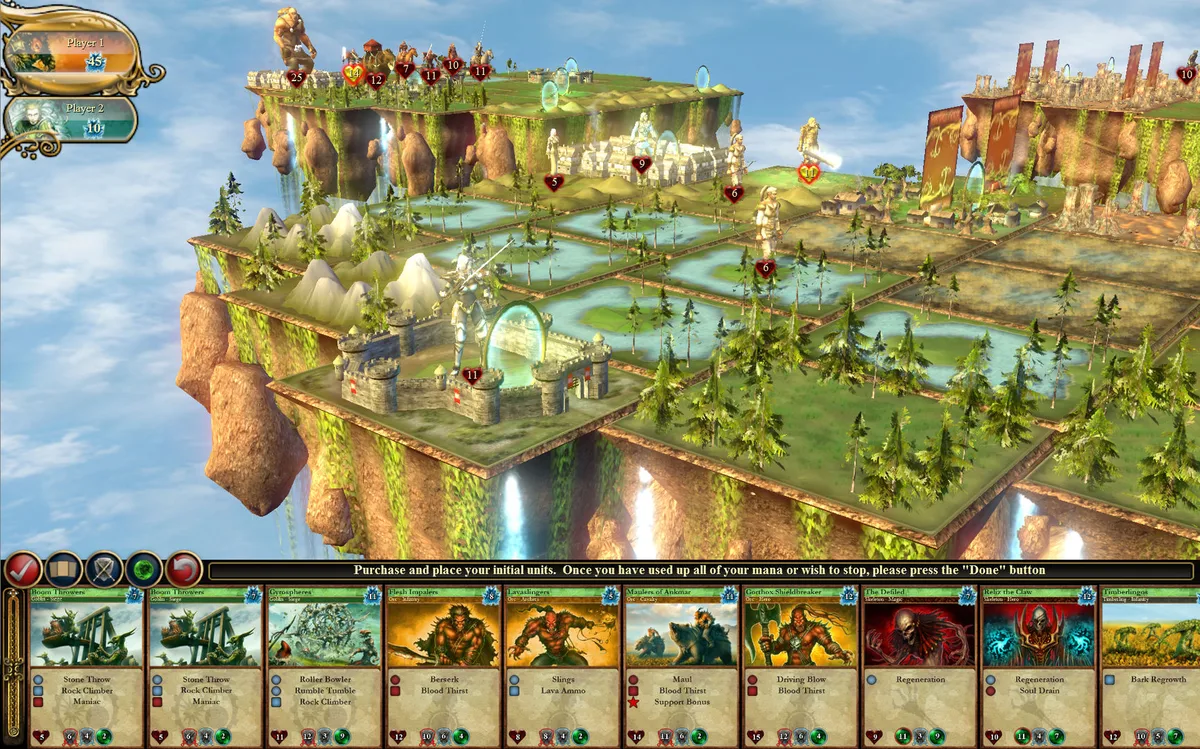
Summoning is restricted to the Guardian. Once per round, a Guardian may bring in a unit at a reduced cost of seven mana, and the new unit must be placed either on the tiles directly behind the Guardian or on adjacent tiles along the Home Row. That placement limit ties reinforcements to the player's starting edge rather than the front line, so a summoned unit arrives near the Guardian and must then travel outward tile by tile. The mana comes from the same pool that pays for spells, unit abilities and portal creation, which makes each summon a commitment against other spending.
Because mana is awarded at the end of a player's turn according to which terrain tiles that player owns, terrain control feeds the summoning and spell economy directly. The units represent races including dragons, dwarves, elves, goblins, humans, orcs, skeletons, wisps and wraiths, and Guardians are the primary player units that command these armies. Every spell card carries a mana cost, and each one can also be spent for its sacrifice value during battle instead of being cast for its normal effect, so card conservation and mana income pull on the same resources.
The Battle Phase: Values, Wounds and Retreat
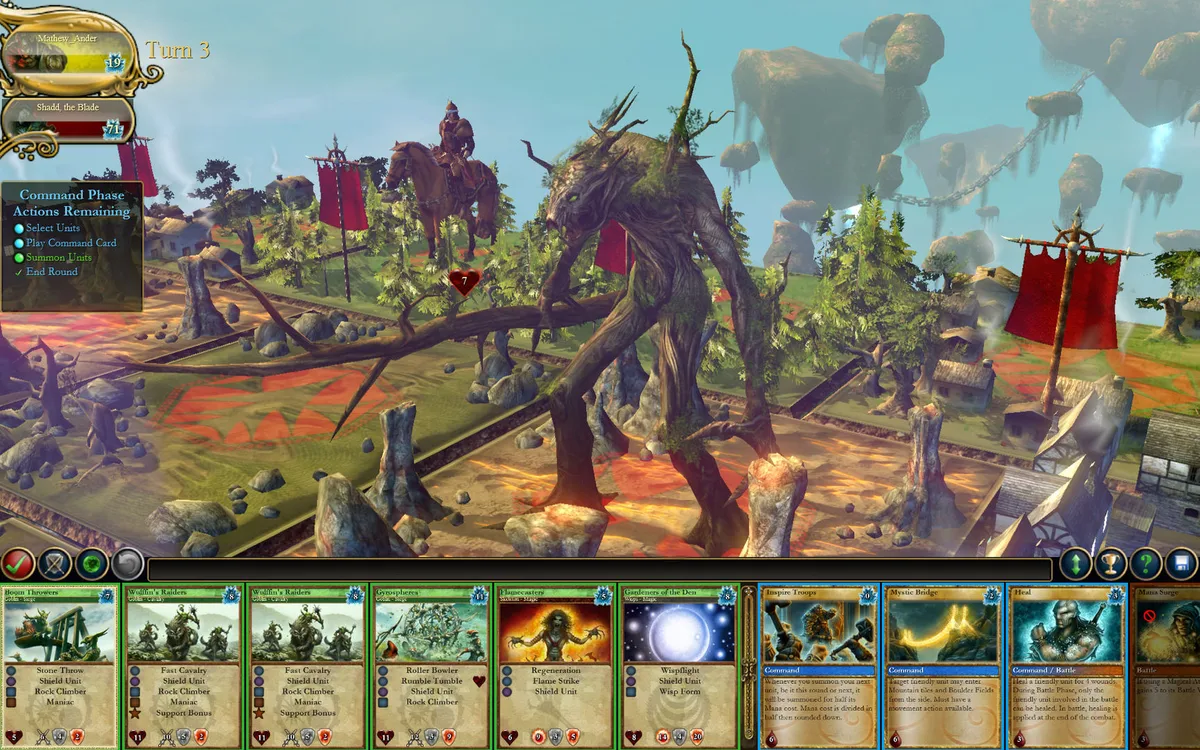
The Battle Phase proceeds in five steps: determining initial Battle Value, playing spell cards or activating battle abilities, sacrificing a spell card for its sacrifice value, determining Battle Wounds, and finally retreating or advancing. Initial Battle Value is calculated from attack, defense, terrain, support and passive abilities. Each unit's attack is classified as physical, magical or both, and its physical defensive value reduces incoming physical attack during the phase. Wounds are then determined by dividing the final Battle Value by 2 and rounding up, inflicting total damage that affects elimination and retreat.
After wounds are resolved, the defending unit retreats if it has suffered more wounds than the attacking unit, moving to the map tile directly away from the attacker while avoiding obstacles; however, it will not retreat if the attacker is destroyed. A retreating unit may not move onto another unit or into impassable terrain unless an ability permits it. This retreat step concludes the Battle Phase, following the earlier calculation, spell activation, sacrifice and wound determination steps that together structure combat resolution.
Sacrificing Spell Cards to Swing a Fight
The Battle Phase devotes a distinct step to sacrificing a spell card, separate from playing cards or activating battle abilities. When a player chooses to sacrifice, they read the sacrifice value printed at the bottom left of the card and apply it to raise their own attack value or lower the opponent's attack value. Sacrificed cards cost no Mana, so the swing comes from the card itself rather than the mana pool. A player who prefers not to sacrifice selects the No Sacrifice Card option, leaving both Battle Values unmodified and adding nothing to the fight.
Every spell card can be spent for its sacrifice value during battle instead of being cast for its normal effect, which puts a mana cost on casting but none on sacrificing. Battle Value also draws on support: a standard support contributes three, and a Support Bonus adds a given value to that standard +3 support, so support can be tuned upward by modifiers rather than being fixed. These adjustments sit alongside the card's own printed sacrifice number, so the sacrifice step and support values feed the same Battle Value that later determines wounds.
Scroll sideways to see the full table →
| Element | Documented rule |
|---|---|
| Platform and listing date | Windows strategy title; Steam product date 2010 |
| Base movement | One map tile per turn unless terrain or abilities allow more |
| Terrain tiles | 13 types granting class bonuses, class penalties and physical or magical defense benefits |
| Mana income | Awarded at the end of a player's turn through terrain tile ownership |
| Guardian summoning | Once per round at 7 mana, placed behind the Guardian or adjacent on the Home Row |
| Battle Phase steps | Initial Battle Value, spell/ability activation, spell sacrifice, wounds, retreat or advance |
| Wounds | Final Battle Value divided by 2, rounded up |
| Spell sacrifice | Sacrifice value applied to either side's attack value at no mana cost |
Sources & further reading.
- Guardians of Graxia — official game profile Retrieved Oct 21, 2026
- Guardians of Graxia — official game profile — publisher-supplied gameplay manual Retrieved Oct 21, 2026
First published .