 THE GAME ARCHIVE

Building Tension for the Big Payoff
The Tension Gauge is the fuel for a character's most expensive options, and it fills as you attack, dash, and jump. That simple rule shapes how you build toward a payoff: throwing out attacks and covering ground with dashes and jumps directly charges the meter, so the match rewards sustained pressure rather than passive waiting. The gauge is a prerequisite for two moves in particular, the Overdrive Attack and the Roman Cancel, both of which draw on the same stored resource. Because charging comes from the same actions you use to fight, a player who keeps moving and striking naturally accumulates the meter needed to convert a sequence into something bigger. Robo Ky is the exception, using an Electric Gauge that behaves like the Tension Gauge but also boosts the effectiveness of his crouch-plus-Dust Electric Mat technique as it charges.
Once the meter is stocked, three moves spend it at defined rates. An Overdrive Attack consumes 50 percent of the Tension Gauge for a powerful finisher, and a Dead Angle Attack also costs 50 percent, performed just after guarding by pressing any two attack buttons except Dust while pressing in a direction. A Roman Cancel likewise takes 50 percent, executed by pressing any three attack buttons except Dust simultaneously during an attack, which lets you interrupt that attack. Faultless Defence differs from these fixed costs: holding the punch and kick buttons together while guarding gradually decreases the gauge rather than spending a flat half. Because each paid action draws from the same pool, deciding whether to cash in on an Overdrive finisher, escape pressure with a Dead Angle, or cut an attack short with a Roman Cancel becomes a question of which 50 percent purchase the moment demands.
Gatling Combos and Counter Hits
Gatling Combos form the backbone of extended offense: pressing attack buttons in sequence chains normal moves together, with each hit landing only if the opponent is struck by the first attack. The number of moves a character can link this way differs from fighter to fighter, so the chain length is part of each character's toolkit rather than a universal string. A successful sequence delivers continuous damage, and because the chain depends on the opening hit connecting, the routing is tied directly to whether that first strike finds its mark.
Counter Hits change what follows a clean interception. Landing a hit on an opponent in the middle of a move staggers them for longer than usual, opening combos that would not normally connect. Staggering also arises from certain normal moves, special moves, and Overdrive Attacks when they land, leaving the opponent temporarily defenseless; tapping left and right repeatedly speeds their recovery. Because the stagger window is broader than standard hitstun, the attacking player can extend pressure, while the staggered player's only stated counterplay is fast directional input to shorten the vulnerable period.
Guarding, Bursts and Instant Kills
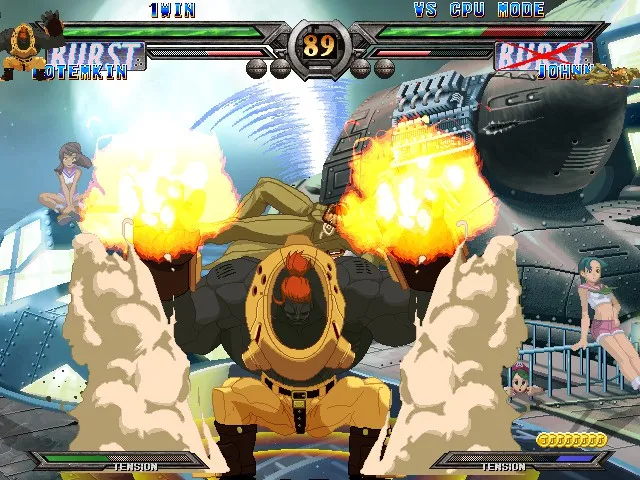
Guarding extends beyond simply holding back. Faultless Defence, performed by holding the punch and kick buttons while guarding, lets you block special moves while pushing the opponent away to maintain distance. Unlike standard guarding, this technique drains the Tension Gauge for as long as it is active; if the gauge empties, Faultless Defence becomes unavailable. The Guard Level Gauge offers a separate route to turning defence into offence: it rises each time you block an opponent's attack and falls when you are hit. Once this gauge reaches a certain level, you can counter any attack from your opponent, converting a successful block into a counterattack.
Bursts and Instant Kills provide high-risk, high-reward options governed by their own gauges. A Psych Burst is triggered by pressing the Dust button and any attack button simultaneously; when the Burst Gauge is full, the character becomes temporarily invincible and blows the enemy away. However, Psych Bursts cannot be used while being hit by an Overdrive Attack or while being thrown, and an X appears on the gauge to signal this. Instant Kill Attacks begin by pressing all four attack buttons, which switches the Tension Gauge to an Instant Kill Gauge that steadily falls; if it reaches zero, your strength starts to be consumed. Pressing all four attack buttons except Dust returns the gauge to normal. While in this state, you can input the command for an Instant Kill Attack. The gauge is completely wiped out after you launch the attack, so a miss leaves you unable to use any Tension-dependent actions.
Throws, Sweeps and Aerial Mobility
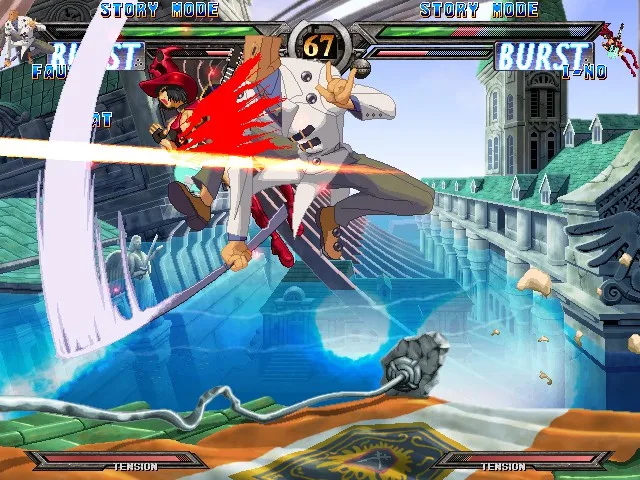
Throws are performed on the ground or in the air: standing near the opponent, press either the left or right direction together with the Heavy Slash button to grab and toss them through the air. The same input works midair, but throws cannot be made while dashing or backstepping in midair. Sweeps answer crouching opponents: press Slash and Heavy Slash together while crouching, and a swept opponent cannot use a Recovery move. Robo Ky substitutes his Electric Mat for the standard Sweep, tying this knockdown tool to his own Electric Gauge.
Aerial movement has two distinct forms. Two-Level Jumps let a character jump again while in midair, and Chipp Zanuff alone can jump three levels. High Jumps are triggered by quickly tapping down and then up on the directional pad, producing a jump higher than usual; a Two-Level Jump cannot follow a High Jump, so the two options exclude each other in a single leap. When knocked down, pressing any attack button in midair regains balance, and pressing a direction during recovery lets the character move that way, setting up a counterattack.
How a Match Is Won
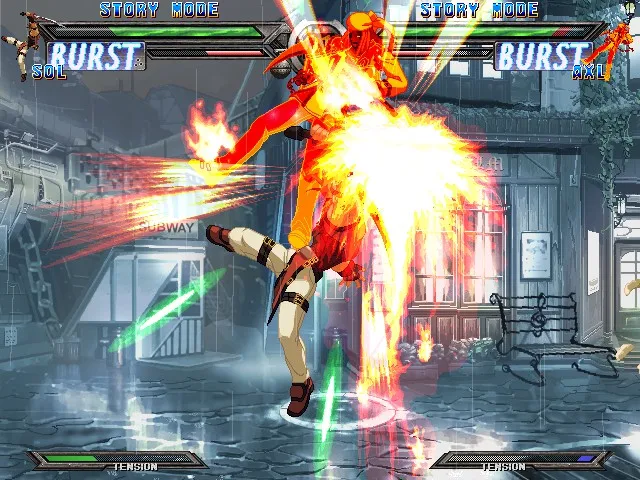
Winning a round hinges on the Strength Gauge: drain all of your opponent's strength and the round is yours. A match is decided by taking two out of three rounds, and the round count can be adjusted in the Options Menu. Each round runs on a 99-second time limit, also adjustable there, and when the clock expires the player holding the higher strength level is declared the winner. That rule changes the calculus of a close round, since a small strength lead matters once time runs out even if no knockout is scored.
Ties have their own resolution path. A double knockout, or equal strength for both players when time expires, produces a tie. If the match remains unsettled after three rounds, a fourth round is played as a final round; if the outcome still cannot be decided by the end of that fourth round, the game ends for both players. Separately, in Arcade Mode, pressing the Start button on the Game Over or Continue screen restarts the match.
Sources & further reading.
- Guilty Gear X2 #Reload — official game profileRetrieved Nov 1, 2026
- Guilty Gear X2 #Reload — official game profile — publisher-supplied gameplay manualRetrieved Nov 1, 2026
First published .