 THE GAME ARCHIVE
Hacker Evolution is a hacking simulation built around a command console rather than a menu of abstract actions. The publisher describes a game set in a virtual operating system environment, where the player hacks into computers, looks for exploits and information, steals money to buy hardware upgrades, and pieces a larger puzzle together from code and scraps of data. The console carries more than twenty commands and tools, and that vocabulary is the game's real interface: every objective is expressed as something you type at a named host, a numbered port, or a file on a remote machine.
The publisher's walkthrough for the Reinsertion content shows how tightly those commands interlock across a single level. A scan reveals a server on the target map; a crack opens a service; a connect and file read expose a hidden camera; an exploit downloaded from the same host breaches the next service; a transfer pulls in cash; an upgrade spends it on the player's own CPU; killtrace pushes the detection counter back down. Read in order, the walkthrough is effectively a lesson in how the systems depend on one another.
Reconnaissance: Scanning the Target Map
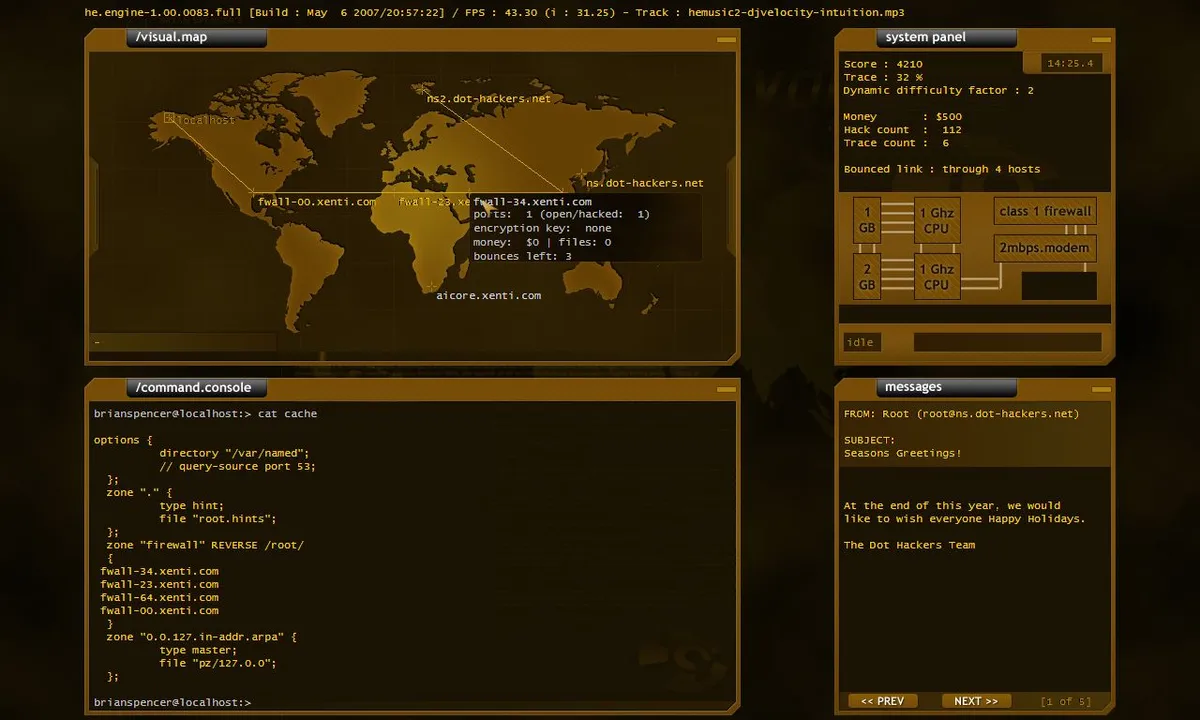
Reconnaissance starts at the console. Typing scan against a host name reveals that host on the target map, and the map is where the network topology takes shape: scanned machines appear as nodes that later commands can address. In the Reinsertion walkthrough's first level, a message from root@dot-hackers.net arrives, and scan dot-hackers.net brings the server onto the map. Scanning is not limited to servers; the same command against a camera address such as 9910-camera.ip adds that device to the map, and later scan router.camera.ip and scan 6723-camera.ip do the same for a router and a second camera.
This makes scanning the gate on every other action. Commands are aimed at named hosts and numbered ports, so a machine that has not been revealed cannot be productively targeted. The practical consequence is a strict reconnaissance-first rhythm: before cracking, connecting, decrypting or attacking anything, the player finds out it exists. The walkthrough reinforces this repeatedly, slipping a new scan into the middle of an ongoing sequence whenever a file or log quietly names a fresh address.
Ports and Connections: Reaching the Right Service
The connect command reaches a machine, and ports determine which service on that machine answers. At dot-hackers.net the walkthrough reads info.msg through port 99, pulls an exploit for the xftp service through port 80, and later opens port 799 to read scanner.log. A host name paired with a port is therefore the unit of address: the player is not talking to a computer in the abstract but to one of its services, and different ports expose completely different content.
That is what makes careful port reading pay off. Each successful connection can turn up a file name, an address or a log entry that points at the next target, so a player who connects broadly and reads what is there is effectively being handed the next objective. The router sequence shows the pattern clearly: connecting to router.camera.ip on port 50 and reading 6723-remote.log yields the address of a second camera.
Cracking, Exploits and Decryption Keys
Cracking a service and executing a downloaded exploit are separate steps. The crack command attacks a specific port on a named host; at dot-hackers.net the walkthrough issues crack dot-hackers.net 99 before reading info.msg. Later in the same level, the player connects on port 80, downloads xftp_799.exploit for the xftp service, and runs exec xftp_799.exploit dot-hackers.net to breach that service. The pattern recurs: an exploit is acquired first, then executed against a named host to compromise the service running there.
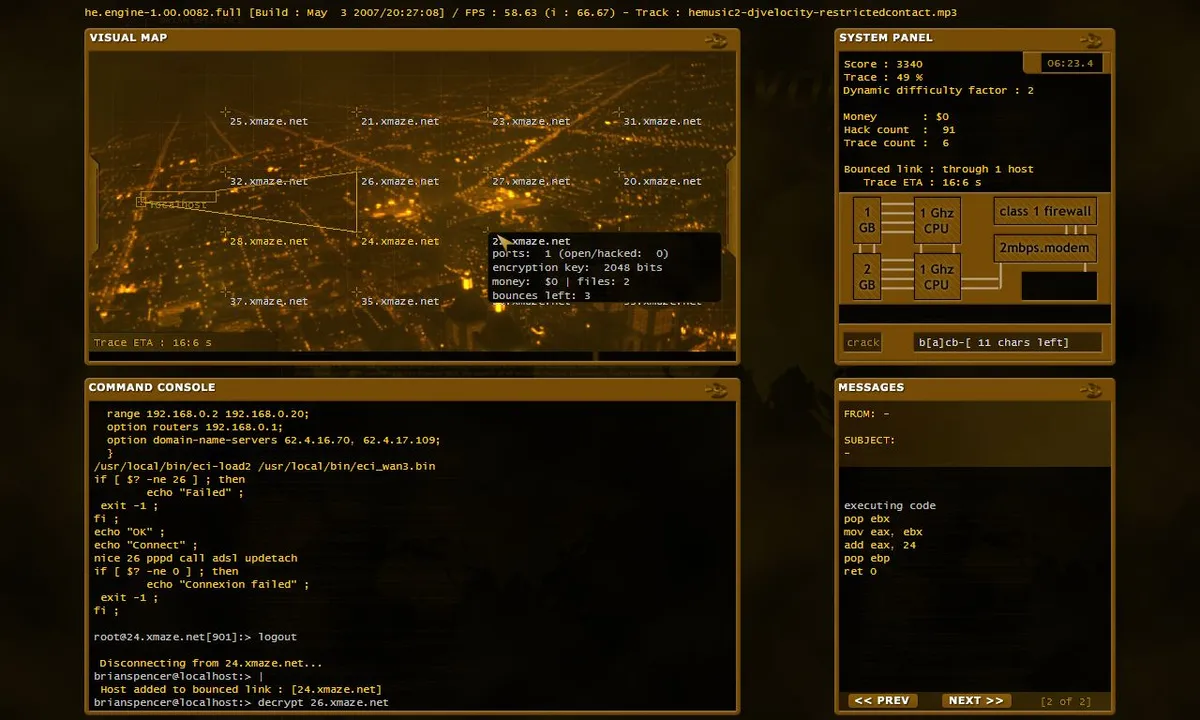
The router adds a second lock to the same door. Facing router.camera.ip, the player downloads camerawatch_50.exploit from dot-hackers.net, executes it on the router, logs out, and only then runs decrypt router.camera.ip to break the encryption key. With the key cleared, connecting on port 50 yields the remote log and the next camera address. Exploit execution and key decryption are thus distinct prerequisites that must both be satisfied before a restricted system opens, and the walkthrough shows the same two-stage procedure again for 6723-camera.ip and 9910-camera.ip, with the added instruction to remove hosts from the bounced link before decrypting.
The Economy: Transfers, Upgrades and Trace Control
Money comes from an active server-side operation, not a passive account. Connected to dot-hackers.net, the walkthrough issues transfer 1000 and repeats it until six thousand dollars has been collected in six chunks. Those funds then feed hardware: upgrade cpu0 spends on the central processing unit by its numeric slot, strengthening the machine running the console. The economy of the early level is deliberately circular, with the same host that yields the cash also providing the workstation improvement that follows the deposits.
Detection is a counter to be pushed down, not a one-time alarm. After the transfer and CPU upgrade, the walkthrough has the player type killtrace repeatedly until the trace level drops, then returns to dot-hackers.net on port 799 to read scanner.log. Money also appears as a trace remedy: in the Main Building level the player transfers all available cash specifically to lower the trace level. The same small set of commands, applied in sequence, ties stolen funds, a hardware upgrade and trace management into one continuous chain on a single host.
Levels, Bounced Links and Firewall Order
Missions chain specific targets into a fixed order. The Main Building level begins by cracking the xftp service on port 99 at dot-hackers.net, connecting to that port to download null_19.exploit, logging out, and running the exploit on the same host for complete access. Only then does the player reconnect, transfer all available money to reduce the trace level, and read the download on port 99 to continue. Objectives are sequential and dependent: skipping a step strands the player without the exploit, the funds or the file that the next step requires.
Bounced links turn that sequence into routing problem-solving. The player assembles a chain by adding hosts to a link, so traffic passes through them; the walkthrough has the player build a link from dot-hackers.net and router.camera.ip, crack the service on port 199 at 6723-camera.ip, add that camera to the link, and then attack 9910-camera.ip. Decryption is the exception that keeps the routing honest: hosts must be removed from the bounced link before a server is decrypted.
The Core Server level compresses the routing logic into ordering. The publisher describes it as relatively simple in structure but demanding the right firewall sequence, so that bounced links can be created to reach the next firewall and earn money to reduce the trace level. The documented order runs 15-firewall.xenti-hq.com, then 09-firewall.xenti-hq.com, then 19-firewall.xenti-hq.com, then 06-firewall.xenti-hq.com. The lesson is that the network map and the link are editable tools, and the puzzle is deciding what order to use them in.
Tools, Modding and What a New Player Should Do First
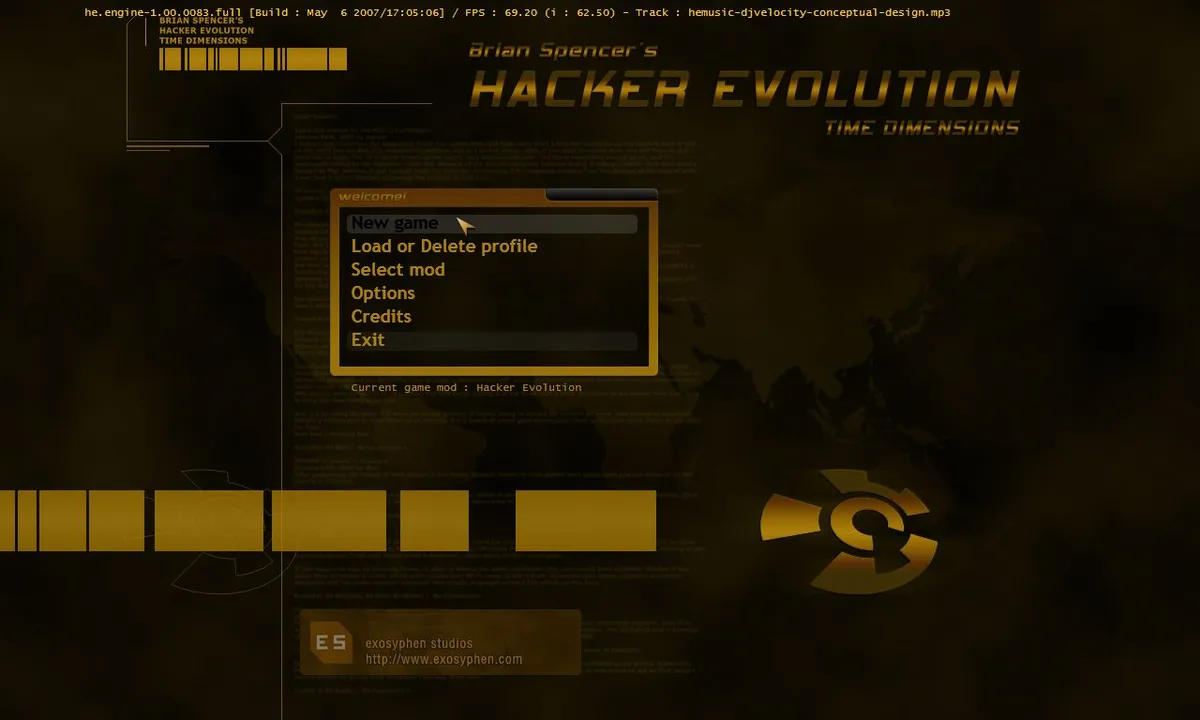
The console is the whole instrument, and it is deliberately dense: more than twenty commands and tools, with the manual showing a working grammatical shape for each. Commands take a target and often a port, so spacing and naming matter. The game's advertised extras include modding capability, an included mod editor for building new levels easily, multiple interface skins and optional freelance jobs for variety beyond the campaign.
For a first session, the walkthrough order is the safest template: scan the host before anything else, crack the port whose service you need, connect and read every named file you find, then download the exploit the file names and execute it against the host, decrypting targets that hold a key. Treat transfers as routine maintenance, dropping in thousand-dollar chunks, spend the proceeds on upgrade cpu0-style hardware improvements, and keep killtrace ready after every loud action. The manual shows genuine backtracking, like logout before exec and stripping hosts out of a bounced link before decryption, so a player who works from the objective text and keeps an eye on new addresses surfacing in logs will stay out of trouble.
Scroll sideways to see the full table →
| Item | Detail |
|---|---|
| Title | Hacker Evolution |
| Developer / publisher | exosyphen studios |
| Genre | Simulation |
| Platforms listed | Windows, macOS, Linux |
| Release year listed | 2010 |
| Console | Over 20 commands and tools |
| Contents noted | Mod editor, multiple interface skins, optional freelance jobs |
| Documented walkthrough content | Hacker Evolution – Reinsertion expansion pack |
Sources & further reading.
- Hacker Evolution — official game profile Retrieved Oct 20, 2026
- Hacker Evolution — official game profile — publisher-supplied gameplay manual Retrieved Oct 20, 2026
First published .