 THE GAME ARCHIVE

What Worms Pinball Offers
Worms Pinball is a pinball simulation distributed on Steam for Windows, developed and published by Team17 Digital Ltd and catalogued under the Casual genre with a 2011 store year. Its pitch is a single, elaborately equipped table on which the Worms crew is sent spinning across what the store text calls one of the most realistic pinball tables ever created. The documented design leans on two things at once: a physics model detailed enough to make every contact feel weighted, and a table dense with hardware and rules to keep the player reading the playfield rather than simply slapping the flippers.
The distinctive promise lies in how much of the table reacts. The ball is a vector object that accurately reflects its surroundings, both ball and flippers are simulated, and the feature list names magnetic fields, user-controllable moving gadgets, moving mechanical parts and transparent ramps. On top of that sit up to six multiballs simultaneously, tilt functions, hit combinations and a set of named flipper techniques. The result is a table where the player is managing a live physical system and a parallel set of objectives at the same time, rather than chasing a single straight line of shots.
A Physics Model You Can Feel
The foundation is a realistic and dynamic physics simulation. The store text is specific about what is modelled: impulse, inertia, acceleration, momentum and torque, described as real-world physical qualities simulated to produce outstanding realism. For a player, that list maps onto the decisions that matter in pinball. Impulse and momentum describe how hard a flipper hit transfers energy into the ball and how much that ball carries into whatever it strikes next. Acceleration and inertia govern how quickly the ball changes direction and how stubbornly it keeps its current path. Torque suggests rotational behaviour as part of the same model.
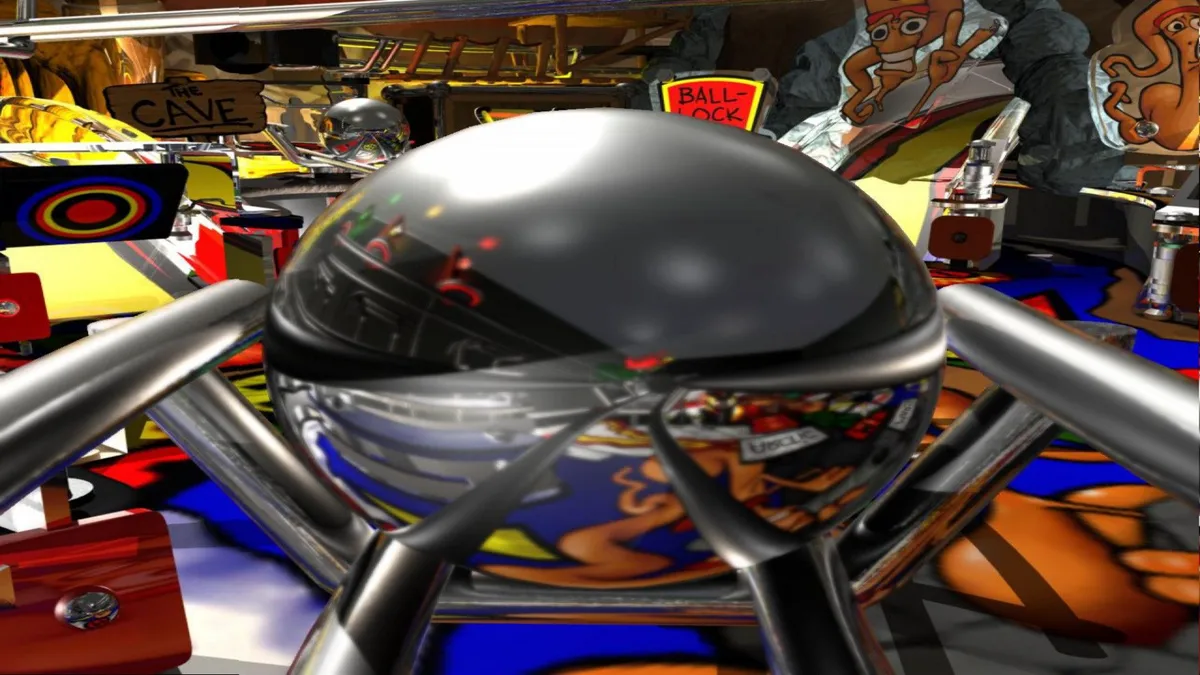
Because the ball is a vector object that accurately reflects its surroundings, the simulation is framed around the ball responding to the environment rather than following canned animations. The stated goal is an immersive quality of playing in a real-world environment. That ambition is supported by presentation work as well: atmospheric lighting, reflection and shadow effects dress the table, and multiple full-screen views let the player watch the action from different framings. Together with the tilt function, these features form the documented layer that surrounds the core physics.
Flipper Simulation and the Named Techniques
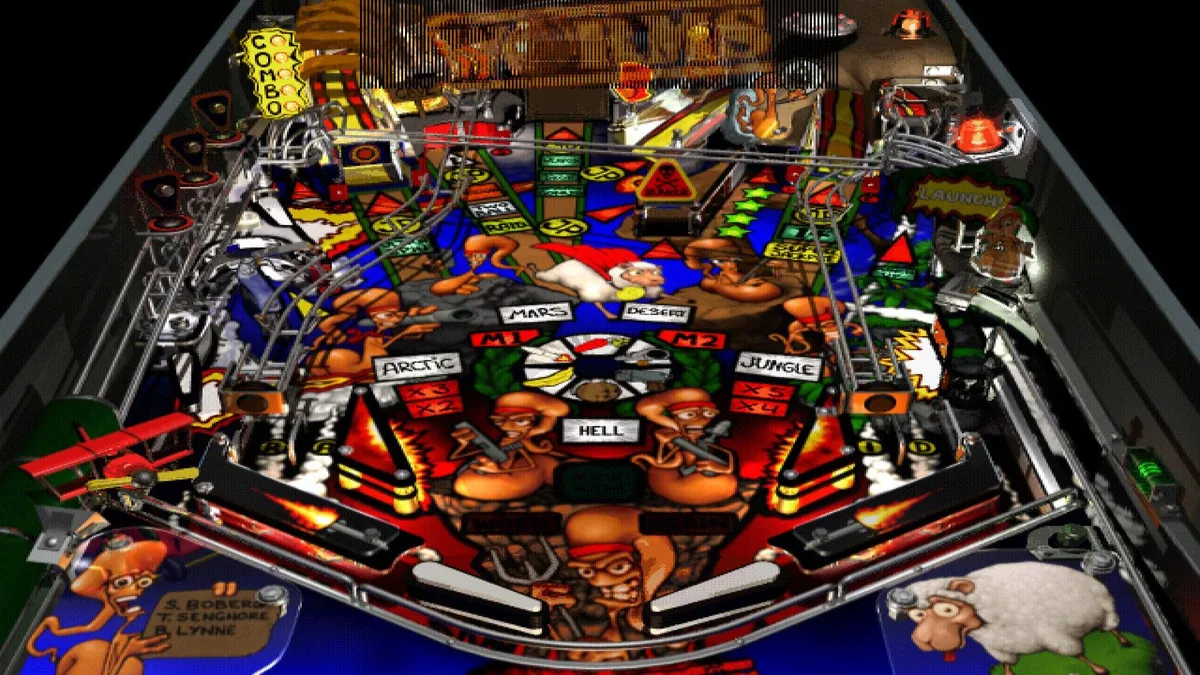
Flipper play is built on an accurate and flexible vector-based ball and flipper simulation, so the flippers are modelled alongside the ball. The store text goes further and names specific techniques that the table's rules account for: drop and dead catches, bounce and flip passes, bang backs and death saves. These names are the documented vocabulary of flipper control in Worms Pinball, listed next to tilt functions and hit combinations as part of the game's sophisticated table rules.
Read as a set, those terms describe a game that expects the player to control the ball with more than contact shots. Catches and passes belong to a family of flipper interactions; bang backs and death saves are named alongside them as recognised table actions. Combined with hit combinations and the tilt function, they signal a design that hands the player a broader toolkit than a simple flipper press. The source does not spell out button bindings or step-by-step inputs for each technique, so the article treats them as the documented features they are.
Multiballs, Magnetism and Moving Hardware
Up to six multiballs can be in play simultaneously, a figure the feature list states directly. That single rule reshapes the table: with several vector-simulated balls moving under the same physics, the player's attention has to cover more than one trajectory at once, and the flipper techniques named above apply in a busier field. The multiball cap is one of the clearest numbers attached to the gameplay and one of the few concrete progression-adjacent facts the source supplies.
The playfield itself is busy. Worms Pinball features transparent ramps, which sit alongside the parallel objectives as part of the table's physical layout. Magnetic fields are listed among the table's features, adding another named mechanic to the ball's environment. User-controllable moving gadgets and moving mechanical parts mean some of the hardware on the table is not static, and the player has documented influence over the gadgets. The table also carries wild sound effects and music to go with the lighting and view options.
Parallel Objectives, LED Sub-Games and Hidden Content
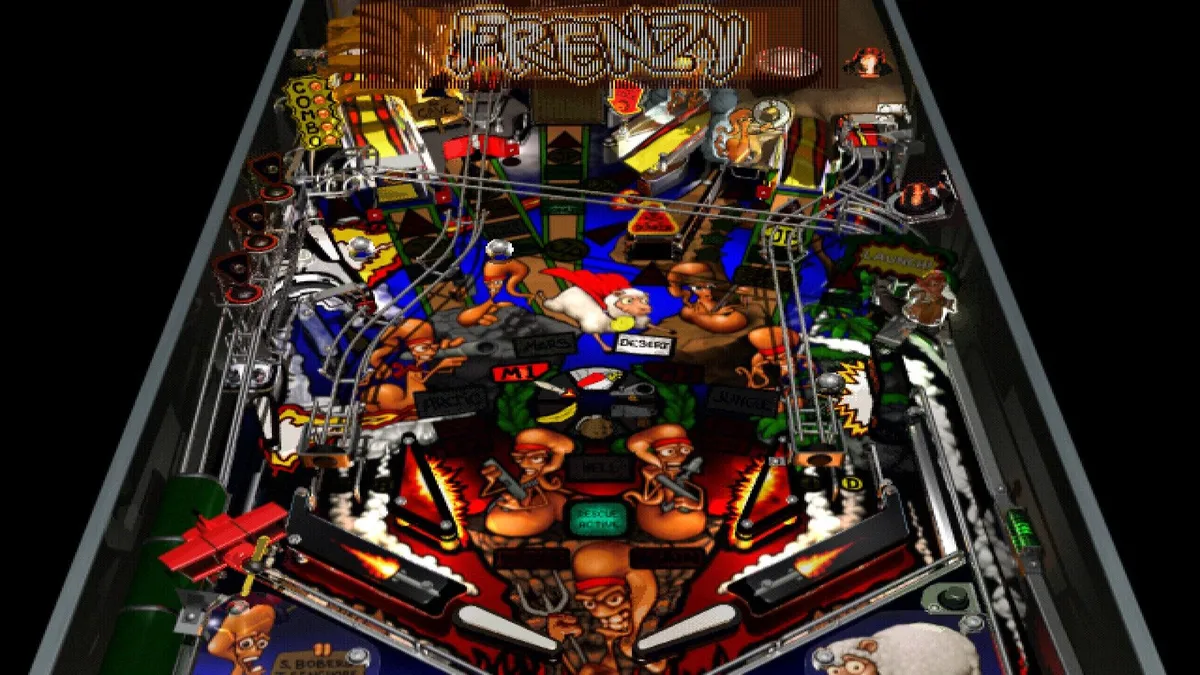
The table is described as sporting 3D LED displayed sub-games and parallel objectives, so it offers several goals that can be pursued at the same time. This is where the game's structure becomes more than a physics showcase: the player is working toward multiple documented objectives, and the LED display carries sub-games in three dimensions. The table also contains over 150 animated parts, with thousands of frames of rendered FMV animation used for the LED display, giving these objectives a heavily animated presentation.
Beyond the explicit sub-games, the feature list promises fantastic hidden sub-games. Sophisticated data compression techniques are credited with fitting several thousand frames of rendered FMV animation onto the scoreboard and the table, so both surfaces carry animated content rather than static art. For the player, the parallel objectives, the 3D LED sub-games and the hidden sub-games are the documented reasons to keep exploring the table, and the FMV animation is the documented presentation layer through which they appear.
Starting Guidance from the Documented Rules
Two documented features give new players useful entry points. First, the game offers multiple full-screen views, so no one has to accept the default framing; the store text presents the views as a gameplay feature rather than a cosmetic extra. Second, a tilt function is listed alongside the view options, which puts nudging into the standard toolkit. With up to six multiballs possible, a wide view of the table is the framing most likely to help a player track more than one ball at once, though the source does not state which view is best for that.
The named flipper techniques are the other starting point. Drop and dead catches, bounce and flip passes, bang backs and death saves are all listed as table rules, and the ball-and-flipper simulation is described as accurate and flexible. Learning which of those techniques to use in a given situation is what the documentation implies a player will spend time on. The source does not explain any individual technique in detail, so the practical emphasis remains on the fact that these moves are part of the designed play rather than on step-by-step instructions.
Package and Access
The current official access point is the Steam listing for Worms Pinball, from Team17 Digital Ltd, on Windows, with a catalog year of 2011. One caution belongs here and nowhere else: the article relies on the official store description and catalog entry, and independent hands-on verification has not been performed, so the gameplay described is the documented feature set rather than a tested account. The catalog year is the store listing's year; the source material does not establish a separate earlier release for the same game.
Scroll sideways to see the full table →
| Field | Documented value |
|---|---|
| Title | Worms Pinball |
| Developer / Publisher | Team17 Digital Ltd |
| Platform | Windows |
| Genre | Casual |
| Catalog year | 2011 |
| Multiball cap | Up to six simultaneously |
| Simulated physics | Impulse, inertia, acceleration, momentum, torque |
| Table features | Transparent ramps, 3D LED sub-games, parallel objectives, moving gadgets, moving mechanical parts, magnetic fields |
| Named flipper techniques | Drop and dead catches, bounce and flip passes, bang backs, death saves |
| Animation | Over 150 animated parts; thousands of frames of rendered FMV |
Sources & further reading.
- Worms Pinball — official game profile Retrieved Oct 20, 2026
First published .