 THE GAME ARCHIVE

A Hacking Simulator About Power Budgets, Not Just Passwords
Hacker Evolution Duality is exosyphen studios' hacking simulation, and its central tension is arithmetic rather than guesswork: every intrusion compares your CPU Units against a target server's Firewall Units, and the server can only be hacked when your total matches or exceeds that Firewall figure. The twist is that your own server does not have to carry that load alone. By bouncing a link through servers you have already hacked, their CPU Units are added to yours during the hacking power calculation, so a machine that was once a simple objective becomes a permanent part of your attack backbone. That design choice turns the Target Map into a resource grid and makes every successful hack an investment as much as a trophy.
Bouncing Links: Turning Past Hacks Into Raw Hacking Power
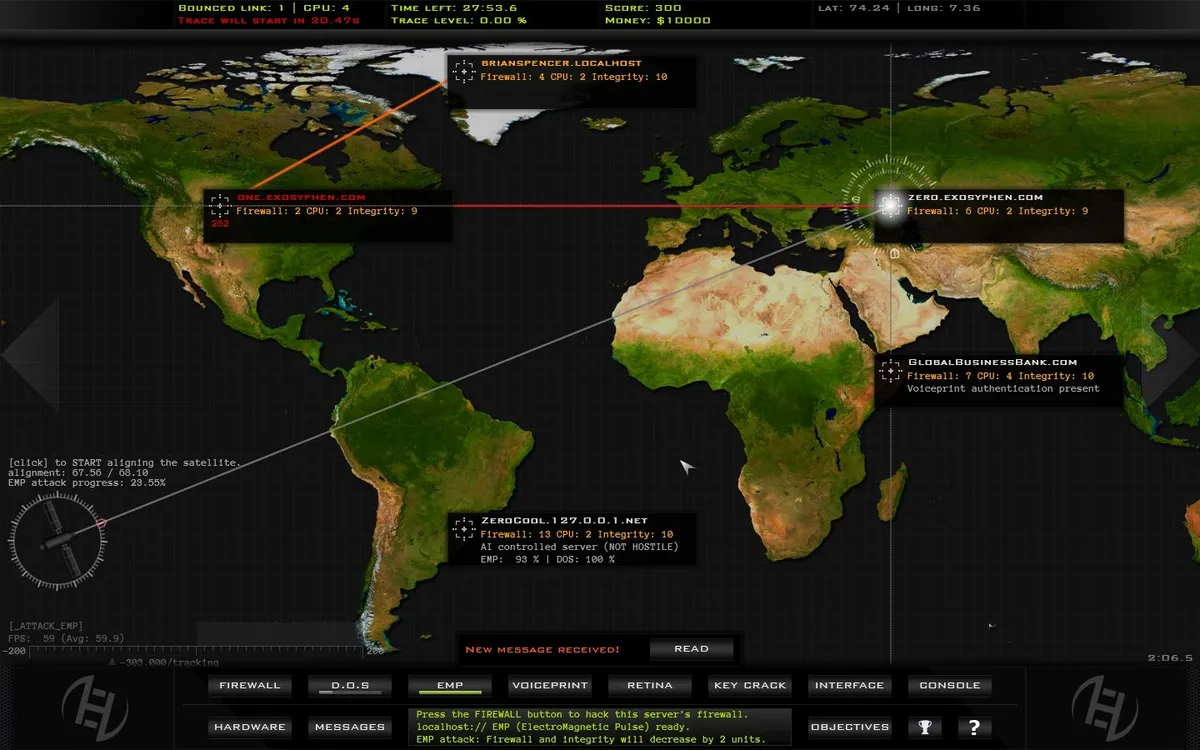
The mechanic is deliberately simple to operate and hard to ignore. Double-click a server you have already hacked, and your link bounces through it: an orange connection appears on the Target Map tying that server to yours, and the Bounced Link Indicator on the Information Bar updates to reflect the change. Double-clicking the same server again removes the link, so the whole system can be reconfigured on the fly. The payoff is cumulative, and stacking several bounced servers together can multiply your hacking power many times over, which is exactly what the manual recommends when a target's Firewall is too high for your base CPU total.
Bouncing carries a second effect that often matters more than the power gain: your Tracetime increases by five seconds for every CPU Unit that a bounced-link server possesses. Because Tracetime is the window you have to act before a trace on you begins, a fat bounced link actually buys you more breathing room while it contributes CPU Units to the hack. The manual sells the mechanic on exactly that double benefit, describing bouncing as a way to increase both Tracetime and hacking power. The practical consequence is that link building is a preparation decision as much as a power decision: stack links before you lock on, because once you are locked on the countdown is already running. The manual's broader advice to analyze a situation before proceeding applies most sharply here.
Links are also disposable in a less welcome way. If you take too long reaching a stage, previously hacked servers such as ONE.EXOSYPHEN.COM, ZERO.EXOSYPHEN.COM, and possibly GLOBALBUSINESSBANK.COM may regenerate, and your bounced links disappear from them. The manual's remedy is specific: hack those servers again with the Firewall Tool in the same order as before. Skip that step and you will simply lack the CPU power the target demands, no matter how much you have upgraded your own hardware.
Tracetime, Trace Level and the Integrity Safety Net
Tracetime is the countdown that begins the instant you lock on to a target server, giving you a fixed window to act before a trace starts. Your base Tracetime is five seconds for every Firewall Unit your server holds, and buying more Firewall Units adds five seconds each, so the defensive stat and the clock are the same resource. Locking back on to your own server stops the countdown and resets Tracetime. If it reaches zero, your Trace Level begins rising at one percent per second, and a hundred percent means you lose the game.
Trace Level is the harsher meter because it does not reset. Locking back on to your own server only stops it rising, so any percentage you accumulate carries forward through the rest of the level. Integrity Units, bought through the same hardware button, reduce it by ten percent each, which makes them an emergency brake rather than a shield. The manual's tip is blunt: save money to purchase Integrity Units and decrease your Trace Level when it becomes critical, which implies the intended economy assumes some accumulated Trace Level rather than flawless play.
Firewall Units do double duty here, because they are also your server's defense against intrusion and can be damaged by hostile attacks; at zero, your server has no protection from being hacked. Combined with the five-second Tracetime bonus per unit, Firewall Units look like the most broadly useful purchase in the hardware catalog, even though the manual elsewhere notes a level can be completed on all three difficulty settings without upgrading at all. That does not make upgrades pointless, only optional, which is a useful distinction for a player deciding whether to spend or save.
The Firewall Tool, the Interface Tool and the Trap Switches
Two tools dominate the early loop. The Firewall Tool is your primary hacking device, and after locking on to a target you work the hack inside its window, selecting the correct switches and then logging out at the bottom of the tool. The Interface Tool handles a different job: opening it and pressing the transfer button starts a red progress bar, and once that bar fills you press logout to move money out of a server. The manual's task list confirms that stealing money sits alongside hacking servers and disabling systems as objective types, so both tools are progression tools, not flavor.
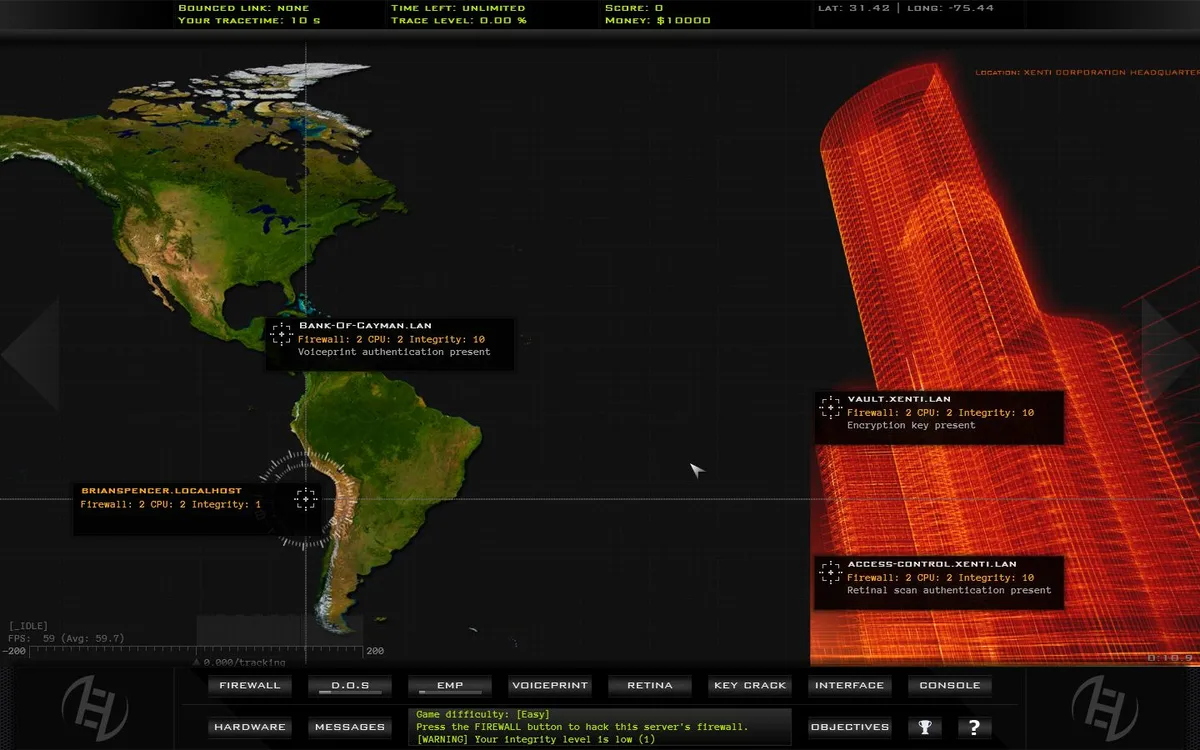
The switches carry a hidden cost, because some of them are traps: toggling one adds ten percent to your Trace Level. The manual's walkthrough demonstrates the trap in the very first Interface Tool sequence, warning not to toggle a particular switch and then noting that the transfer bar, logout and a quick relock on the player's own server raise the dollar balance to $10,000, complete the second objective, and reveal a new server in Russia called ZERO. It is a neat piece of teaching design: the same interface that pays you can also punish a careless click.
Relocking is time-sensitive because the Tracetime countdown keeps running while the transfer processes, and letting it lapse starts the Trace Level climb. Messages relating to tasks and objectives arrive periodically and can be reviewed from the Messages button, while the Event Screen scrolls changes, hints and beginner prompts, which together do much of the work of telling the player what just changed.
DOS and EMP: Breaking Firewalls Before You Break In
When a target's Firewall Units cannot be overcome even with bounced links, the manual sends you to the weapons, and each weapon solves a slightly different problem. The EMP Attack Tool fires an electromagnetic pulse through a hacked military satellite, producing damaging current and voltage surges on the target, and it can be aimed at any target server. It is not always available, though: a grey bar on the button must turn green before use, and then you lock on to the target and press the EMP button on the toolbar or the E key to launch the same strike.
The DOS Attack is a puzzle wrapped around a weakened target. Each port is flooded by a bandwidth amount shown in white, and you move sliders until those values match the necessary figures listed beside them in red. Matching each port produces the word MATCHED in red; once all four are correctly assigned, the grey network traffic display at the top slowly fills with red and the window closes. The target then loses one Firewall Unit and one Integrity Unit, and the cancel button aborts the attempt at any time. In the manual's walkthrough, a combined CPU total of ten against a thirteen-Firewall target is precisely the situation where both DOS and EMP damage are required before hacking becomes possible.
Hostile AI Servers and the Bribing Trap
Not every server sits still and waits. A hostile AI-controlled target server displays a Hostility Rating alongside an Attack Timer, and the rating measures how aggressive the AI feels toward your server. The higher the rating, the more often it launches attacks, and the more likely an attack is to use the more powerful of its two weapons, the EMP Attack. The Attack Timer shows in white digits next to the rating, counting down the seconds until the next attack after the previous one. Every time the server is hacked, attacked, used to bounce links through, or has its money or files stolen or manipulated, its Hostility Rating increases, so provocation has a price.
Depositing cash is the other lever. In Single Player you can temporarily bribe a server to calm down for a while, but the manual warns against doing the same in Open World, where the server will spend your money on upgrades instead. That warning is a good illustration of how the mode difference changes the value of a single action: the same button is a safety valve in one mode and a gift to the enemy in the other.
Single Player, Open World and Time Limits
Single Player follows the storyline through a sequence of levels, each with its own objectives, and completing a level unlocks the next one in the sequence. Time is a real constraint there: the documented level 01 grants 30 minutes before the game ends, so the hacking clock and the level clock run at the same time. The same walkthrough shows that upgrading is optional for clearing content, since a level can be completed on all three difficulty settings without buying any hardware at all, which reframes upgrades as insurance rather than requirements.
Open World reshapes that structure into something closer to a multiplayer skirmish. You face computer-controlled virtual hackers across levels with different objectives, arranged like a multiplayer match but with the opponents driven by an artificial intelligence program, and any level can be chosen at any time rather than unlocked in order. Open World scores can be submitted to online leaderboards tied to a serial number, with an option to submit them automatically. A purchase that did not include a serial number can get one free from the studio, though none are issued for the demo or for pirated copies.
Core Systems at a Glance
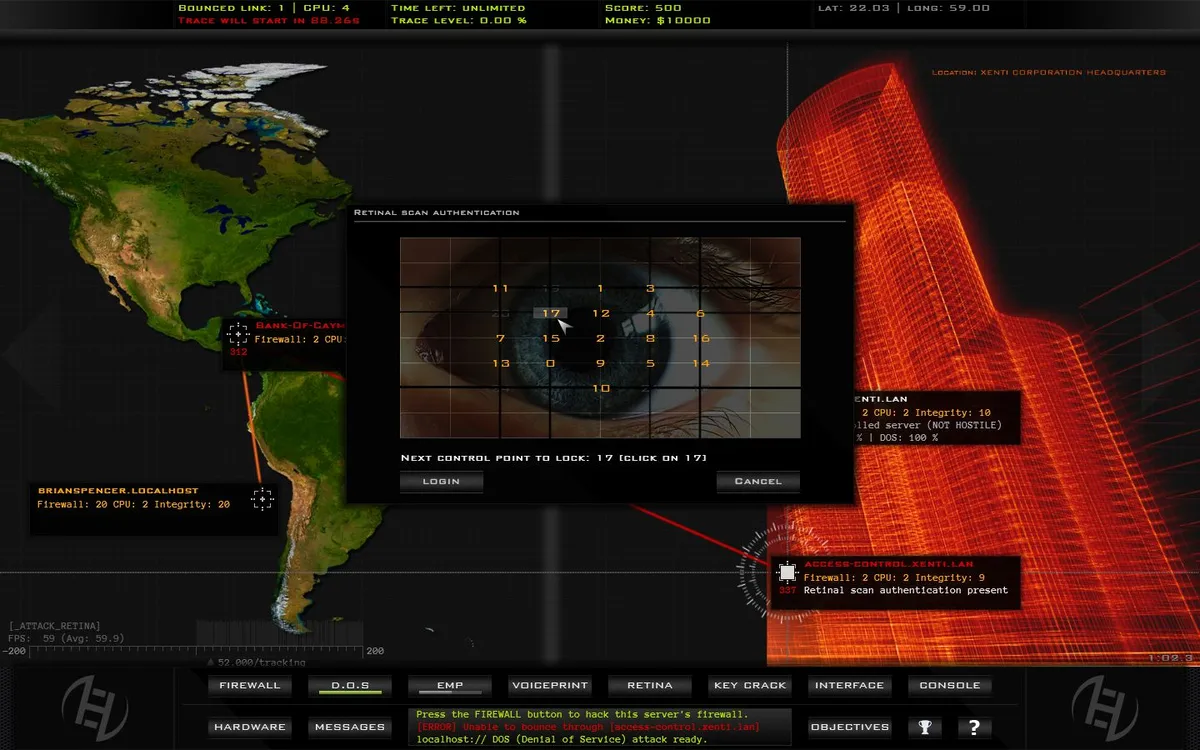
The keyboard shortcuts pull the whole system together: F opens the Firewall Tool, D the DOS Attack Tool, E the EMP Attack Tool, I the Interface Tool, H the Hardware window, M Messages and O Objectives, with the space bar locking on to your own server. Those bindings give a quick sense of how the game expects you to operate, flipping between offensive tools and the self-management screens that keep Trace Level and Tracetime under control.
Starting Advice Backed by the Manual
A few behaviors follow directly from the documented rules. Do not spend the starting $5,000 immediately; the level 01 walkthrough explicitly says to hold it because one objective requires more. Treat bounced links as a power budget: add links until the combined CPU total meets the target's Firewall, and renew any regenerated server before attacking, since lost links quietly erase your margin. Keep enough cash for Integrity Units, because Trace Level does not reset and a trap switch or an expired Tracetime can push it into critical territory. And when the grey bars on weapon buttons have not yet turned green, wait rather than mashing the button, since the manual notes weapons may not be fully charged when instructions arrive.
Scroll sideways to see the full table →
| System | What It Does | Key Figure |
|---|---|---|
| CPU Units vs. Firewall Units | Hack succeeds when your total meets or exceeds the target's Firewall Units | Bounced servers add their CPU Units to your total |
| Bounced Links | Adds CPU power and Tracetime; fragile if servers regenerate | +5 seconds Tracetime per CPU Unit of each bounced server |
| Tracetime | Countdown that starts on lock-on | 5 seconds per Firewall Unit; resets when relocking own server |
| Trace Level | Rises after Tracetime expires and does not reset | 1% per second; 100% loses the game |
| Hardware Upgrades | Firewall and Integrity Units | $5000 per unit; Integrity cuts Trace Level by 10% each |
| DOS Attack | Matches port bandwidth sliders | Reduces target Firewall and Integrity by 1 each |
| EMP Attack | Satellite-based strike requiring charge | Grey bar must turn green before launch |
Sources & further reading.
- Hacker Evolution Duality — official game profile Retrieved Oct 20, 2026
- Hacker Evolution Duality — official game profile — publisher-supplied gameplay manual Retrieved Oct 20, 2026
First published .