 THE GAME ARCHIVE

Doll Controls: Moving, Shooting, Mana Actions and Switching
Doll control in Hitogata Happa uses the arrow keys or an analog controller to move the character, with three or more buttons covering the remaining actions. The default layout assigns the Z key to Button A for the shot, the X key to Button B for the Mana Action special attack, the C key to Button C for selecting a new doll, and the A key to Button P for the pause menu. Movement is therefore separate from firing, so a player can reposition while deciding whether to spend the Mana Action or swap dolls.
The button roles form four distinct actions during play. Holding forward progress is a matter of steering with the movement input, while tapping Button A delivers the standard shot and Button B triggers the Mana Action, described in the manual as a special attack. Button C opens the selection of a new doll, letting the player choose a replacement rather than relying on the current one indefinitely. Button P brings up the pause menu for a break in the action. Each function sits on its own key in the default configuration, so switching dolls and firing do not share an input.
Kamikaze Bomb Attacks and the Flow Charge Gauge
A Bomb Attack is a kamikaze maneuver the manual also calls Humanoid Explosion. It becomes available only when the current doll's Flow Charge sits at 100 percent; at that point the player rams an enemy to set it off. The payoff is devastating damage to any enemies within range, but the doll is destroyed by its own attack. Because a doll is also lost to a direct hit from enemy fire, the approach run itself carries risk, and the manual warns against colliding with enemy attacks while trying to ram a target.
The Flow Charge gauge fills automatically as time passes, so a Bomb Attack is always building toward readiness. Charge speed varies by doll: Leaf, the basic warrior doll, has the fastest Flow Charge and the most powerful Bomb Attack, giving her the strongest single-strike damage despite minimal firepower, while some other dolls gain charge more slowly. Except when using the Rooty doll, the gauge drains during invincibility. Losing every doll ends the game, so each explosion spends a limited resource.
Zone of Control: Turning Bullets Into Gems
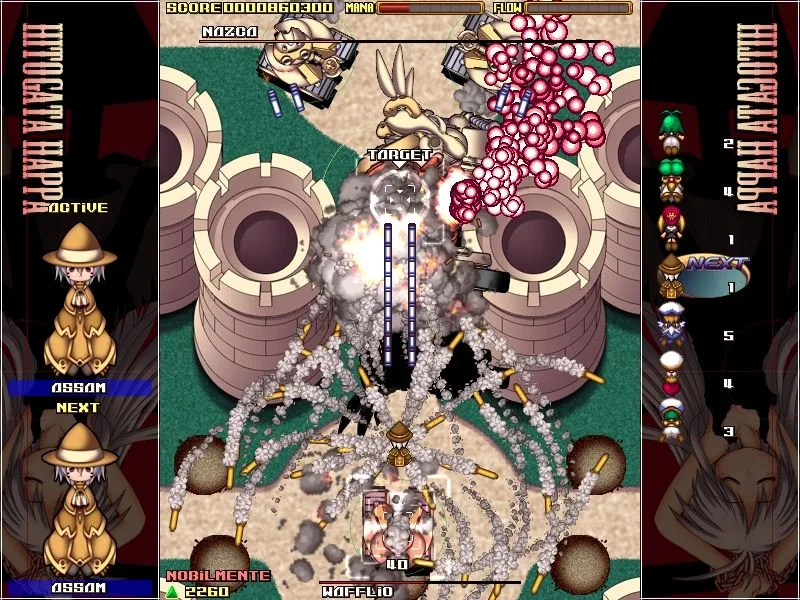
Every enemy projects a circular Zone of Control around itself. Flying into that area and destroying the enemy converts any projectiles caught inside into Small Gems, and enemy fire becomes Small Gems only through this method. The timing of the kill is the crux: the player must be inside the enemy's zone when the shot lands, so the approach and the finishing blow are bound together. Points earned this way reward a deliberate entry into danger, and the manual advises against firing too eagerly while maneuvering in the zone.
A second zone can expand around the player's own doll when it flies near an enemy, generating a partial Planeshift that drastically lowers enemy projectile speed. This expanded area shrinks back to the enemy's original size once the doll moves out of range, so the slowdown persists only while the doll stays close. Because gems feed doll creation, the conversion is not just scoring: Small Gems are collected automatically, while Large Gems appear whenever an enemy is destroyed, count for four Small Gems each, and are picked up automatically only by some dolls.
Gems, Doll Loss and Boss Time Limits
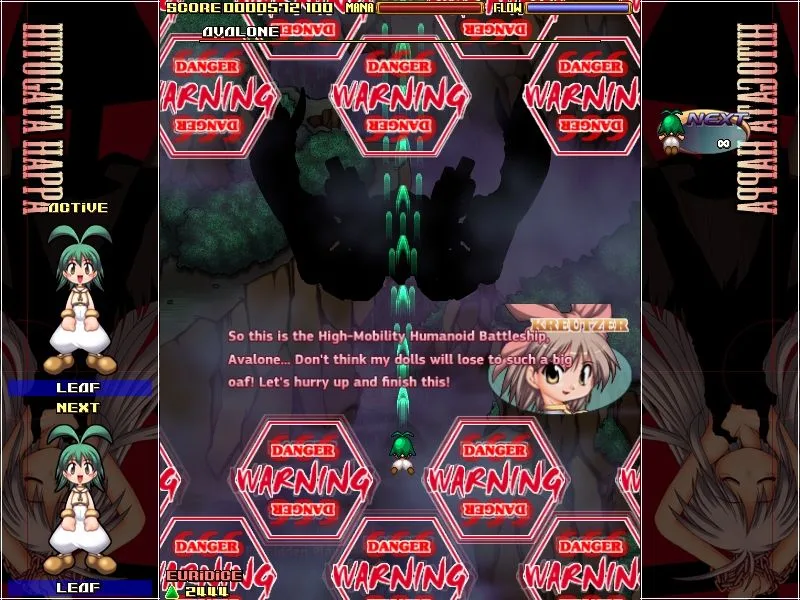
Each mission closes with a boss, and defeating that boss completes the stage. That final fight also carries a time limit. If the timer runs out while the boss is still alive, the battle shifts into Error Mode, a state in which the boss becomes incredibly powerful. The limit therefore turns the boss encounter into a deadline: the player is working toward the boss's defeat before the clock empties. The documented rules tie stage completion directly to defeating the mission-ending boss rather than to survival alone.
The set of dolls works as a finite life stock. A doll is lost when it takes a direct hit from an enemy attack, and a doll is also lost when the player attempts a Bomb Attack, because the kamikaze maneuver destroys the doll using it. The game ends when the player runs out of dolls, so the basic objective is to avoid losing all of them. Because both an enemy hit and a Bomb Attack remove one doll, each attacks spends from the same limited pool that enemy fire depletes.
Stages, Characters and Difficulty Settings
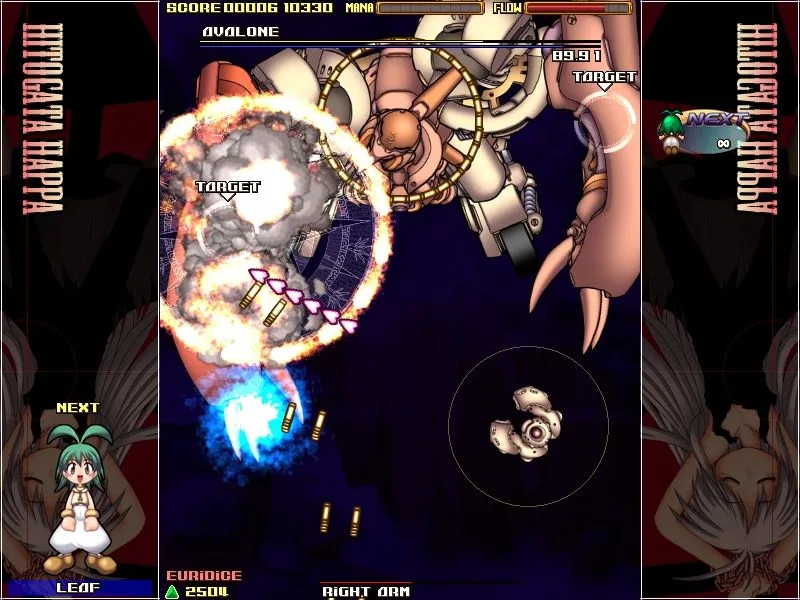
The campaign is built from six vertical-scrolling stages, and each mission closes with a boss whose defeat completes the stage. The character roster holds twelve playable dolls, four of them unlockable, and each doll carries its own special abilities that change how a run plays. Because dolls double as a finite life stock, an enemy hit or a kamikaze bomb attack each removes one from the pool, and running out ends the game. Stage progress therefore depends on holding dolls in reserve while still clearing each boss before its timer expires and Error Mode activates.
Four difficulty settings are documented: Eurodice, Nobilmente, Allemande and Doomsday. According to the manual, Nobilmente serves as the standard mode, Allemande as the difficult mode with a few extra surprises, and Doomsday as the impossible mode for diehard players seeking intense gameplay. Eurodice offers a pick-up mode without some of the more challenging elements found in the other modes. A title menu offers New Game, Continue from the last mission played, and Practice for selecting a single mission.
Practice, Continue and Online Records
The title menu splits play into three routes. New Game starts from the beginning, while Continue resumes from the last mission the player reached, so a session can pick up where it stopped rather than restarting the campaign. Practice selects a single mission for repeated play, but only missions the player has already played appear on that list. A Practice attempt begins automatically with the most Gems the player has ever obtained for that mission, giving the selected stage a starting stock of the gem currency instead of a fresh count.
Scores are tracked per difficulty and feed the Results screen, which shows highest scores for each difficulty and allows recorded plays to be played back. Scores upload automatically to Steam, and the online leaderboards are viewed from this screen. The game profile also lists 13 Steam achievements alongside full online leaderboards, so record keeping covers both score rankings and achievement completion. The Steam product record date is a store listing year, not proof of the original game release.
Sources & further reading.
- Hitogata Happa — official game profile Retrieved Oct 21, 2026
- Hitogata Happa — official game profile — publisher-supplied gameplay manual Retrieved Oct 21, 2026
First published .