 THE GAME ARCHIVE
What IMAGE FIGHT Asks of the Player
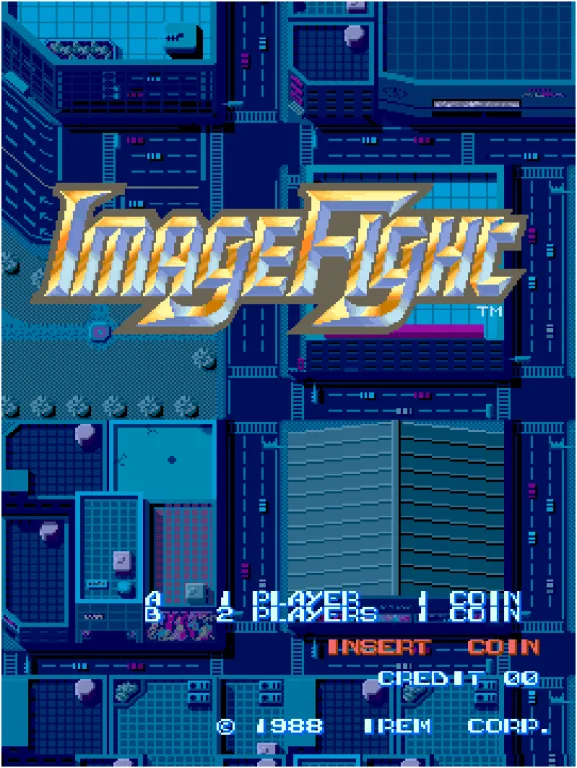
IMAGE FIGHT is a scrolling shoot 'em up released by IREM in 1988 for the arcade. The published description sets out a two-part journey: the player first clears a VR training course, then takes the fight up into outer space. That framing gives the game its shape. The arcade session opens as a simulation exercise, and the transition to space is something the player must earn rather than something that happens automatically at the start.
Two documented systems sit underneath that journey. First, the action is scrolling shooting: the player fires at enemies as the playfield moves. Second, the game tracks results stage by stage. After every cleared stage the player can check how many ships were destroyed, and the score is tested again after stage 5. A score that is still not good enough at that checkpoint can send the player into a supplementary course. Those two rules are the core of what the published material tells us about how IMAGE FIGHT plays.
The Premise: A Training Simulation That Opens Into Space
The word "clear" carries real weight in the published description. The VR training course is not a menu or a practice lobby the player can skip. It is the opening phase that has to be completed before the outer-space fight begins. Read as a piece of arcade design, that ordering does useful work. A new player meets the shooting fundamentals inside a scenario labeled as training, and the move to space then reads as a promotion within the run rather than a separate mode chosen from a screen.
Because the course must be cleared, the training framing and the stage structure are the same thing seen from two angles. The stages are the training; finishing them is what finishing the course means. The publisher material does not describe a separate tutorial outside the stages, so the clearest reading is that the VR setting colors the stages themselves rather than sitting beside them.
The Core Loop: Scroll, Fire, Clear the Stage
The moment-to-moment play is scrolling shooting. The screen scrolls, the player fires at enemies, and stages are cleared one after another. The published description does not detail the ship's movement axes, weapon pickups, bomb systems or boss encounters, so the safer way to describe the loop is at the level the evidence supports: a scrolling shooter organized into discrete stages, each of which ends in a clear result.
The stage clear is the hinge of the whole design. It is where the action pauses, where the result is reported, and where the game's next decision is made. That makes the loop longer than a simple dodge-and-fire cycle: a player is not only surviving the stage in front of them, but feeding a record that the game will consult again later. Every cleared stage adds to that record.
The Ships-Destroyed Readout After Every Stage
The most distinctive documented system is the post-stage report: after clearing each stage, the player can check how many ships they destroyed. That is a different piece of feedback from a bare score line. It tells the player how productive their shooting was during the stage they just finished, and it does so at the very point where the game moves on to the next stage. Over several stages it accumulates into a running picture of the run.
For the player, the readout is useful in two ways. It provides immediate feedback on whether their firing kept up with the stage, and it appears often enough that a player who wants to improve has something concrete to check stage after stage. It also makes the game's later evaluation feel legible: the player has been shown ship counts all along, so the idea that results are being judged is established well before any decision is applied.
Stage 5 and the Supplementary Course
Stage 5 is the documented checkpoint. If the player still does not have a good score after clearing stage 5, they may have to take a supplementary course. The wording matters here: the extra course is a consequence of the score check at that stage, not something the player opts into from a menu. The stage-by-stage structure keeps going, but the path through it can lengthen.
Placed next to the ships-destroyed readout, the checkpoint gives the run a genuine midpoint decision. A player who has been scoring well moves on; a player who has not may be sent back into training material. The published description does not specify the exact threshold, the length of the supplementary course, or whether it can repeat, so players should treat the rule as a documented gate rather than as a known numeric target.
Where the Player's Decisions Actually Sit
The documented rules put the meaningful choices in the shooting itself. Because kills are reported after each stage and a score check waits at stage 5, a player who wants to reach outer space without a detour has a reason to shoot efficiently and keep the destruction count up throughout the training stages. That is a strategic emphasis rather than a mechanic: the evidence does not describe scoring multipliers, continues or a visible target score, so the practical advice is simply to treat the kill tally as information worth watching.
For anyone approaching the game, the documented starting point is straightforward. Clear each stage, then read the ships-destroyed report before moving on, because stage 5 will ask whether the run has been good enough. The supplementary course should be understood as part of the training arc, not as a failure state. The published material presents it as an additional course the player may have to take, so it is best treated as more of the same exercise the player has been working through.
Original Arcade Release and Later Reissue Context
IMAGE FIGHT is documented as an IREM arcade release from 1988. The citing material is licensed publisher documentation, and it also carries context for a modern reissue line. That surrounding text describes general features of the reissue series rather than specific additions to this game: adjustable difficulty settings, an optional CRT-style look where supported, and online high-score competition among players. Those are best attributed to the modern reissue context, not to the 1988 arcade board.
The distinction is worth keeping in view. The training-course gate, the post-stage ship count and the stage 5 check belong to the original game's documented description. Difficulty customization, CRT-style presentation and global leaderboards belong to the modern reissue wrapper. A player meeting IMAGE FIGHT through a current release is playing the same arcade design, with those wrapper options available around it.
Scroll sideways to see the full table →
| Item | Documented detail |
|---|---|
| Title | IMAGE FIGHT |
| Publisher | IREM |
| Release year | 1988 |
| Platform | Arcade |
| Genre | Shooting |
| Opening phase | Clear the VR training course |
| Following phase | Take the fight up into outer space |
| Per-stage feedback | Check how many ships you destroyed |
| Stage 5 rule | A still-poor score may require a supplementary course |
Sources & further reading.
- IMAGE FIGHT — licensed publisher game documentation Retrieved Oct 19, 2026
First published .