 THE GAME ARCHIVE
From the Surface Pod into Unmapped, Procedural Caves
Koya Rift begins each run on the surface of a hostile planet, with your character standing beside a delivery pod from a mercenary mothership. From that starting point, you venture underground into a network of caves. The game is a two-dimensional shooter-platformer, so this descent places its shooting and platforming within an underground setting rather than keeping the action on the surface. The minimap initially conceals the area below ground: the pod gives you a visible starting location, but not a preview of the tunnels and caverns ahead.
Those underground spaces are procedurally generated, with a different arrangement of tunnels and caverns each time you play. The concealed underground map and changing cave layout work together: you begin without seeing the area below, and the next run does not simply return you to the same network. Exploration therefore starts with an unmapped cave system rather than a fixed layout supplied in advance. The recurring structure is the surface arrival followed by the journey underground; the arrangement of the spaces you enter changes between runs.
Hunting Phantom Crystals with Generated Weapons and Enemies
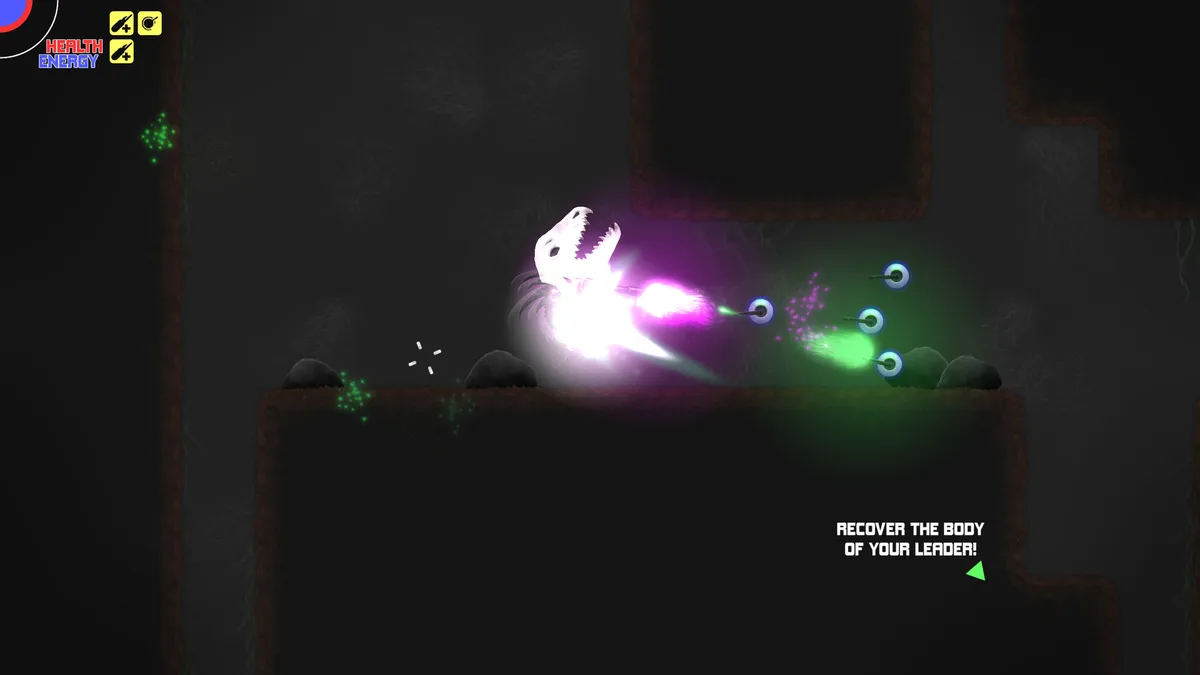
The targets of your hunt are the Phantom Crystals, which grow the enemy soldiers you encounter underground. Winning requires destroying every crystal, so fighting individual Phantoms is not enough to complete the objective. The soldiers are active pursuers, hunting you while the crystals themselves continue to grow and evolve. That puts two kinds of enemy activity alongside your search: mobile opponents pursue you, while the structures you must eliminate keep developing. Your task is to destroy the sources of those soldiers, not simply to defeat whatever enemies you meet along the way.
Individual fights also vary because procedural generation extends to the enemies and your own weapons. A Phantom's generated characteristics include its size, movement speed, color, health, damage and weapon behavior. Variation therefore reaches beyond appearance: opponents can differ in how quickly they move, how much health they have and how their weapons behave. Your weapons are generated too, so approaching a fight means adapting to the equipment you have rather than assuming an identical weapon each time. The crystal hunt combines that changing armament with individually varied pursuers, while retaining the same requirement to eliminate every Phantom Crystal.
Earning Upgrades, Buying Allies and Funding Their Progress
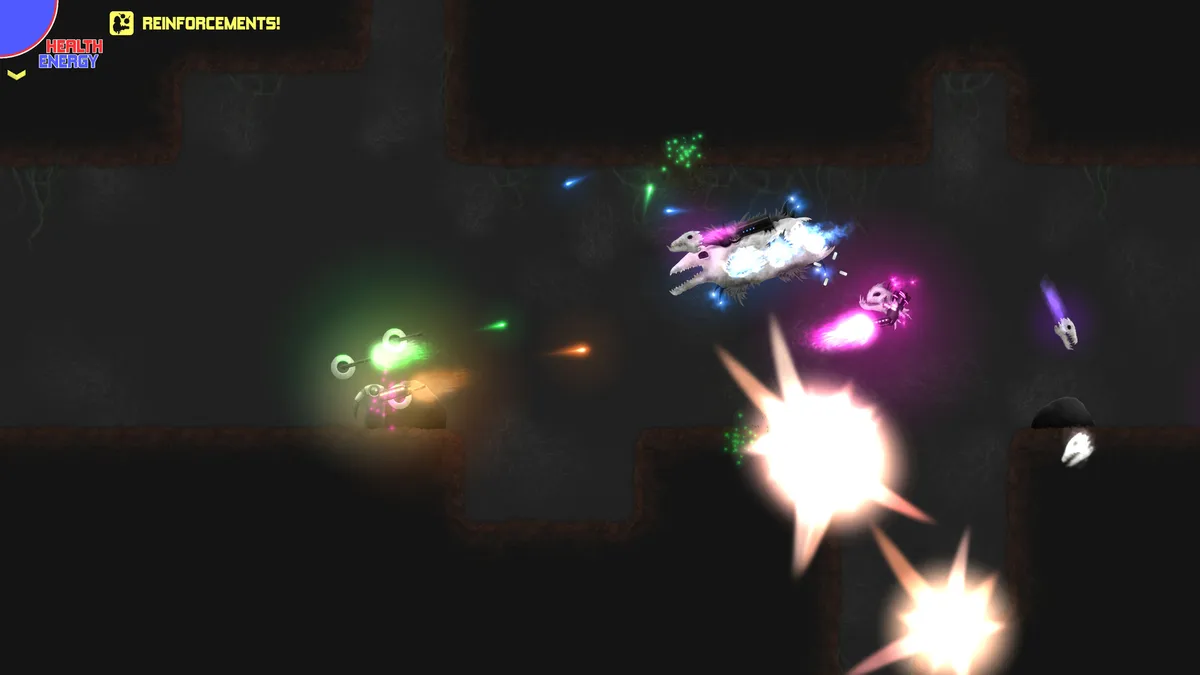
Progression includes earning upgrades and purchasing allied units as you advance. Killing opponents has a cash value, giving combat an economic role alongside removing enemies. Ally prices are among the values altered by the game's difficulty adjustments, as is the cash awarded for a kill. Those two rules connect the income from fighting with the expense of buying support: neither the reward for defeating an opponent nor the price of an ally is a fixed part of the economy. Earning upgrades accompanies these purchases as another part of your progress.
Buying an ally is distinct from advancing its level: allies require experience to level up, and the amount required is another adjustable value. Their purchase cost and their experience requirement therefore represent separate measures of investment, one in cash and the other in experience. Allied units also have variable movement speed and fragility, so their rules extend beyond recruitment and leveling. Taken together, these documented properties describe support units with a price, an experience threshold for advancement, and physical characteristics that can change. Paying for a unit and developing it are separate parts of the progression system.
Adaptive Difficulty: Run Results, Phantom Reactions and Enemy Raids
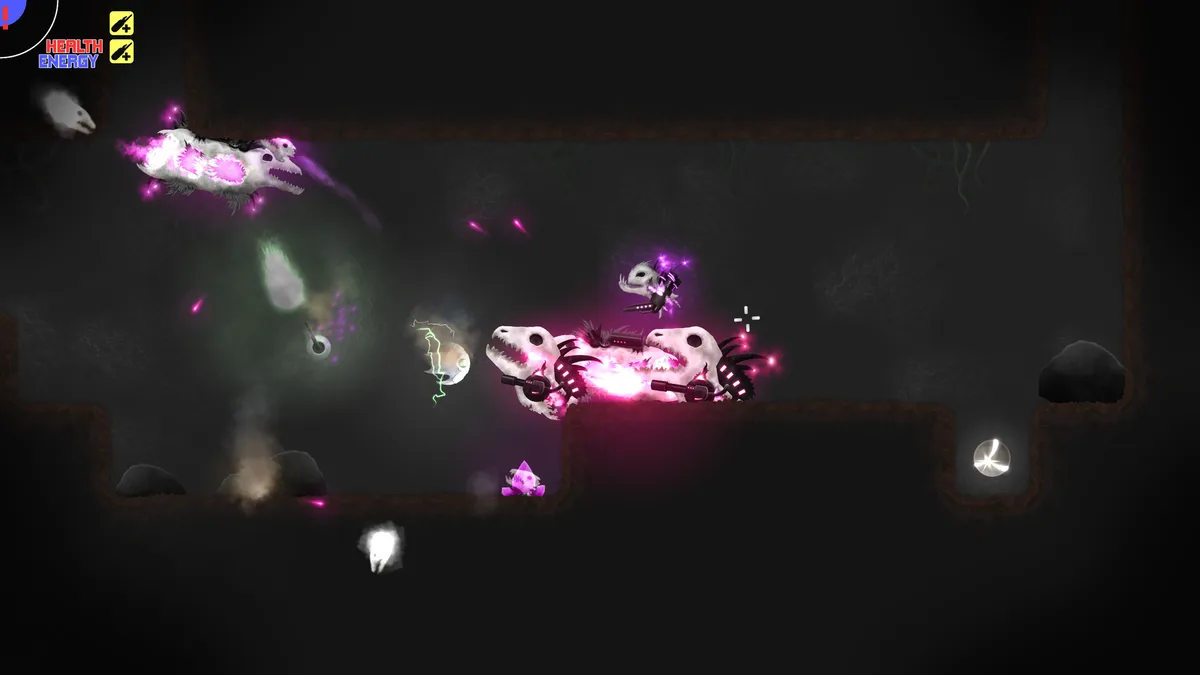
Koya Rift adjusts difficulty according to your results: winning makes the game harder, while losing makes it easier. Completing a level too easily can therefore lead to a tougher next attempt, rather than leaving the challenge unchanged. This is not a choice between three fixed difficulty settings, nor merely an adjustment to the player's health. Instead, the system uses a finely graded difficulty measurement with an exceptionally broad range in both directions. Its adjustments reach into the behavior of the Phantoms themselves, changing their reaction speed and the pace at which they grow and evolve.
Enemy raids are another adjustable component: difficulty changes both their swiftness and their force. Enemy health and damage also vary, but the system reaches beyond the opposition to alter the tools you fight with. Energy weapons have adjustable accuracy, size, firing rate and density, while special weapons have variable effects. Health recovery rate and level size belong to the same collection of changing values. A run's result can thus feed into several distinct parts of subsequent play: how quickly enemies respond, the strength and speed of raids, the properties of your firepower, and the rate at which health returns.
Sources & further reading.
- Koya Rift — official game profileRetrieved Nov 11, 2026
First published .