 THE GAME ARCHIVE
Left 4 Dead is best understood not as a story you move through, but as a pressure system you survive. Valve's co-op action horror game puts up to four players into the aftermath of a zombie apocalypse and asks a simple question: how long can you keep each other alive? What separates it from a standard shooter is the machinery behind the scenes — a system Valve calls the AI Director, which shapes the frequency and ferocity of enemy attacks around how the team is actually performing.
The Premise: Four Survivors, Four Movies
The campaign is structured like a season of horror films. Each of the four "movies" is made up of five large maps, and each movie can be played by one to four human players. Matches emphasize team-based strategy and objectives rather than solo heroics; you guide your survivors across the rooftops of an abandoned metropolis, through rural ghost towns, and through pitch-black forests as you try to escape ground zero.
Across those four movies, the game ships with twenty maps and ten weapons. The number matters less as a stat than as a texture note: the weapon list is deliberately tight, and the maps are designed to be replayed rather than consumed once. The variety comes from what happens inside them on any given run.
The Core Loop: Move, Hold, Adapt
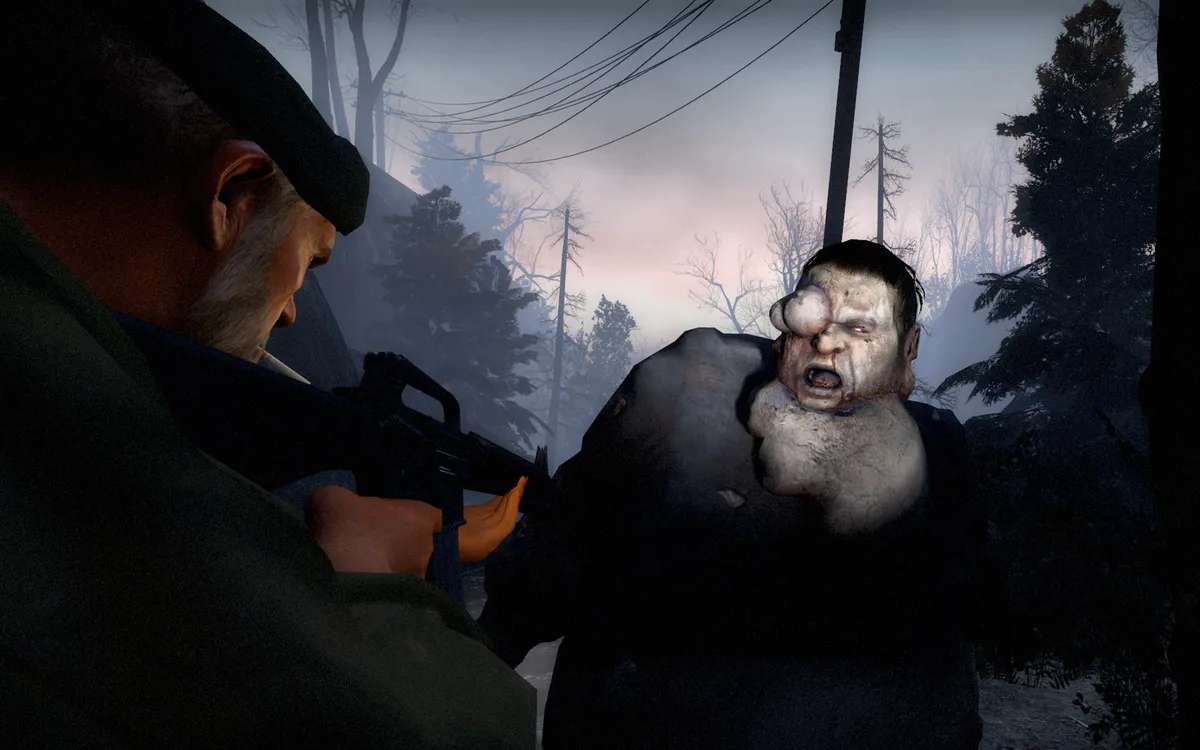
The basic rhythm of a Left 4 Dead run is a loop of movement and holding ground. You move through a map with your team, clearing a path through the infected, then you reach a point where survival means standing your ground together. The AI Director controls the rhythm of that loop. It adjusts the frequency and ferocity of zombie attacks based on your performance, so a team that is struggling gets a different experience from a team that is coasting.
That performance-based design is the crucial mechanical idea. Left 4 Dead is not a game where a fixed wave script replays the same way every time. The Director's job is to generate a unique gameplay experience on each run, and it does that by dynamically creating intensity and varying encounters as you play.
 View full image ↗
The AI Director: A System, Not a Script
Valve described the AI Director as new technology designed to deliver a Hollywood-style horror experience rather than a predictable shooter. The comparison is directional: it points at pacing and escalation, not at a fixed plot. The Director creates a fast-paced but not overwhelming experience by tailoring attacks to what the players are doing.
The practical effect for players is unpredictability. Because the system adapts to team performance and creates unique experiences per run, the same map can produce very different pressure levels on different nights. That is also why the game rewards communication: if your team is silent and scattered, the Director has more room to punish you, and if you are coordinated, the same system produces a different, more manageable rhythm.
Modes: Campaign, Versus, Survival
Left 4 Dead ships with three distinct ways to play. Campaign is the co-op spine: one to four players work through the movies in a survival-co-op structure with team objectives. Versus Mode turns the same fiction into a four-on-four competition where one side plays the humans trying to get rescued and the other plays zombie boss monsters trying to stop them. Survival Mode removes the travel and asks how long you and your friends can hold out against the infected horde.
Each mode changes what the Director's pressure means. In Campaign, the pressure is about completing a route and holding key positions. In Survival, the entire session is a standoff, and the question becomes how long the team can sustain itself as the threat escalates. In Versus, that same adaptive system now has human opponents on the other side of the encounter, turning the mode into a test of coordination and timing rather than pure endurance.
The Sacrifice Add-On
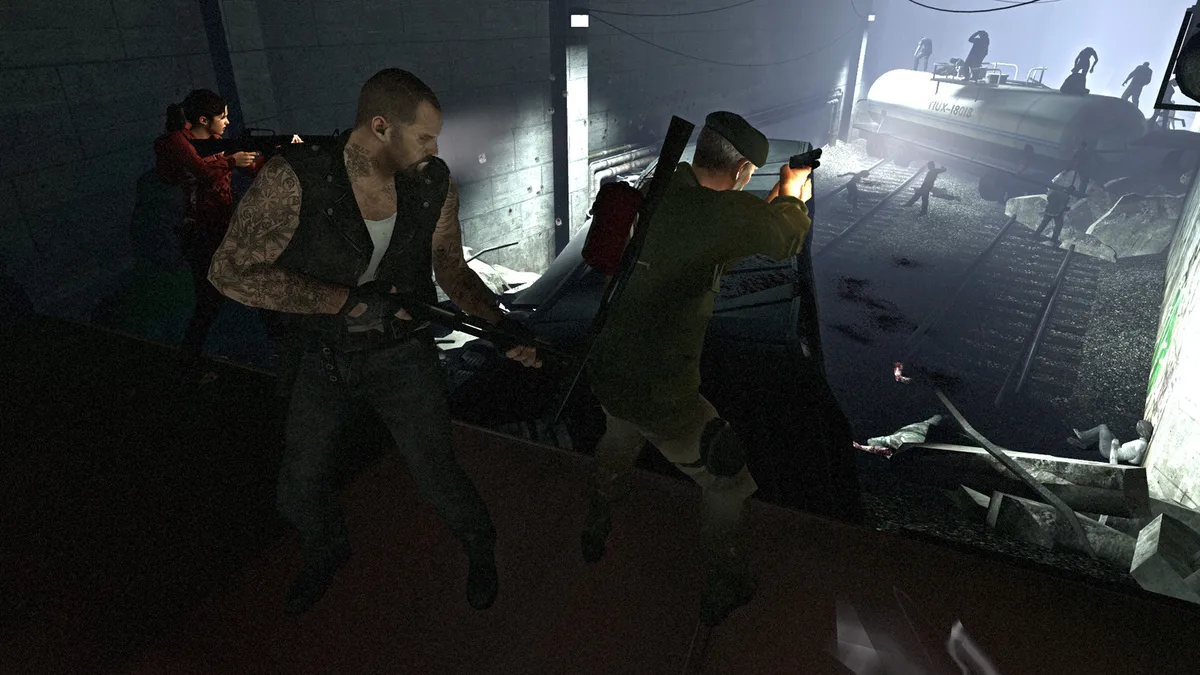
The Sacrifice is a later add-on that acts as a prequel to The Passing and follows the Left 4 Dead survivors' perspective as they move south. Beyond the story, it introduces a new style of finale built around what Valve calls sacrificial gameplay: the players decide who will give their life so the others can live. For owners of Left 4 Dead, the add-on adds a campaign playable in Campaign, Versus, and Survival modes, so the three core modes all inherit the new finale.
The design significance is that the add-on does not add a separate mode. It adds a finale type, and lets that finale be played under the existing rules of Campaign, Versus, and Survival. That is a good example of how Left 4 Dead expands: new pressure scenarios inside an existing structure, rather than a parallel game mode that splits the player base.
 View full image ↗
Starting Guidance: Where to Put Your Attention First
The most useful starting advice is to treat the first Campaign run as a lesson in the loop, not a race. Play with a full group if you can, because the design assumes up to four human players working with team-based strategy and objectives. Stay near your team, and accept that the Director will vary the encounter rather than repeating a fixed pattern. If a section feels quiet, that is not a guarantee it will stay quiet.
Once you are comfortable with Campaign, use Survival Mode to practice the hold-out part of the loop in isolation, and use Campaign to practice movement and route completion. Then try Versus when you want the encounter to include an opposing team rather than only the system.
Design Personality: Why It Still Feels Distinctive
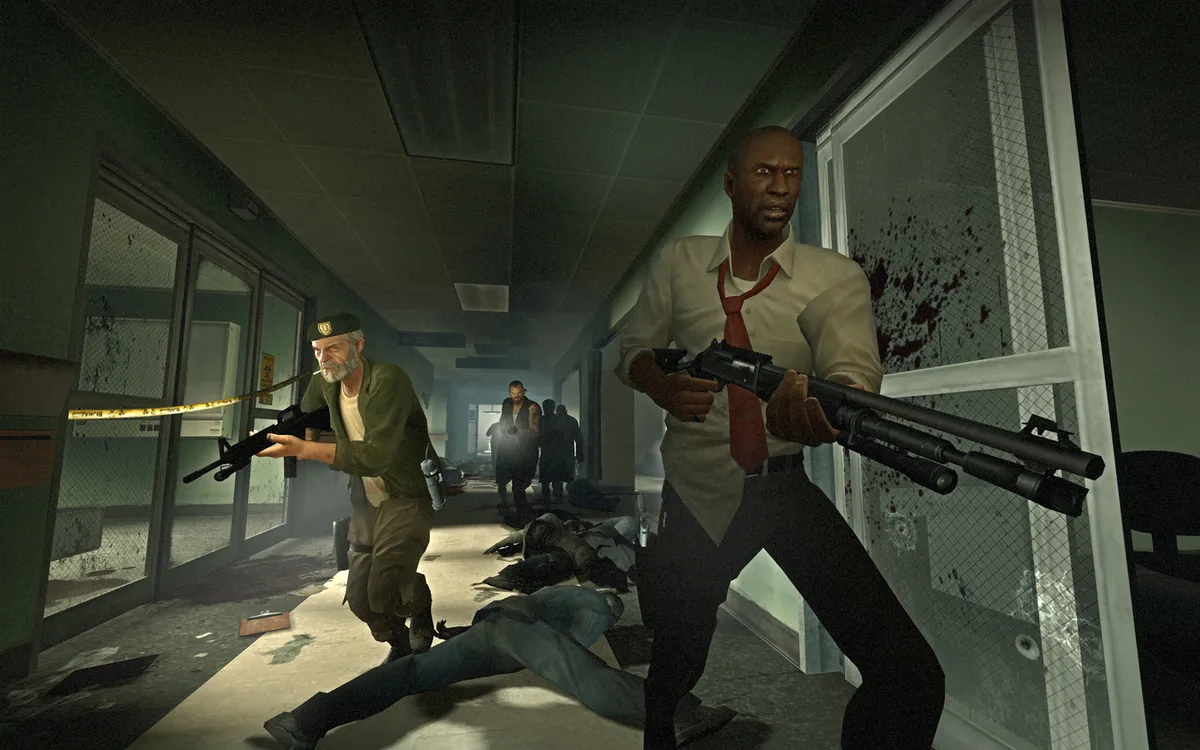
Left 4 Dead's identity comes from the relationship between its small sandbox and its adaptive pressure. Twenty maps and ten weapons is a deliberately compact set of variables. The AI Director is the variable that keeps the whole thing from settling into a memorized route. The cooperative design is not a layer on top of a single-player campaign; it is the assumption the game is built around, from the movie structure down to the mode list.
The title is also a time capsule of 2008 co-op design. It supported single player, co-op, and multiplayer action, but the emphasis on four-player teams and shared survival made it a reference point for team-based shooters. The Sacrifice add-on extended that model by placing the campaign in all three modes rather than in a separate download corner.
 View full image ↗
Editions and Current Official Access
This article is scoped to the Steam catalog entry for Left 4 Dead. That entry lists the game on Windows, developed and published by Valve, with an Action genre tag, and gives 2008 as the release year. It does not provide original release history for other platforms, remakes, or ports, and those are outside the scope of what is supported here. The listed store description also references a co-op action horror game for PC and Xbox 360; this profile focuses on the mode and system facts documented in that description and does not extend them to other platforms or packages.
Fact Summary
- - Title: Left 4 Dead
- - Developer / Publisher: Valve
- - Release year (Steam entry): 2008
- - Platform listed on the official entry: Windows
- - Genre tag: Action
- - Player count: 1 to 4 in campaign and co-op modes
- - Campaign structure: four movies, five large maps each
- - Modes: Campaign, Versus (four-on-four), Survival
- - Add-on: The Sacrifice, played in Campaign, Versus, and Survival
A Note on Scope
This profile is built from the official store page and its description. It does not include hands-on testing, so it should be read as a description of how the game presents its own systems and modes, not as a review of how it feels to play today. Facts that the source material does not establish — such as how specific controls work, what the difficulty curve looks like in practice, or which modern platform builds are available — are left out rather than guessed.
Scroll sideways to see the full table →
| Attribute | Value |
|---|---|
| Game | Left 4 Dead |
| Developer | Valve |
| Publisher | Valve |
| Release year (Steam entry) | 2008 |
| Platform listed | Windows |
| Genre tag | Action |
| Players | 1 to 4 (campaign/co-op) |
| Campaign structure | 4 movies x 5 large maps |
| Modes | Campaign, Versus (4v4), Survival |
| Add-on | The Sacrifice (Campaign, Versus, Survival) |
Sources & further reading.
- Left 4 Dead — official game profile Retrieved Oct 10, 2026
First published .