 THE GAME ARCHIVE
Terraria: A World You Shape From the Ground Down
Terraria is an action-adventure game from developer and publisher Re-Logic, listed on Steam with a release year of 2011 for Windows, macOS, and Linux. Its official store profile sums it up with a four-word promise — dig, fight, explore, build — that doubles as a surprisingly accurate description of the design. Rather than funneling the player down a fixed path, Terraria hands over a world and a set of verbs, then lets the player decide what to do with them.
That open-ended framing places Terraria in a lineage of games where the journey and the destination belong to the player. The official description explicitly says both are "completely in the player's control," and it blends "elements of classic action games with the freedom of sandbox-style creativity." The result is a game whose identity comes less from a single story and more from the relationship between combat, exploration, and construction that the player builds for themselves.
The Premise: Survival, Fortune, and Glory in a World You Own
The official description frames the premise around a fight "for survival, fortune, and glory." That phrasing captures the tone of the game better than any genre label. You are not cast as a hero with a prophecy; you are dropped into a generated world with nothing, and everything you accomplish is a direct result of what you gather, build, and defeat. Survival is the baseline requirement, fortune is the reward for exploration, and glory is the player's own to define.
The official text also raises a series of rhetorical questions — whether you will delve into cavernous expanses for treasure and raw materials, seek out greater foes, or construct a city for the allies you meet — and answers them with a single line: in the world of Terraria, the choice is yours. That is the premise in its entirety, and it is worth taking literally rather than as marketing color. The design is built so that all three impulses — mining, fighting, building — are genuinely available, and each feeds the others.
A significant part of the premise is that the world itself is not fixed. The official profile lists "Randomly generated worlds" as a key feature, and describes the adventure as "truly as unique as the players themselves." Two players can start on the same day and end up in landscapes with different terrain, resources, and opportunities laid out before them.
The Core Loop: Four Verbs That Feed Each Other
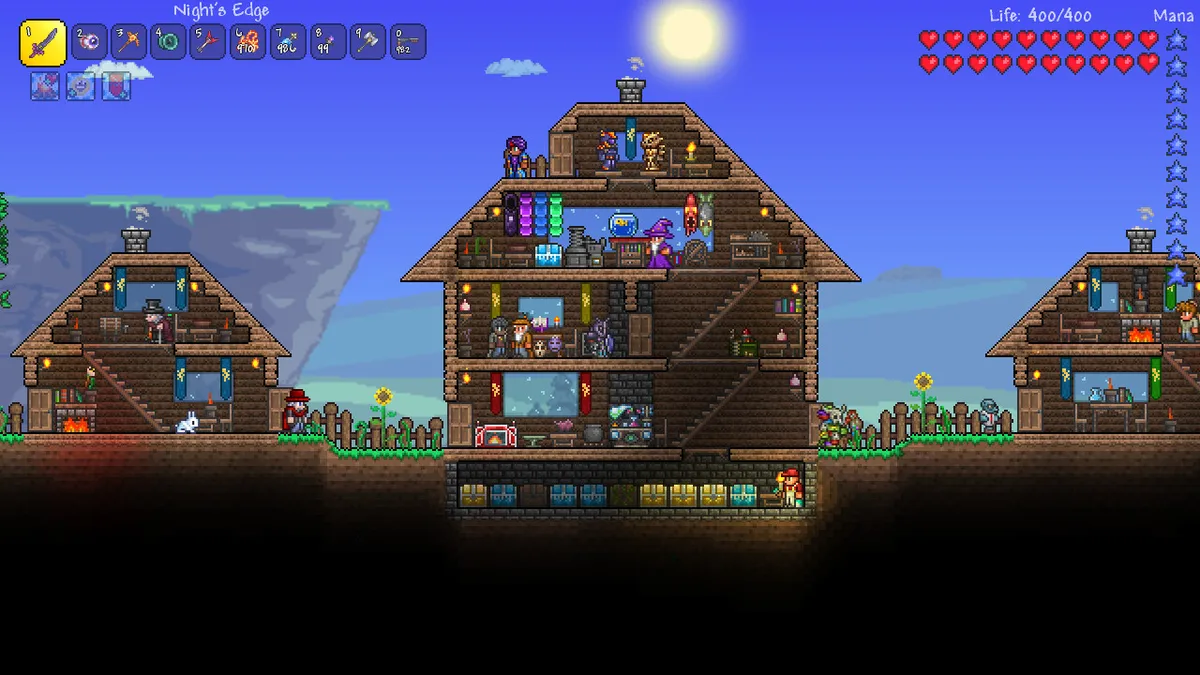
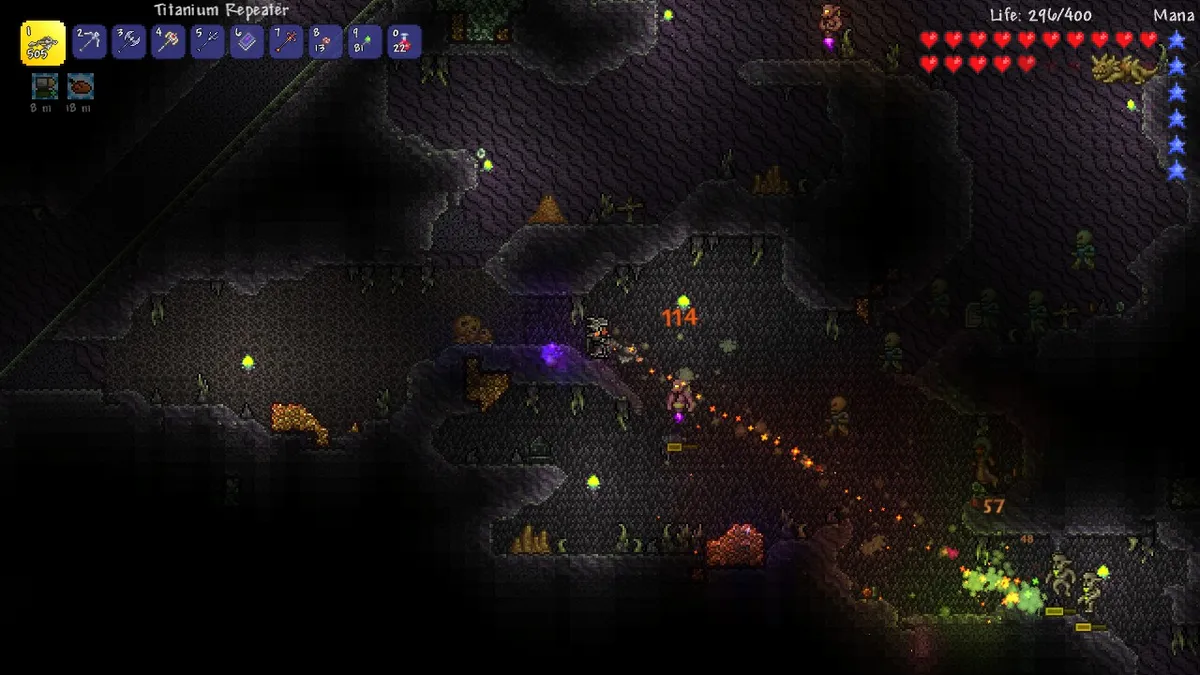
Terraria's loop is unusually legible, and the official description states it almost as a list. You dig through terrain to create tunnels and reach resources. You fight enemies when they appear. You explore to find locations and materials. You build structures, items, and environments from what you collect. The interesting part is not any single verb but how tightly they interlock: digging produces materials, materials enable both building and combat gear, and combat and exploration open the way to more places to dig.
Consider what that interlock means in practice. A tunnel is not just transport; it is a source of stone, ore, and treasure, and it can also become a defensive corridor or the foundation of an underground base. A weapon is not just a way to win a fight; it is often the thing that lets you survive long enough to reach the next resource. Because the same materials serve crafting, construction, and combat, a player is rarely doing only one thing at a time.
The loop also has a clear feedback direction. Collecting materials is explicitly tied to crafting items, weapons, and structures, and defeating enemies is described as yielding rewards and progress toward stronger gear. So the player is not merely accumulating objects; they are converting exploration and combat into capability. That conversion is what turns a sandbox into a progression.
 View full image ↗
Mechanics and Systems: Crafting, Tools, and the Sandbox Frame
Terraria's systems are documented as sandbox play, randomly generated worlds, and free content updates — a short list that nonetheless explains a great deal about how the game behaves. Sandbox play means open-ended gameplay with player-driven goals and creative freedom. Randomly generated worlds means each new world has its own layout and content. Free content updates means the game continues to receive new content over time, which matters for a title whose value is partly in how much there is to discover.
Crafting sits at the center of the system layer. The official description explicitly mentions crafting "ever-evolving gear, machinery, and aesthetics," which is a wider scope than weapons alone. Item crafting is described as using a variety of recipes and materials, and the player is documented as using specialized tools for digging, building, and combat rather than a single universal action.
Two further systems are documented directly. Player interaction with non-player characters is described as a source of quests and services, and boss encounters are described as part of how the player progresses through the game's content. The official description's image of constructing a city "to house the host of mysterious allies you may encounter along your travels" lines up with this: building is not only self-expression, it is also how you make room for the characters who give you services.
Progression: From Wood to Bosses to Cities
Progression in Terraria is documented as flowing through three connected channels. The first is resource gathering: collecting materials to craft items, weapons, and structures. The second is enemy defeat: overcoming enemies to earn rewards and move toward stronger gear. The third is construction: building bases and structures as a key gameplay goal. Together these channels mean progress is measured less by a level number and more by what you can now make, survive, and reach.
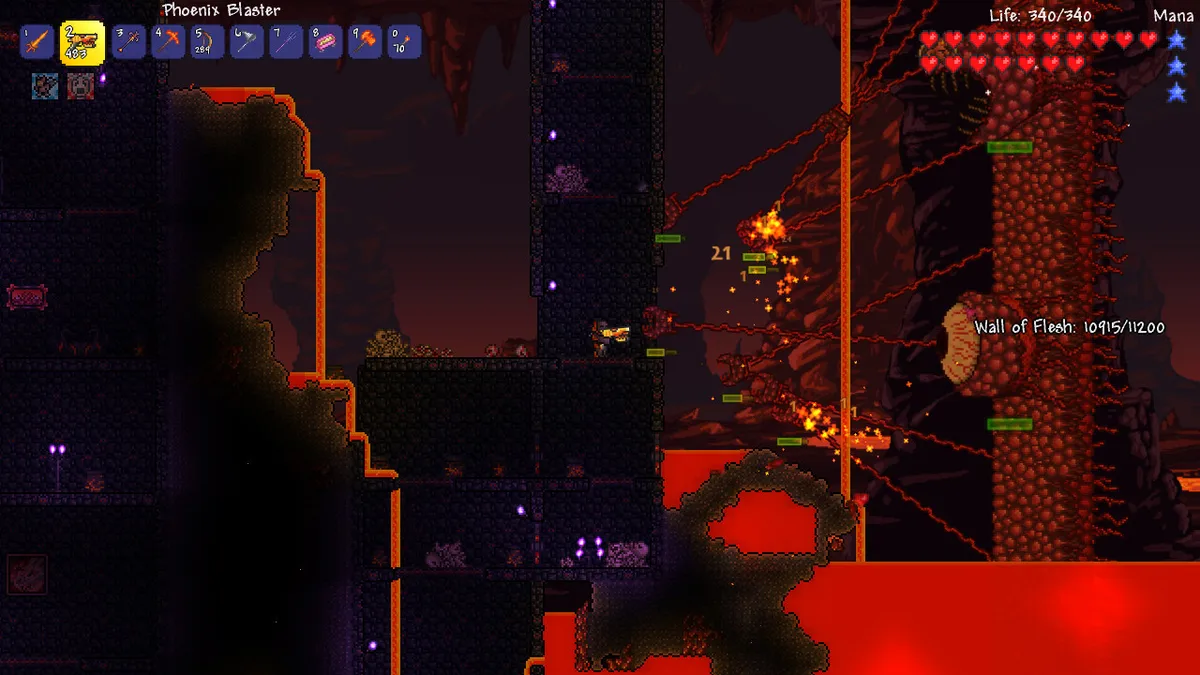
Boss fights are documented as a progression milestone rather than an optional side activity. Encounters are how the player advances through the game's content, which gives combat a structural role in the loop: you fight in order to gain access, not merely to clear a room. Crafting and exploration then convert that access into new materials and new structures, which in turn prepare you for the next encounter.
The objectives listed in the source material reinforce this. Survival is described as a primary objective, crafting is described as creating tools, weapons, and structures to advance gameplay, exploration is described as discovering hidden locations and secrets, and building is described as constructing bases and structures. In other words, the game treats all four verbs as goals in their own right, not as means to reach a single end state.
 View full image ↗
Modes and Play Style: Sandbox With Stakes
The source material documents the game as operating in both a sandbox mode, with open-ended and player-driven goals, and a survival mode, in which the player manages health, resources, and threats from enemies. These are not contradictory descriptions; they describe the same design from two directions. The world is open, but the enemies and resource constraints keep the openness from feeling weightless.
Because goals are player-driven, the practical "mode" is often defined by what the player chooses to prioritize in a given session: a mining run, a building project, a boss attempt, or a push into unexplored terrain. The official description's line that "nothing is impossible" is best read as a statement of scope rather than a literal guarantee, but it reflects the game's premise that the player sets the agenda.
Source-Backed Starting Guidance
The official material supports a few sensible starting points, drawn directly from documented mechanics rather than from first-hand play. First, treat the first tool as the foundation: specialized tools are documented for digging, building, and combat, so reliable tool access is the practical gateway to every other system. Second, dig with a purpose and a route home in mind: digging creates tunnels, and exploration is how you find locations and resources, but building is also a documented way to establish a base.
Third, don't skip crafting just because a fight is winnable: crafting is documented as the system that produces items, weapons, and structures, and enemy defeats feed rewards and stronger gear. Fourth, expect the world to differ from any world you have seen before, because worlds are randomly generated with unique layouts and content. Starting guidance based on one world's map will not necessarily transfer to another.
Finally, remember that allies are part of the plan. The official description ties city construction to housing allies, and non-player characters are documented as offering quests and services. Building shelter is therefore both a survival move and a system-access move: it is how the player brings services within reach.
 View full image ↗
Design Character: A Game Defined by Player Ownership
The distinguishing design feature of Terraria, as documented, is the degree of control given to the player. The official profile says the journey and the destination are "completely in the player's control," and the listed genres — Action, Adventure, Indie, RPG — reflect a game that draws on several traditions without settling into one. The description's own summary, that the game blends classic action with sandbox creativity, is a fair statement of its ambitions.
A second characteristic is the game's long tail. Free content updates are listed among its key features, and the game has continued to receive content since its 2011 Steam release year. Combined with randomly generated worlds, this gives the game an unusual amount of replayable surface: new content to explore plus new worlds to explore it in.
Edition and Access Notes
This feature is scoped to the official Steam entry for Terraria, which lists Windows, macOS, and Linux as platforms, Re-Logic as both developer and publisher, and 2011 as the release year. The source material does not document original release history beyond that year, nor does it describe the differences between this entry and other versions of the game. Those distinctions should not be assumed from the information available here.
The store profile also notes that a four pack is available. Beyond that, no pricing, bundle contents, or storefront-specific bonuses are documented in the supplied material, so none are described here.
The table below supplements the feature with the documented catalog facts.
Scroll sideways to see the full table →
| Field | Value |
|---|---|
| Title | Terraria |
| Release year | 2011 |
| Developer | Re-Logic |
| Publisher | Re-Logic |
| Platforms | Windows, macOS, Linux |
| Genres | Action, Adventure, Indie, RPG |
| Key features | Sandbox play, randomly generated worlds, free content updates |
Sources & further reading.
- Terraria — official game profile Retrieved Oct 9, 2026
First published .