 THE GAME ARCHIVE
What the Player Actually Does
LEGO Batman 2: DC Super Heroes is a TT Games action-adventure in which Batman and Robin join Superman, Wonder Woman, Green Lantern, and other DC heroes to save Gotham City from Lex Luthor and the Joker. The publisher frames the experience around two activities: collecting a roster of DC Comics characters and flexing the super abilities those characters bring to bear on the city. The game is classed in the action and adventure genres and ships on Windows, but the player-facing shape of it is a city-scale toy box — you move through Gotham, switch among heroes, and use the right power on the right obstacle. What follows is an orientation to the documented systems rather than a walkthrough.
The Roster of 50 Is the Progression System
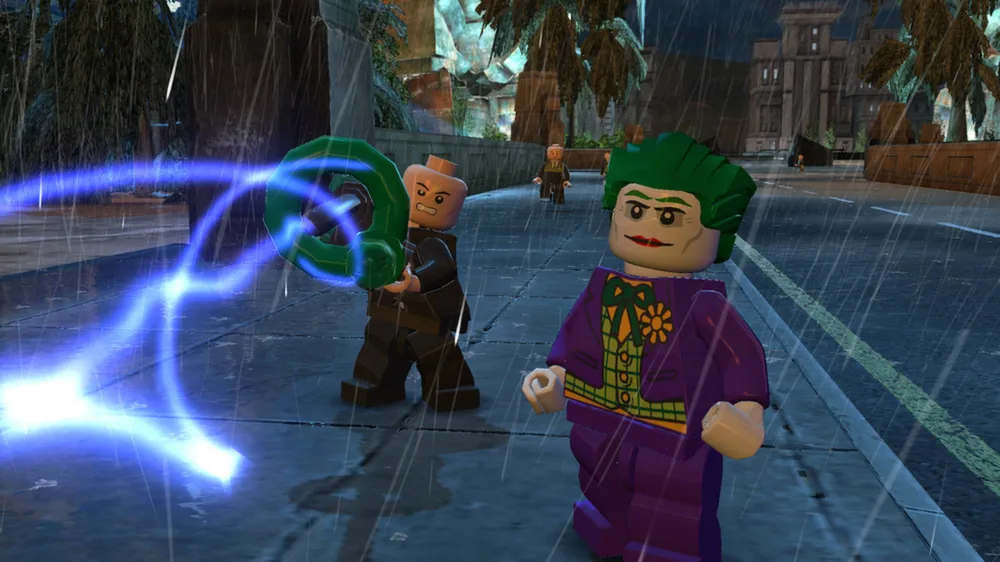
The publisher sets a roster goal of 50 collectible DC Comics characters. That number is not a cosmetic tally; it is the structure that drives play. Each hero carries a specific power, and the sum of those powers determines what you can answer in the world. Superman, Wonder Woman, and Green Lantern stand alongside Batman, Robin, and the villains Lex Luthor and the Joker. The practical consequence is that the collection loop and the puzzle loop overlap: you meet a barrier that one ability clears, and having or recruiting the hero with that ability is how you move past it.
Because the abilities are spread across characters rather than stacked on one, switching becomes a real decision. You are choosing which tool fits the next problem, not which character looks best. A player who has unlocked more characters has more answers available at any given moment; a player early in the game has fewer. This is horizontal progression: not bigger numbers, but a wider set of tools.
Flight, Super-Breath, and Heat Vision
The clearest super ability is free-roaming flight: a flying character can soar through the air over Gotham City rather than staying on the street. That changes how you read the map, because the vertical axis opens up as a route once a flyer is on the roster. The publisher also treats flight as distinct from vehicle travel, so rising into the air as a hero and taking a Batwing are two separate options rather than the same tool under two names.
Super-Breath and Heat Vision are the two named ways of manipulating the environment, and they are complementary. Super-Breath freezes and pushes objects; Heat Vision heats and cuts holes through them. The verbs matter. Freezing and pushing is a hold-and-shove action — one that sets up or moves a target. Heating and cutting is a removal action — one that opens a route by destroying what blocked it. A scene can therefore ask for a push or for a cut, and the character you need changes with the verb.
Together, flight, Super-Breath, and Heat Vision define the game's basic puzzle grammar: reach, hold, and remove. A height you cannot walk to may yield to flight; an object you cannot move may yield to freezing and pushing; a barrier you cannot pass may yield to heat and cutting. The publisher presents these as the reasons to collect characters, which is the key design insight — the roster is the solution set, and each unlock adds vocabulary to it.
Suits and the Pressure Cannon
Not every obstacle is solved by a new hero. The publisher names two equipment paths: Batman's Power Suit and Robin's Hazard Suit, the latter equipped with a Pressure Cannon that can absorb and dispense hazardous liquids. That phrasing defines the gadget precisely. The Pressure Cannon is a fluid-transfer tool rather than a weapon: it takes a hazardous liquid in and puts a hazardous liquid out. When it is useful, and what it is useful for, depends on what the environment contains and where the liquid needs to go.
The suits illustrate how the game layers options. You have characters, you have their innate super abilities, and you have equipment that changes what a specific character can do. A hazardous-liquid problem points to the Hazard Suit; a cutting problem points to Heat Vision; an altitude problem points to a flyer. The result is that the game keeps asking you to change who you are playing as — not because one character is stronger, but because the environment asks a specific question and only some tools answer it.
Vehicles: Batmobile, Batwing, and Batboat
The publisher lists three ways to explore Gotham City: walking, flying, and unlocking and controlling vehicles. The vehicle category is named specifically — the Batmobile, the Batwing, and the Batboat. Note that this is a list of options rather than a route map; the publisher does not assign each vehicle to a stated surface, so do not treat a street-air-water mapping as documented. What is documented is that vehicle travel is its own way of getting around the city and that unlocking and controlling vehicles is part of exploration alongside walking and flying.
It is worth distinguishing driving from flying as a character ability. Free-roaming flight belongs to certain heroes and lets them soar. Vehicle travel is a separate option the publisher describes as unlocking and then controlling a vehicle such as the Batwing. So there are two aerial options — fly as a hero, or take the Batwing — and the player chooses based on what is available and what the moment needs. Three vehicles also means three distinct tools to unlock and learn, which is progression just as much as recruiting heroes.
Drop-In Co-op and Dynamic Split Screen
The game supports easy drop-in/drop-out co-op play with dynamic split screen. Two components deserve separation. Drop-in/drop-out means a second player can join or leave without ceremony, which suits a game the publisher pitches at friends and family. Dynamic split screen is the display arrangement itself: the screen adapts to what the two players are doing rather than being fixed in one configuration. That is a practical solution when two players have different characters, abilities, and travel methods in a large city — when they are together, one arrangement serves them, and when they diverge, the display has to accommodate both.
Co-op also intersects with the ability system. Because characters have different powers and suits, two players can each bring a different answer to the same scene, which turns character selection into a light form of cooperation. The publisher frames multiplayer as a social feature, but the systems themselves make it mechanically meaningful: a second player is a second character slot in a game built around swapping.
The Characters Talk
One distinctive feature is that the LEGO characters talk. The publisher presents this as a first for a LEGO video game, and it changes how scenes are delivered — speech becomes a channel for story and personality that a wordless presentation cannot use. For a game built around a broad cast of DC personalities, giving those characters voices is a natural fit, and it means story beats land through dialogue.
The 2012 Release
LEGO Batman 2: DC Super Heroes was released in 2012 on Windows, developed by TT Games and published by Warner Bros. Interactive Entertainment, and classified in the action and adventure genres. That context matters when weighing the systems above, because the publisher's promoted identity for the game is very specifically the roster, the powers, the suits and gadgets, the vehicles, and the co-op. Those are the features the official description leads with.
Starting Advice Backed by the Documented Systems
If you are new, orient yourself around two things the publisher names as core. First, treat the character roster as your toolkit and expect to switch often; abilities are spread across characters, and early on you will feel the limits of a small roster. Second, pursue vehicle unlocks, because the publisher separately calls out unlocking and controlling vehicles as one of the three ways to explore Gotham — alongside walking and flying — so each vehicle you add widens your options for getting around.
When you hit a wall, run through the documented ability list before assuming you are stuck. Can the obstruction be frozen and pushed with Super-Breath? Can it be heated and cut with Heat Vision? Is it a matter of altitude that free-roaming flight solves? Is it a hazardous liquid that Robin's Hazard Suit Pressure Cannon can absorb and dispense? Would a different travel method — walk, fly, or vehicle — change the approach? These are the game's own verbs, and they cover much of what you will meet. Finally, if a friend is available, remember that drop-in/drop-out co-op with dynamic split screen is always an option: a second player is a second character slot.
- At a glance — Title: LEGO Batman 2: DC Super Heroes. Release year: 2012. Platform: Windows. Developer: TT Games. Publisher: Warner Bros. Interactive Entertainment. Genres: Action, Adventure. Roster goal: 50 DC Comics characters. Named abilities: free-roaming flight, Super-Breath, Heat Vision. Named suits: Batman's Power Suit, Robin's Hazard Suit with Pressure Cannon. Named vehicles: Batmobile, Batwing, Batboat. Co-op: drop-in/drop-out with dynamic split screen. Characters talk (a first for a LEGO video game).
Sources & further reading.
- LEGO® Batman™ 2: DC Super Heroes — official game profile Retrieved Oct 16, 2026
First published .