 THE GAME ARCHIVE

A Small Fish in the Abyssal Deeps
Lightfish places you in control of a small fish living in the abyssal deeps of the ocean, a zone surrounded by deadly creatures. Those monsters inhabit the dangerous territories you must clear, and the core objective is to destroy all of them. The setting is not a neutral backdrop: the ocean depths define where the creatures gather and where the fish must operate while working through the zones. It is framed as an arcade game, and the Steam product record lists it under Action, Casual, and Indie.
The documented rules tie the fish's survival directly to contact. Drawing lines onto unexplored territory is the method for destroying the monsters inhabiting those dangerous zones, so clearing a zone depends on extending lines into territory that has not yet been covered. At the same time, any enemy that manages to touch the Lightfish kills it instantly. The two rules interact tightly: the player pushes line-drawing into monster-held areas while keeping the fish clear of every enemy body.
Drawing Lines to Destroy Monsters
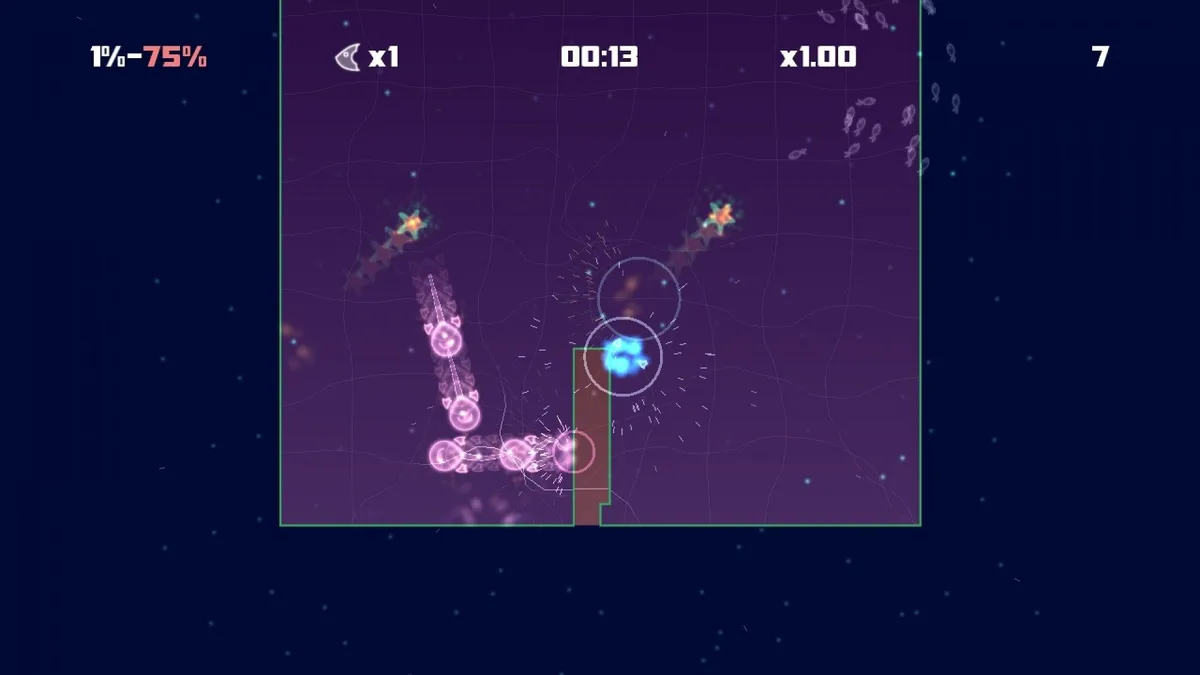
The central action in Lightfish is drawing lines onto unexplored territory. Every stroke that reaches into a monster-held zone works toward the goal of destroying every monster in that area, while unmarked space remains the resource the player is trying to claim. The player steers the small fish through the deadly abyssal environment and uses line-drawing as the offensive tool, so the act that clears a zone is the same act that pushes the fish closer to the creatures that occupy it.
That offensive push is governed by a strict contact rule: any enemy that touches the Lightfish kills it instantly, with no partial damage and no second chance. The two documented rules therefore pull against each other. Clearing a zone requires extending lines into territory where monsters are already gathered, but the fish itself must stay clear of every enemy body while those lines are being laid down. The result is a risk calculation repeated across each zone rather than a single safe approach.

One Touch Means Instant Death
Because a single touch ends the run, every movement near an enemy is governed by one absolute rule: contact kills the fish instantly, with no partial damage and no reprieve. The abyssal setting matters here, since the deadly creatures are gathered in the same dangerous zones the fish must clear by drawing lines onto unexplored territory. The zone therefore splits into safe unmarked space and occupied territory, and the fish must slip between enemy bodies while the line work proceeds.
The instant-death rule is not the only hazard in play: the game documents ten enemy types across forty-five unique levels, so the creatures touching the fish differ from zone to zone. Clearing a level still means destroying every monster by extending lines into their territory, while the fish avoids all contact. Each new enemy type changes the spacing problem the player solves, because the line that destroys a monster must be laid without letting that monster or any other reach the Lightfish.
Modes, Levels and Score Challenges
Lightfish is documented with two different game modes, giving the fish two ways to be played rather than a single fixed format. The main progression is spread across 45 unique levels, each stocked with the monsters the fish must destroy by drawing lines into their territory. Across those levels the game features 10 enemy types, so the creatures occupying the dangerous zones vary from one stage to the next. Since an enemy touch kills the fish instantly, a new enemy type changes the spacing problem: the destroying line must reach the monster without letting it or any other creature reach the fish.
Alongside the level structure, Lightfish includes score challenges that encourage replayability. These sit beside the two game modes and the 45 unique levels, so a completed zone can be revisited for a score target rather than only for the clearing objective. The scoring layer adds a second aim to the line-drawing and avoidance rules already governing each zone: beyond laying lines into monster-held territory while keeping the fish clear of every enemy, the player can return to existing stages to chase higher scores. The Steam product record lists the game under Action, Casual, and Indie.

Colorful Depths and an Original Soundtrack
Lightfish frames its line-drawing and instant-death rules inside a colorful underwater world populated by beautiful yet deadly sea creatures. The abyssal setting gives the monsters their home, and the presentation keeps that danger visible rather than abstract: the creatures the fish must destroy and avoid are rendered as vivid inhabitants of the deep. A distinctive graphic style is adapted to how the game plays, so the visual treatment is tied to the line-drawing and avoidance that define each zone instead of sitting apart as decoration.
An original soundtrack accompanies the action across the abyssal zones and the numerous levels, providing the audio layer for each session of drawing lines and avoiding contact. Music and visuals work together as the two documented presentation elements of the game, sitting alongside the mechanical structure of two game modes, ten enemy types, forty-five unique levels, and score challenges that encourage replayability. The Steam product record, a store catalog entry rather than a statement of the original release, lists the title under Action, Casual, and Indie.
Sources & further reading.
- Lightfish — official game profile Retrieved Oct 22, 2026
First published .