 THE GAME ARCHIVE
What the 2013 Duels Entry Asks of the Player
Magic: The Gathering - Duels of the Planeswalkers 2013 is a Windows strategy game from Stainless Games, published by Wizards of the Coast LLC and dated 2012 in the Steam product record. The store description frames the player's job simply: play with friends or AI while travelling across fantastic planes, taking on new encounters and opponents. Around that framing sits a specific set of systems — ten customizable decks, cards unlocked through play, puzzle-style encounters, a four-seat Planechase format, a run up to Nicol Bolas, individual records, and a land-tap option at casting. Each one changes how a match is approached rather than merely decorating it.
The store copy also insists the game is built for all experience levels, pairing an expanded tutorial and deep gameplay with content pitched from "new to the game" up to "expert Planeswalker." That pairing matters because the headline options are not all aimed at the same player. Deck modification and the land-tap choice are both grouped under a play-your-way pitch, while the land-tap option is separately flagged as a feature for those already skilled in slinging spells. Read together, the design offers newcomers a floor and veterans a set of levers.
Ten Decks, Thirty Unlockable Cards Apiece, and a Customization Layer
The game ships ten distinct decks, built from cards drawn from the latest Magic: The Gathering expansions. The store copy attaches a notable timing detail to that card pool: the game includes the first chance to play with cards from the Magic 2013 Core Set before their official release. For the player, the deck list is therefore both the starting toolkit and a piece of the release's appeal — the sets feeding the ten decks are presented as current rather than archival.
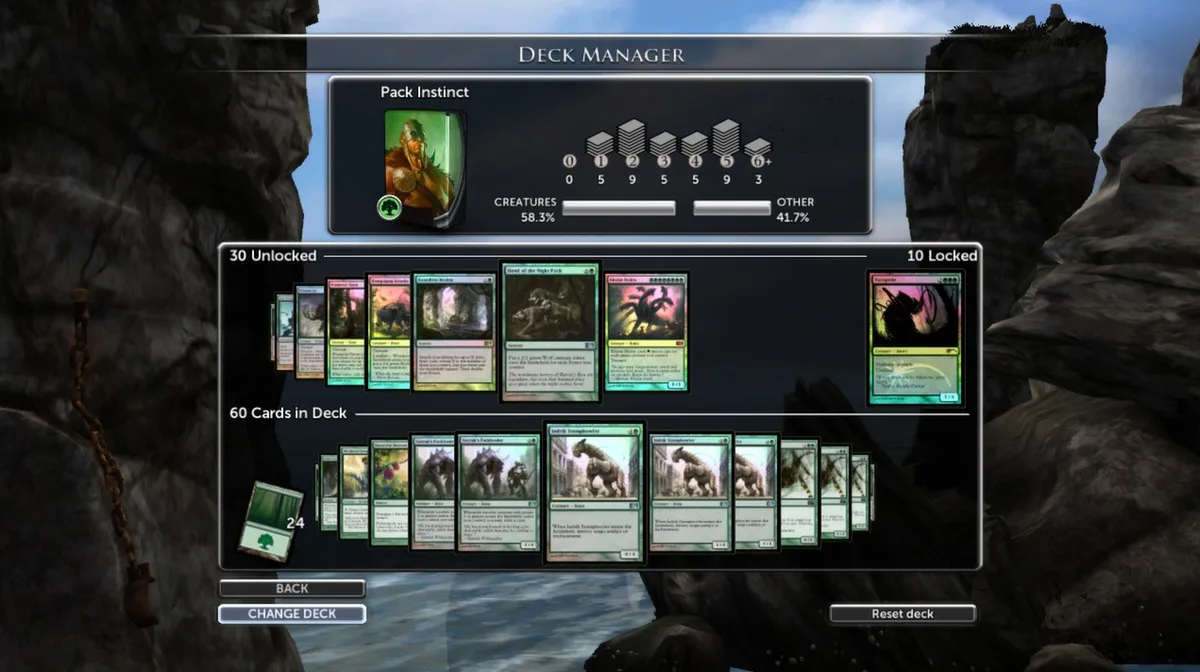
Each of the ten decks carries 30 additional cards that unlock through gameplay. This is the central progression hook: the roster is not finished at first launch, and ordinary play is the route to filling out a deck's options. Because the unlocked cards attach to specific decks, the practical incentive is to keep playing a deck you enjoy rather than abandoning it after a first impression — the deck you like is the deck that grows.
Unlocking is only half the system. The game also lets you modify your decks to play the way you want, so the extra cards are not fixed additions handed to you in a preset order — they feed into a deck you actively shape. This is the clearest strategic decision the store copy documents: which unlocked cards make the cut, and how a deck's contents are arranged around your preferred approach. The ten decks become ten ongoing projects rather than ten static loadouts.
Planechase: Four Seats, Friends or AI, and an Ever-Shifting Environment
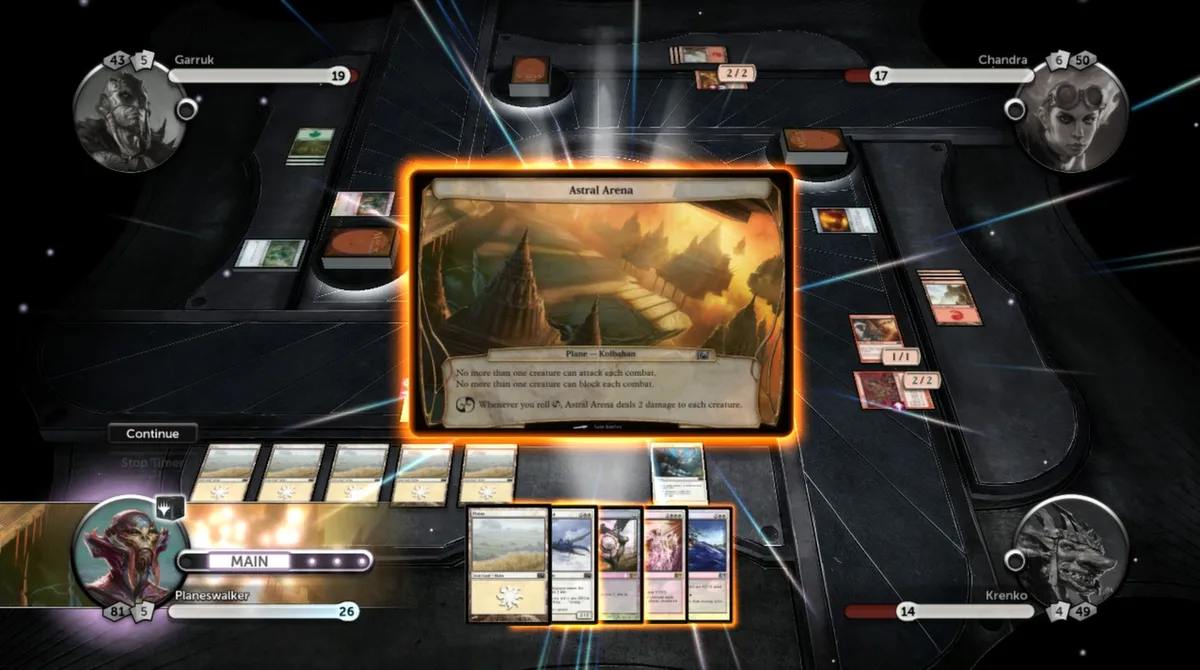
Planechase is the game's headline multiplayer format. You and up to three other players or AI battle across the Multiverse, which makes for a table of up to four. The store copy describes that table as facing strange phenomena in an ever-shifting environment, and the format is offered in both local and online play. Those two facts together define the mode's accessibility: the same four-seat, shifting-environment format can be played around one machine or over a connection, and empty seats can be filled with AI rather than requiring a full human group.
What separates Planechase from an ordinary duel is that the environment itself is described as shifting. The setting is not a fixed backdrop; the players face strange phenomena while battling across the Multiverse in an ever-shifting environment. The documented consequence for play is that a Planechase match is conditioned by shared, moving circumstances rather than by a single stable board, and every seat at the table — human or AI — contends with the same shifting condition. The mode therefore layers a changing, table-wide setting on top of the familiar duel between Planeswalkers, with up to three other participants filling the remaining seats.
The store copy also advertises an updated multiplayer game mode alongside additional features and challenges, with updated graphics and music and the latest cards and decks. For a group deciding how to spend an evening, the practical read is that Planechase is the documented multiplayer destination, and it is explicitly set up to absorb AI opponents when human seats are short. That flexibility is the format's most concrete advantage in a four-player design.
Deciding Which Lands to Tap at the Moment of Casting
One of the game's more technical additions is a casting-time decision: the option to choose what lands to tap when you cast your spells. Rather than accepting a default selection, the player identifies which specific lands are committed to the spell. The store copy presents this as a feature for those already skilled in slinging spells, which places it firmly in the veteran half of the game's all-levels pitch. It is a small interface-level choice with real weight for a player who cares how the board is left after a spell resolves, since the choice belongs to the player rather than to an automatic routine.
Land selection and deck modification sit at different points in the loop and reward different kinds of planning. Modifying a deck is a between-games act: it determines which cards are available and how the deck is arranged. The tapping choice is an in-match act: it governs how those cards are paid for when cast. The game groups both under its play-your-way pitch, so a player who cares about controlling outcomes gets one lever at deck construction and another at casting — preparation and execution, held together by the same design promise.
Encounters as Stacked-Deck Puzzles on the Road to Nicol Bolas
Encounters are described as a unique type of puzzle within the game. In an encounter, your opponent plays a stacked deck that represents a particular type of Magic strategy. That is a meaningfully different challenge from a standard match: instead of a shuffled duel against a general-purpose deck, the puzzle presents a fixed, prearranged situation built around a recognizable strategy, and the task becomes reading that strategy and answering it. Encounters therefore reward preparation of a particular kind — knowing what the opposing deck is trying to do — rather than adaptation to a random draw.
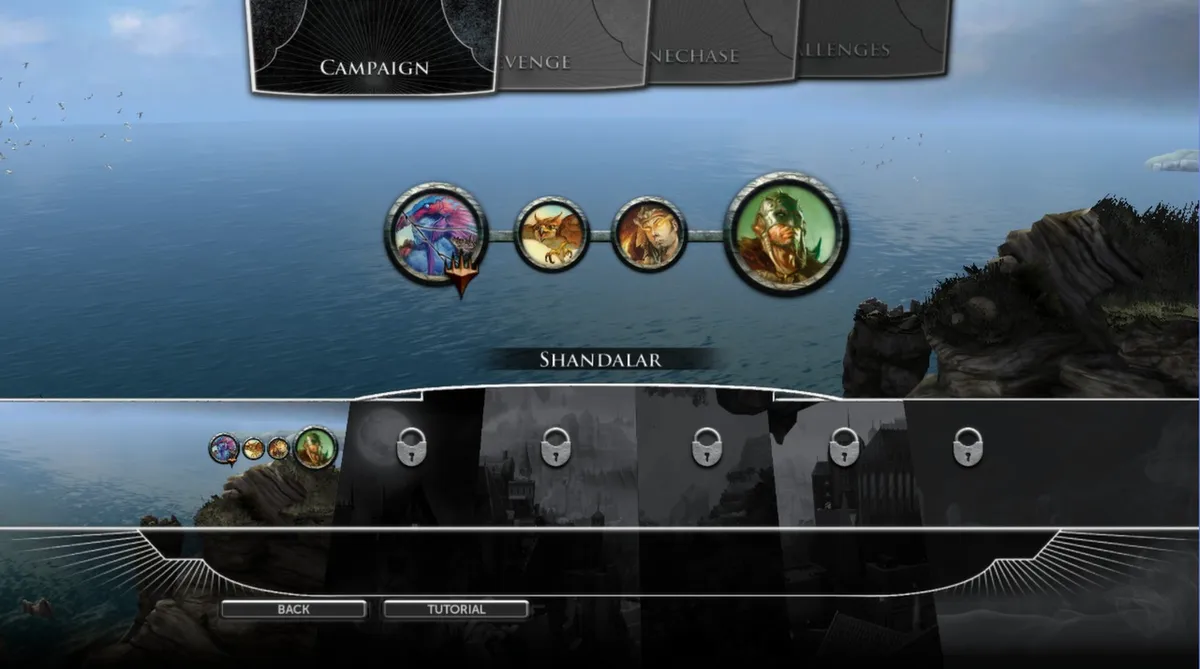
These puzzles sit inside a larger journey. The store copy has the player travel across fantastic planes, take on new encounters and opponents, and solve challenging puzzles — encounters are one activity along that path rather than the whole of it. After honing your skills, you pit yourself against the ultimate villain of the Multiverse, the dragon Planeswalker Nicol Bolas. The documented arc is thus skill-building followed by a climactic confrontation, which gives the encounters and the ten-deck progression a destination: the work you do in smaller matches is preparation for Bolas.
Records, Items, and the Shape of Long-Term Play
Beyond the card unlocks, the store copy lists individual records for your gameplay and new game items to unlock. Together these give the game two kinds of persistence: a record of how you have played, and additional items earned as you go. The 30-cards-per-deck unlock system is the most concrete progression path documented, and it interlocks with deck modification — the unlocks are only useful because the game lets you modify decks to play your way. A player's long-term project is therefore a collection of tuned decks rather than a single character or a single track.
The all-levels design also shapes how a new player should think about the early hours. An expanded tutorial and deep gameplay are pitched at everyone from newcomers to expert Planeswalkers, and the land-tap option is aimed at the expert end. The sensible reading is that a first-time player can lean on the tutorial and the default flow while the unlock system steadily widens each deck, then start taking deliberate control — choosing which cards to add through modification and which lands to tap at casting — as familiarity grows.
Starting Guidance from the Documented Systems
The evidence supports a short, practical set of priorities. First, pick a deck you enjoy and keep playing it: each deck's 30 additional cards unlock through gameplay, so time spent with one deck compounds. Second, revisit the modification screen as cards arrive — the game lets you modify decks to play the way you want, so new unlocks are only worth as much as the deck you build with them. Third, use the expanded tutorial if you are new, and treat the land-tap option as a deliberate step up once you are comfortable, since the store copy presents it for those already skilled in slinging spells.
Fourth, use encounters as strategy practice rather than filler: a stacked deck representing a particular Magic strategy is a fixed test of reading and answering that strategy, which builds habits that carry into the run toward Nicol Bolas. Fifth, when playing with others, remember Planechase supports local and online sessions with up to four seats including AI, so a missing human player does not close the mode. None of this assumes hidden difficulty settings, extra controls, or content the store copy does not describe.
Scroll sideways to see the full table →
| Item | Documented detail |
|---|---|
| Title | Magic: The Gathering - Duels of the Planeswalkers 2013 |
| Developer / Publisher | Stainless Games / Wizards of the Coast LLC |
| Platform / Date | Windows / 2012 (Steam product record) |
| Genre | Strategy |
| Decks | Ten distinct decks, 30 unlockable cards each |
| Planechase | Up to 4 players including AI, local and online |
| Casting option | Choose which lands to tap when casting spells |
| Final objective | Face the dragon Planeswalker Nicol Bolas |
Sources & further reading.
- Magic: The Gathering - Duels of the Planeswalkers 2013 — official game profile Retrieved Oct 21, 2026
First published .